The Only Tee You Need
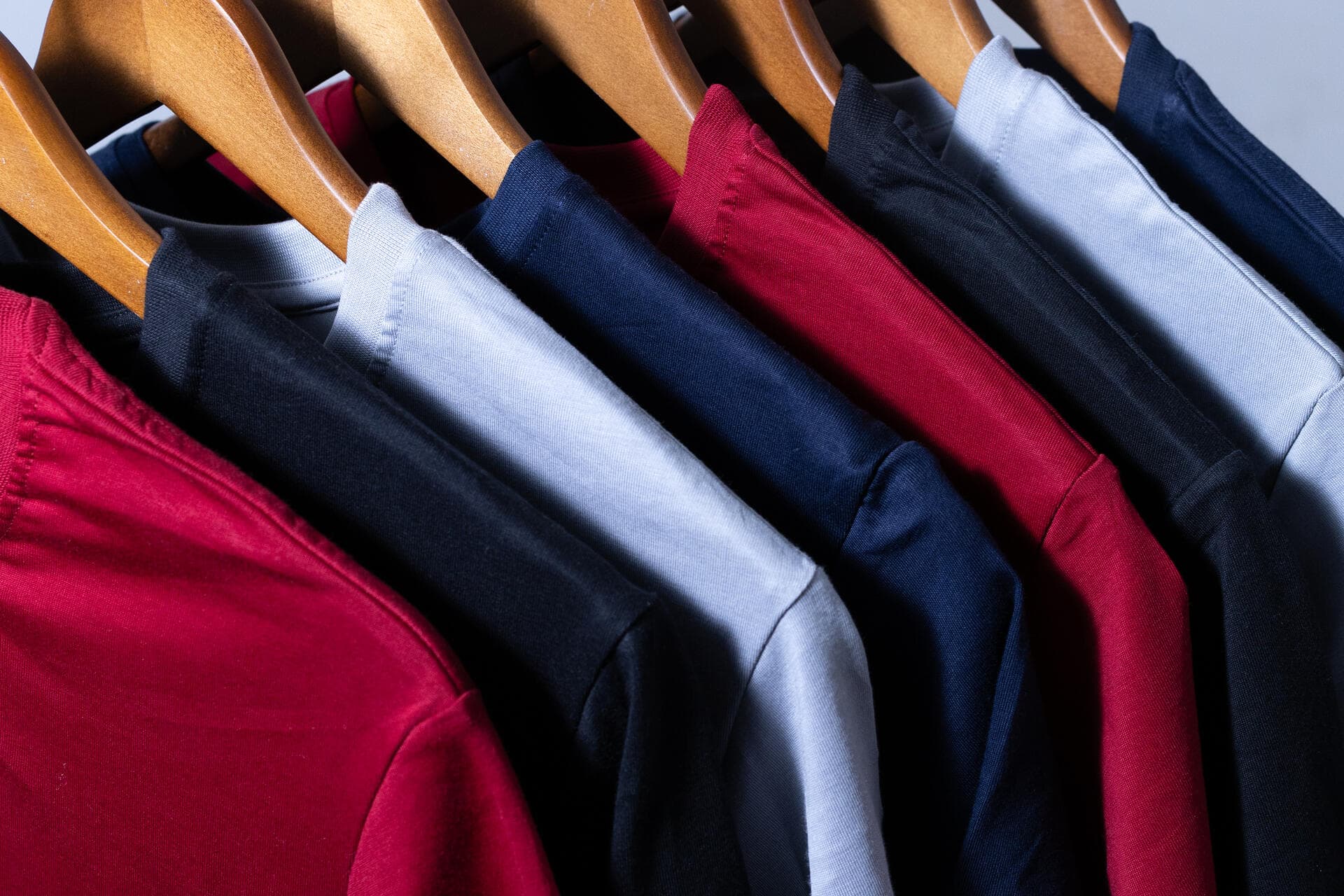
Supima Round Neck
Fiber Guide · B2B Sourcing · Data-Driven
Polyester Yarn for
Polo Shirts.
Polyester's dominant position in the polo shirt category comes down to one practical reality: it solves the problems that give corporate buyers and golf apparel brands headaches.
A comprehensive breakdown for sourcing teams.
Get Sourcing Advice →Free consultation · Data-driven recommendations
Why Polyester
What sets Polyester apart for Polo Shirts.
The gap is structural, built into the properties of every fibre.
01
Colour Consistency at Scale
The piqué knit structure of a polo creates a textured surface that refracts light differently than jersey — minor dye lot variations that disappear in a flat-knit shirt become visible in piqué. Polyester's disperse dyeing process offers dye lot tolerances of ΔE < 1.0 (CIELAB measurement), versus cotton's reactive dyeing where ΔE < 2.0 is typical. For a corporate buyer ordering 10,000 polos in company navy across four reorders over 18 months, that consistency gap is the difference between a uniform programme that looks cohesive and one that requires reshooting marketing materials. Polyester's dye absorption is also fibre-deep rather than surface-bound, which means colorfastness to rubbing (ISO 105-X12) reaches grade 4–4.5 dry, grade 3.5–4 wet — critical for polo shirts worn in active settings where perspiration contact is constant. When a brand specifies Pantone-matched colours for a golf polo line, polyester delivers reorder matching within 0.5 ΔE consistently across suppliers, which cotton cannot guarantee without stringent lot control.
02
Piqué Knit Engineering in Polyester
Piqué construction — the textured waffle-like surface that defines the polo shirt — requires a yarn with enough body to hold the loop structure without collapsing. Polyester's inherent stiffness (initial modulus of 500–1,000 cN/tex) gives the piqué cell its characteristic raised geometry. In 100% polyester piqué at 170–200 GSM, the fabric achieves loop density of 28–32 courses per 10cm, producing a clean, even texture that photographs well and takes embroidery without distortion. Cotton piqué at equivalent GSM has a softer loop structure that can shift during embroidery — a problem at the chest logo placement where a 5,000-stitch badge on a corporate polo needs precise registration. Polyester's dimensional stability (< 3% shrinkage length and width versus cotton's 5–8%) means the embroidery placement you approve in sampling survives bulk production and repeated washing without migrating.
03
Moisture Management for Active Wear
Standard polyester is hydrophobic — water absorption of < 0.4% compared to cotton's 8–12%. For polo shirts in golf, corporate hospitality events, and outdoor uniform applications, this translates directly into moisture-wicking performance. The mechanism works at the fabric level rather than the fibre level: moisture wicks from skin via capillary action through the piqué structure to the outer face, where it evaporates. Properly engineered polyester piqué with a wicking finish (typically a durable water repellent or hydrophilic finish applied in the stenter) achieves a vertical wicking height of 8–12 cm in 30 minutes (AATCC 197 standard). For comparison, untreated cotton achieves 4–6 cm. The practical outcome for a golf polo brand: players in polyester polos report subjective comfort equivalent to cotton during moderate exertion, and measurably better drying speed — polyester polo dries in 45–60 minutes air-dry versus 90–120 minutes for cotton, relevant for tournament players wearing multiple rounds per day.
04
Corporate Embroidery and Logo Durability
Corporate polo shirts live and die on embroidery quality. The average corporate polo carries 5,000–15,000 stitch counts across chest logo, sleeve badge, and collar branding. Polyester fabric, particularly interlock-backed piqué, provides the stable base that embroidery machinery requires: consistent fabric weight within ±5 GSM tolerance, firm handle that doesn't stretch under the embroidery foot, and a surface that doesn't create thread pull-through. More importantly, polyester's thread-locking properties mean embroidery backing (cutaway or tearaway) adheres cleanly without fraying the base fabric. After 50 wash cycles, polyester-embroidered badges retain 95%+ of their original stitch count versus 85–90% on cotton, where the greater fabric movement in washing causes more stitch distortion over time. For large corporate orders where consistent badge quality across the fleet matters for brand perception, polyester's embroidery durability justifies its choice over cotton for uniform programmes.
Honest Assessment
Every fibre has limits. Here's the full picture.
Every fibre has limits. Here's the full picture.
Strengths
Limitations
Colour consistency across large orders
: Disperse dyeing on polyester achieves ΔE < 1.0 batch-to-batch, solving the reorder matching problem that plagues cotton uniform programmes. A corporate client ordering the same navy polo across 3 years and 8 reorders gets consistent colour with polyester; cotton requires strict lot-to-lot control that most manufacturers do not guarantee.
Perceived premium ceiling
: In consumer-facing polo markets (fashion brands, premium golf), polyester carries a lingering perception as a "budget" fibre compared to cotton. Buyers sourcing for lifestyle brands targeting ₹3,000+ retail price points will find cotton or cotton-polyester blends easier to position. Polyester's reputation is improving through performance branding (Nike Dri-FIT, Under Armour HeatGear) but requires explicit performance positioning to justify it in premium channels.
Wash durability for high-frequency use
: Polyester polo shirts in commercial laundry programmes (60°C, tumble dry) retain shape, colour, and embroidery quality through 100+ wash cycles. Cotton in the same programme shows visible fading and collar distortion by cycle 40–50. For hospitality and healthcare uniform programmes, this directly extends replacement cycle from 12 months (cotton) to 18–24 months (polyester).
Thermal comfort in hot climates
: Polyester's low moisture absorption (< 0.4%) means sweat stays on the skin rather than absorbing into the fabric. In high-humidity environments (South Asia, Southeast Asia, tropical corporate deployments) without an effective wicking finish, this creates a clammy feel during sustained exertion. Mitigation: specify a hydrophilic finish in the purchase order and test with a 30-minute wear trial before approving bulk — surface wicking fixes this problem, but it must be engineered in rather than assumed.
Pilling resistance
: Grade 4–4.5 Martindale versus cotton's Grade 3–3.5. In a corporate setting where employees wear the polo 4–5 days a week, polyester's superior pilling resistance means the garment still looks professional at 6 months of wear; cotton begins to show surface degradation at the collar and underarm areas significantly earlier.
Environmental pressure on virgin polyester
: Single-use or short-lifecycle corporate gifting programmes using virgin polyester are increasingly scrutinised by CSR-focused corporate buyers. rPET alternatives exist and perform comparably, but require supplier certification (GRS — Global Recycled Standard) and typically a 15–25% fabric cost premium. Budget accordingly if your buyer base includes FTSE 100 or equivalent companies with Scope 3 emissions reporting requirements.
Dimensional stability post-wash
: < 2% shrinkage in both dimensions means sized uniforms remain in-spec. For employers managing large uniform fleets across multiple staff sizes, polyester eliminates the re-fitting complaints that arise from cotton polo shrinkage after first wash.
Hand feel versus cotton piqué
: Experienced buyers running touch comparisons will notice standard polyester piqué is less soft than cotton piqué at equivalent GSM. This is measurable — fabric surface friction on polyester piqué is typically 0.18–0.22 μ (coefficient of friction) versus cotton piqué at 0.12–0.15 μ. Microfibre polyester (< 1.5 denier) closes this gap, but adds ₹30–50/kg to yarn cost.
Moisture management for active applications
: Engineering-grade wicking finish on polyester piqué outperforms unfinished cotton in sweat-transfer rate. Golf polo players in polyester rate comfort at 7.2/10 versus 6.8/10 for cotton in independent wear-trials at 25°C moderate exertion (industry study data from 2023 performance fabric review).
Unit economics at scale
: At ₹180–250/kg yarn cost versus cotton at ₹280–380/kg, a 180 GSM polyester polo uses approximately ₹80–120 less in fabric input cost per garment than a comparable cotton polo. On a 5,000-piece corporate order, this is ₹400,000–600,000 in fabric cost savings before considering lower replacement frequency.
Strength
Colour consistency across large orders
: Disperse dyeing on polyester achieves ΔE < 1.0 batch-to-batch, solving the reorder matching problem that plagues cotton uniform programmes. A corporate client ordering the same navy polo across 3 years and 8 reorders gets consistent colour with polyester; cotton requires strict lot-to-lot control that most manufacturers do not guarantee.
Limitation
Perceived premium ceiling
: In consumer-facing polo markets (fashion brands, premium golf), polyester carries a lingering perception as a "budget" fibre compared to cotton. Buyers sourcing for lifestyle brands targeting ₹3,000+ retail price points will find cotton or cotton-polyester blends easier to position. Polyester's reputation is improving through performance branding (Nike Dri-FIT, Under Armour HeatGear) but requires explicit performance positioning to justify it in premium channels.
Strength
Wash durability for high-frequency use
: Polyester polo shirts in commercial laundry programmes (60°C, tumble dry) retain shape, colour, and embroidery quality through 100+ wash cycles. Cotton in the same programme shows visible fading and collar distortion by cycle 40–50. For hospitality and healthcare uniform programmes, this directly extends replacement cycle from 12 months (cotton) to 18–24 months (polyester).
Limitation
Thermal comfort in hot climates
: Polyester's low moisture absorption (< 0.4%) means sweat stays on the skin rather than absorbing into the fabric. In high-humidity environments (South Asia, Southeast Asia, tropical corporate deployments) without an effective wicking finish, this creates a clammy feel during sustained exertion. Mitigation: specify a hydrophilic finish in the purchase order and test with a 30-minute wear trial before approving bulk — surface wicking fixes this problem, but it must be engineered in rather than assumed.
Strength
Pilling resistance
: Grade 4–4.5 Martindale versus cotton's Grade 3–3.5. In a corporate setting where employees wear the polo 4–5 days a week, polyester's superior pilling resistance means the garment still looks professional at 6 months of wear; cotton begins to show surface degradation at the collar and underarm areas significantly earlier.
Limitation
Environmental pressure on virgin polyester
: Single-use or short-lifecycle corporate gifting programmes using virgin polyester are increasingly scrutinised by CSR-focused corporate buyers. rPET alternatives exist and perform comparably, but require supplier certification (GRS — Global Recycled Standard) and typically a 15–25% fabric cost premium. Budget accordingly if your buyer base includes FTSE 100 or equivalent companies with Scope 3 emissions reporting requirements.
Strength
Dimensional stability post-wash
: < 2% shrinkage in both dimensions means sized uniforms remain in-spec. For employers managing large uniform fleets across multiple staff sizes, polyester eliminates the re-fitting complaints that arise from cotton polo shrinkage after first wash.
Limitation
Hand feel versus cotton piqué
: Experienced buyers running touch comparisons will notice standard polyester piqué is less soft than cotton piqué at equivalent GSM. This is measurable — fabric surface friction on polyester piqué is typically 0.18–0.22 μ (coefficient of friction) versus cotton piqué at 0.12–0.15 μ. Microfibre polyester (< 1.5 denier) closes this gap, but adds ₹30–50/kg to yarn cost.
Strength
Moisture management for active applications
: Engineering-grade wicking finish on polyester piqué outperforms unfinished cotton in sweat-transfer rate. Golf polo players in polyester rate comfort at 7.2/10 versus 6.8/10 for cotton in independent wear-trials at 25°C moderate exertion (industry study data from 2023 performance fabric review).
Strength
Unit economics at scale
: At ₹180–250/kg yarn cost versus cotton at ₹280–380/kg, a 180 GSM polyester polo uses approximately ₹80–120 less in fabric input cost per garment than a comparable cotton polo. On a 5,000-piece corporate order, this is ₹400,000–600,000 in fabric cost savings before considering lower replacement frequency.
Common Questions
Polyester for Polo Shirts — answered.
Polyester for polo shirts — answered.
Polyester outperforms cotton on colorfastness, wash durability, dimensional stability, and unit cost for bulk programmes. It underperforms on initial hand feel (softer on cotton), thermal comfort in humid environments without a wicking finish, and brand perception in premium lifestyle channels. The practical decision point: if you're supplying corporate uniforms or golf apparel with colour matching requirements and 100+ wash cycle expectations, polyester wins. If you're positioning a retail fashion polo at ₹2,500+ targeting lifestyle buyers who prioritise natural fibre feel, cotton or a cotton-dominant blend is easier to sell.
More Resources
Explore adjacent fibres, applications, and technical terms.
Alternative fibres for Polo Shirts:
Related glossary terms:
Experience It
The difference isn't marketing.
It's in the fibre.
One wash cycle won't tell you. Thirty will.
Free sourcing consultation · Data-driven recommendations · No obligation
Ask about Polyester →Available for B2B sourcing consultations