Fabric
Loopwheel and Tubular Knit - How Premium Tees Are Really Made
Loopwheel is real engineering wrapped in heritage romance. Worth admiring - but the cotton matters more than the machine.
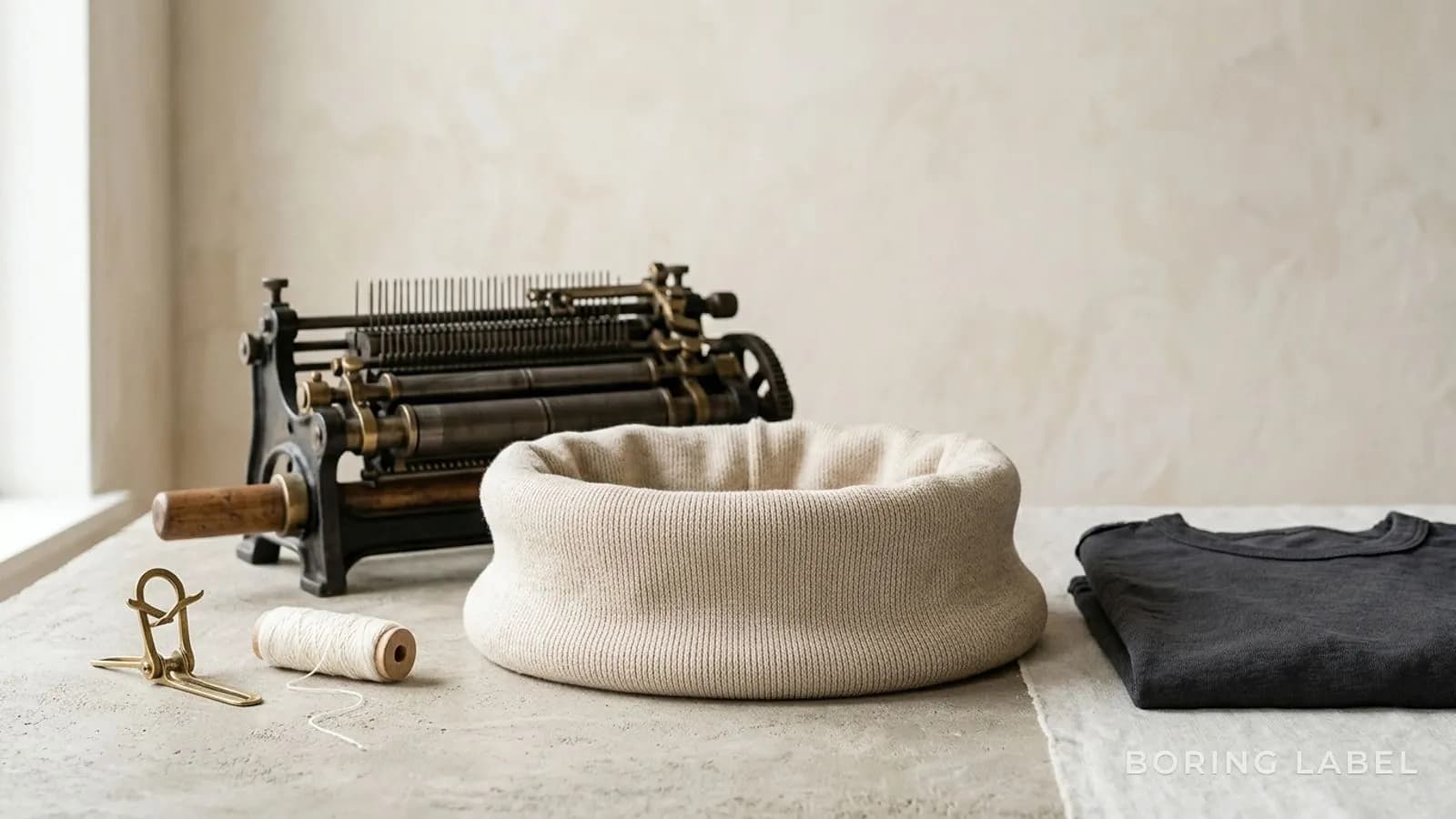
A T-Shirt That Takes Six Hours to Knit
Somewhere in Wakayama, Japan, a machine that is older than most of the people reading this is making a t-shirt very, very slowly. It hangs from a steel beam in the ceiling.
It turns at about the speed of a lazy ceiling fan. It produces roughly one metre of fabric an hour, which means the cloth for a single tee can take the better part of a working day.
A modern knitting machine a few cities over makes the same cloth before its operator has finished a cup of tea.
These slow machines are called loopwheelers, and the fabric they make sells for serious money. A plain loopwheel tee from a heritage brand routinely runs ₹6,000 to ₹8,000, and the heavyweights climb past ₹12,000. For a plain white t-shirt with no logo, no print, and no clever fit.
People who own them swear by them. People who do not own them assume it is a con.
The truth is more interesting than either camp. Loopwheel is real engineering with real, measurable benefits - it is not a sticker stuck on an ordinary shirt.
But it is also wrapped in a thick layer of heritage romance, and a good chunk of that ₹8,000 is paying for the story, not the cloth. This piece walks through how the machines actually work, why tubular knitting matters more than most people realise, where the price really comes from, and the honest question at the end: do you need any of this to own a genuinely excellent tee.
You will not, and the reasons why are worth understanding.
What loopwheel knitting actually is
The Japanese name is tsuriami-ki, which translates roughly as hanging knitting machine, and that name describes the whole thing better than the English word does. A loopwheeler is a circular knitting machine that hangs vertically and feeds its fabric downward using nothing but gravity.
The history is a small surprise. These machines did not originate in Japan at all.
They were a European invention, sometimes called French circular frames, and Japan imported them around 1909 to help kit out a fast-industrialising garment trade. Then the rest of the world moved on.
Faster machines arrived, the economics changed, and almost everyone scrapped their slow vertical knitters. Japan, for reasons that are part stubbornness and part craft culture, kept a few hundred of them running.
Germany kept a handful too. That is essentially the entire global supply, and we will come back to how small it really is.
Here is what separates a loopwheeler from the machine that made the tee you are probably wearing. A modern circular knitter pulls the yarn through under mechanical tension.
Rollers and tension bars grip the fabric and haul it along at five hundred to fifteen hundred rotations a minute. It is fast, consistent, and completely under control, and that control comes at a cost to the yarn.
A loopwheeler does the opposite. It turns at around twenty-four rotations a minute, feeds only a few threads per rotation, and applies no pulling tension at all.
The only force acting on the fresh cloth is its own weight hanging down from the needles. The fabric is, in a sense, knitted in free fall.
That single difference - tension versus gravity - is the source of every claim made about loopwheel fabric. Once you understand it, the rest of this stops being marketing and starts being physics.
Why gravity makes better cloth
When yarn is yanked through a machine under tension, the fibres get compressed and the loops get stretched as they form. The finished fabric carries the memory of that stress. It was made tight and pulled thin, and over a few years of washing and wearing it slowly relaxes out of shape, because you are letting it return to a state it was never allowed to settle into in the first place.
A loopwheeler never applies that stress. The yarn arrives at the needles loose, the loops form gently, and the cloth drops away under its own weight.
Two things follow from that. The first is air.
Older loopwheelers use what are called bearded needles, an antique design that lets a little air work into the yarn structure as the loop closes instead of crushing it flat. Air in the yarn is most of what people mean when they say a fabric feels soft and lofty rather than dense and hard.
The second is shape memory. Because the fabric was never put under tension, it has very little tension to release later.
It resists stretching, sagging, and warping for longer, simply because there is no stored stress waiting to unwind.
So the soft hand and the long shape life are not two separate features you are paying for twice. They are the same thing - low-tension knitting - showing up in two places.
This is exactly the pattern we keep running into across t-shirt construction. With cotton fibre, the length of the staple quietly improves softness, strength, and pilling all at once, which is the whole argument in Supima vs regular cotton.
With loopwheel, low tension does the same trick for the knit. One good decision early in the process pays off in several places downstream.
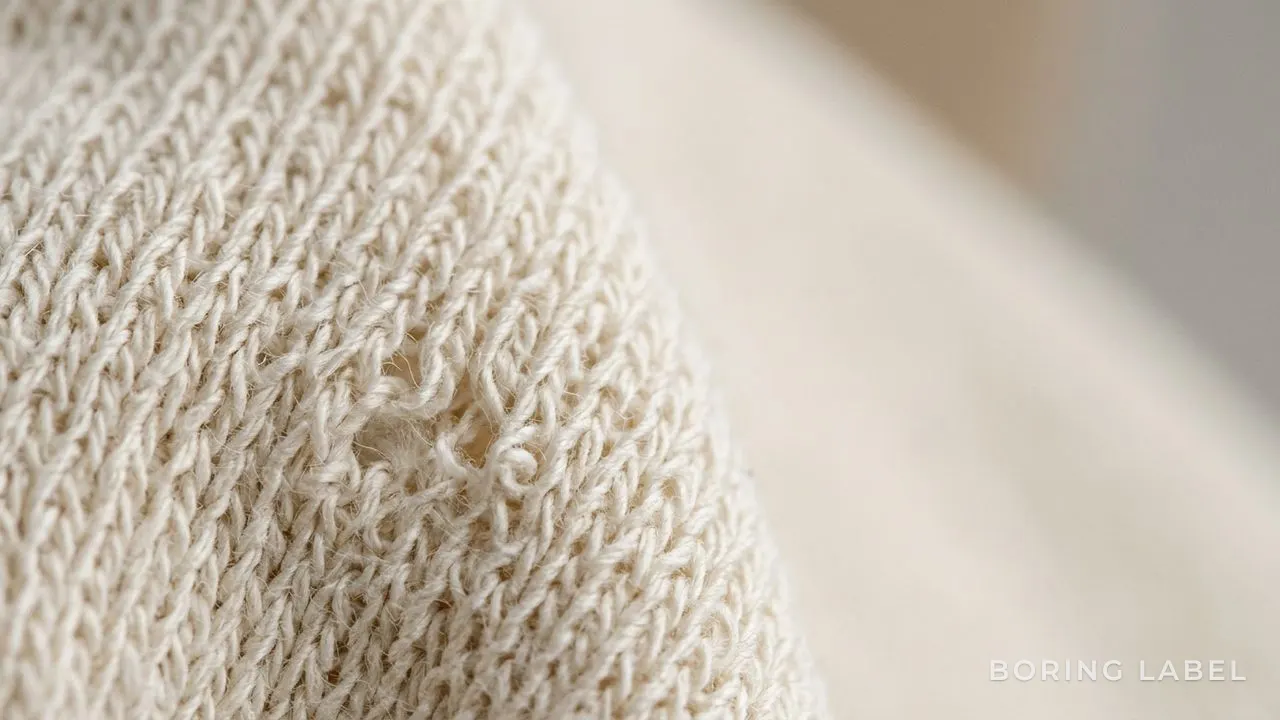
There is a stylistic side effect worth flagging, because people either love it or hate it. Slow gravity knitting on old needles produces slight irregularities in the cloth - faint thick-and-thin variation that the trade calls slub.
On a perfect modern machine that would be a fault. On a loopwheeler it is part of the character, the visible fingerprint of a slow process, and the fabric tends to look better with age and washing rather than worse.
If you want flawless uniformity, this is not your fabric. If you like the idea that no two tees come off the machine quite identical, it is a feature.
What gravity does not do is rewrite the rules of the raw material. A loopwheeler fed cheap, short-fibre cotton will give you a soft, well-built shirt made of cheap cotton.
The machine improves how the yarn is knitted, not what the yarn is made of. Hold that thought, because it is the crack that the whole worth-it question eventually falls through.
Tubular versus side-seam, and the twist problem
There is a second piece of construction tangled up with loopwheel, and it causes a lot of confusion because the two things travel together but are not the same. That piece is tubular knitting.
A loopwheeler knits a continuous tube. The cloth comes off the machine already shaped like a body - a seamless cylinder that only needs a collar and hems and sleeves added.
There are no vertical seams running up your sides, because there was never a flat panel that had to be sewn shut. The width of that tube is fixed by the diameter of the machine, which has a real consequence most buyers never think about: each machine knits one width, so it knits essentially one size.
A factory that wants to offer small, medium, and large needs different machines or different setups, and it has to commit to its size mix before a single shirt is sewn. That is the opposite of how most clothing is made.
The usual modern approach is open-width, or side-seam, construction. The machine knits a wide flat roll of cloth, and the factory cuts every size it wants out of that one roll, then sews up the sides.
It is far more flexible. One bolt of fabric becomes any combination of sizes, the seams can follow the body for a slimmer, more tailored fit, and there is no machine-diameter ceiling on how the garment is shaped.
The trade-off is more cutting, more sewing, and a seam up each side that some people find slightly less comfortable and some do not notice at all.
Now the part that actually matters for your wardrobe: spirality, also called torque, the reason a cheap tubular tee twists around your body after a few washes until the side that should be at your ribs has wandered toward your belly button. This is a tubular-knit problem, and it is worth understanding because it explains both why loopwheel earns its reputation and why a cheap seamless tee can be miserable.
Twisting happens when the yarn and the knit are slightly unbalanced, so the fabric carries a built-in rotational stress that releases in the wash and spins the whole tube. Because tubular cloth has no side seams to lock it in place, nothing stops it from turning.
Side-seam shirts barely twist at all, because the seams pin the shape. Loopwheel cloth largely avoids the problem for a different reason: gravity feeding applies such even, gentle tension that very little torque gets built into the fabric to begin with.
The twist is never created, so there is nothing to release. Modern tubular machines can match this, but they have to work for it - balanced low-torque yarns, careful settings, and a finishing step called a spirality correction system that mechanically de-twists the cloth before it is set.
The honest version is this: loopwheel solves spirality through slowness, and good modern factories solve the same problem through engineering. Both work.
One costs a great deal more than the other.
Why loopwheel is so rare and so expensive
Put a stopwatch on the two machines and the price stops being mysterious. A modern circular knitter produces the cloth for a tee in roughly an hour to an hour and a half.
A loopwheeler takes six to ten hours for the same weight of fabric. Every cost that scales with time - electricity, floor space, the wage of the person minding the machine, the opportunity cost of the floor it sits on - gets divided across six to ten times fewer shirts.
The cloth is expensive because the machine is slow, and the machine is slow by design.
Then there is the supply problem, which is severe in a way that is hard to overstate. There are only around two hundred working loopwheelers left in the world.
Most are in Wakayama, run by a couple of long-standing mills, and some of them are pushing a hundred years old. Germany has the only European loopwheelers, kept running by a single mill in the Swabian Alps.
Nobody manufactures new loopwheelers. When one breaks, it is repaired with salvaged parts and the knowledge of people who have spent decades around them.
You cannot scale this up. You cannot order more capacity.
A handful of brands - names like Loopwheeler, Warehouse, Studio D'Artisan, Whitesville, and Merz b. Schwanen in Germany - are competing for output from a fixed and slowly shrinking pool of antique machines. Scarcity like that sets prices on its own, before anyone has told a single story about heritage.
And the story does real work too, which is fair to name plainly. A brand like Merz b. Schwanen has been around since 1911. The Japanese heritage labels carry decades of denim-world credibility.
When you buy one of these tees you are buying a slow machine and a long lineage, and the lineage is part of what the price is for. There is nothing wrong with paying for heritage as long as you know that is what you are doing.
The problem only starts when a buyer assumes the entire premium is buying fabric performance, when a meaningful slice of it is buying provenance. Roughly speaking, on a ₹10,000 loopwheel tee, the actual fabric and labour are a minority of the ticket, and brand, heritage, and scarcity make up the rest.
That is not an accusation. It is just where the money goes.
Loopwheel versus modern circular knit
Both machines are described as circular, which fools people into thinking they are close cousins. They are not.
They share a shape and almost nothing else. Here is the honest side-by-side.
| What changes | Modern circular knit | Loopwheel (tsuriami-ki) |
|---|---|---|
| Speed | 500 to 1,500+ rotations per minute | About 24 rotations per minute |
| Fabric output | 10+ metres per hour | Around 1 metre per hour |
| Tension on the yarn | Mechanical rollers and bars | Gravity only |
| Needles | Modern latch needles | Vintage bearded needles |
| Hand-feel | Uniform, consistent | Slightly irregular, soft, slubby |
| Softness | Very good with premium fibre | Superior, from air in the yarn |
| Shape retention | Good, some tension to release | Excellent, almost no stored stress |
| Spirality control | Needs balanced yarn or correction finishing | Largely avoided by gentle feeding |
| Machines available | Made new, unlimited | About 200 left, none made new |
| Cost of the cloth | Low | High |
Read down that table and the picture is clear. Loopwheel wins on softness, shape life, and twist resistance, and it wins them through slowness.
Modern knitting wins on speed, consistency, flexibility, and cost. Neither is cheating.
They are two different answers to the question of how you turn yarn into cloth, optimised for two different things - one for craft, one for scale.
But the table hides the most important line, and it is the line that should change how you spend. The single biggest lever on how a tee feels and lasts is not the machine at all.
It is the cotton going into it. A loopwheel tee knitted from mediocre short-staple cotton can be comfortably out-performed by a tee made from premium long-staple cotton on a good modern machine.
The knit method is one factor. The fibre is a bigger one.
Get the fibre right and a modern machine takes you most of the way to the loopwheel experience, which is precisely why the next section is the one that matters.
What the durability claims really mean
The strongest argument loopwheel fans make is longevity. You will read that a loopwheel tee lasts five, ten, even fifteen years where a budget tee gives up in one or two. It is worth pulling that claim apart, because there is a solid core to it wrapped in some wishful rounding.
The core is sound. Low-tension cloth holds its shape and resists the slow deformation that retires most tees long before they wear through - the stretched neck, the sagged hem, the body that has gone baggy and thin in the wrong places.
A loopwheel tee tends to die of honest abrasion after years of wear rather than of distortion after months, and that really does extend its useful life. Where the claim gets slippery is in the specifics.
There is no independent wear-testing for loopwheel tees of the kind raw-denim obsessives have built for jeans. The five-to-ten-year figures are enthusiast anecdote, not lab data, and they quietly assume careful washing and frequent rotation.
Boil one in a hot machine and bake it in a dryer and it will distort and thin like any other cotton, only with more of your money inside it.
There is also a quieter point that cuts against the romance. The machine controls how the cloth behaves under tension, but it does not make the fibre itself stronger.
A long-staple cotton yarn resists thinning and holes because its fibres are long and locked tightly into the twist, and that is true on any machine. Loopwheel protects the shape; the fibre protects the substance.
A loopwheel tee built on weak cotton can still thin out at the shoulders even while it holds its silhouette, which is a strange way for a shirt to fail and exactly the failure that proves the point: knit and fibre are doing different jobs. The durability you actually want is mostly the fibre's work, and the fibre does not care which machine knitted it.
The fit nobody warns you about
One practical thing rarely makes it into the loopwheel pitch, and it trips up first-time buyers more than the price does. Because a loopwheeler knits a fixed-width tube and the cloth was made without tension, these tees tend to hang straight and relaxed, with a boxier, more vintage silhouette than the slim, body-following cut most people now expect.
That is not a flaw. It is what tubular construction does, and the heritage brands lean into it on purpose.
But if you have spent years buying tapered, side-seam tees and you order a loopwheel shirt expecting the same shape, the looseness can read as a mistake when it is exactly what you paid for.
So the construction question and the fit question are not the same question, and it is worth separating them before you spend. A modern side-seam tee can be shaped to follow the body precisely, because the seams do the shaping.
A tubular tee, loopwheel or not, gives that up in exchange for the seamless feel and the straight hang. If a clean, modern fit matters more to you than the knitting story, a tubular shirt of any kind is the wrong starting point regardless of how lovely the cloth is.
Decide which you actually want - the silhouette or the seamless construction - because no single tee gives you both at once, and a lot of loopwheel disappointment is really just a fit expectation that was never going to be met.
So is it worth it? The honest answer
Whether loopwheel is worth the money comes down to a number almost nobody calculates before buying clothes: cost per wear. Not what the tee costs on the shelf, but what it costs each time you actually put it on.
Run it both ways. Take a genuinely good ₹1,299 long-staple tee.
Worn in heavy rotation - a couple of hundred wears a year for a tee you reach for constantly - and cared for properly, it lands somewhere around ₹5 to ₹7 a wear over its life, and you replace it after a few years. Now take an ₹8,000 loopwheel tee.
If you are the sort of person who really does wear the same three or four shirts most days and keeps them for the better part of a decade, you might rack up several hundred wears and bring it down to something like ₹15 to ₹20 a wear. The loopwheel tee can absolutely justify itself on those numbers - but only for that specific person, the daily wearer with a tiny rotation and a ten-year horizon, who also happens to value the softness and the story enough to feel the difference every morning.
For almost everyone else, the maths goes the other way. If a tee gets worn once or twice a week, a good modern one lasts perfectly well and the premium buys you very little extra life.
If you own a dozen shirts and rotate through them, no single one accumulates the wears that would amortise an ₹8,000 price. And if you are honest that a large part of the appeal is the heritage and the rarity rather than the cloth against your skin, that is a perfectly valid thing to spend on - it is just a different purchase from buying performance, and it helps to know which one you are making.
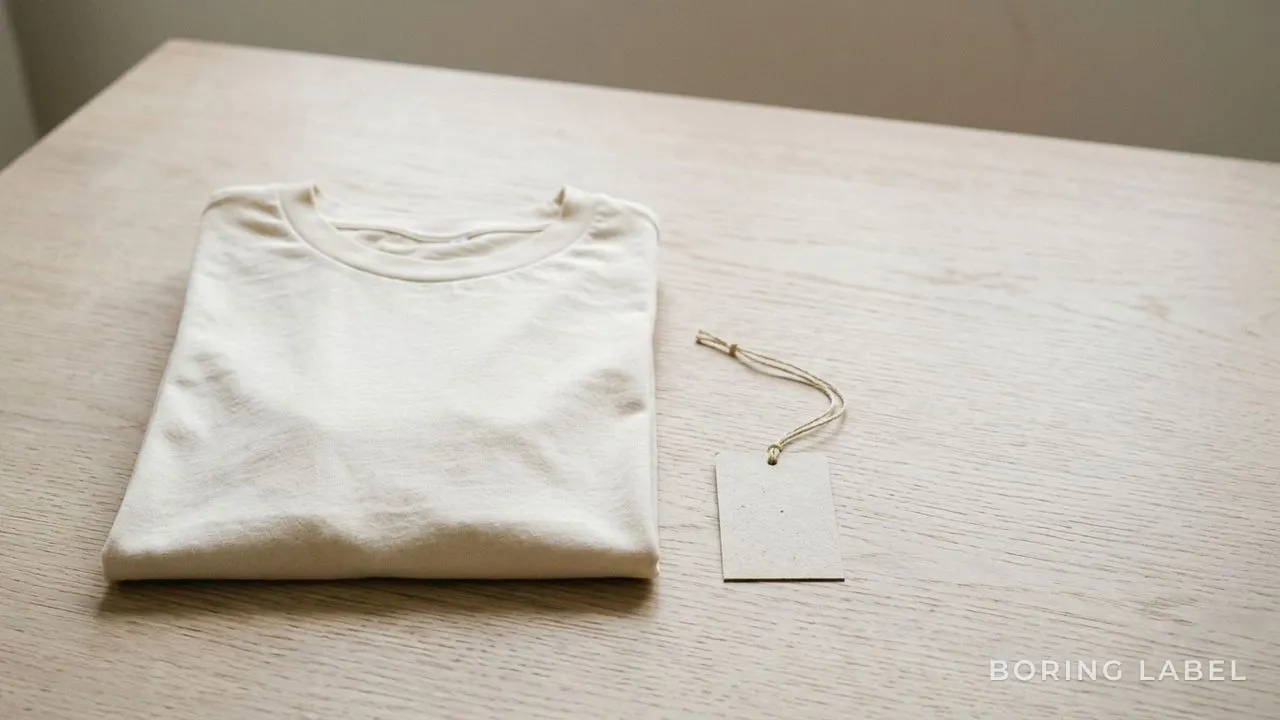
If you do decide a loopwheel tee is for you, a few practical things are worth knowing before you spend, because the category attracts both genuine craft and lazy claims. You can usually spot real loopwheel construction by the lack of side seams, sometimes a visible looped edge on the hem, and that faint slub irregularity in the cloth, though none of this is foolproof without trusting the mill.
Weight matters as much as the knit: loopwheel tees range from light summer cloth around 150 gsm to heavyweight winter shirts past 350 gsm, and picking the wrong weight is a more common regret than picking the wrong machine - our GSM guide walks through what each weight actually does in real wear. And these tees reward gentle care more than most.
Wash cold, turn inside out, skip the hot dryer, and dry flat or hung. The low-tension cloth was made without stress, and aggressive washing is the fastest way to undo the very thing you paid for.
Where this leaves a good ₹1,299 tee
Step back from the heritage machines and the honest conclusion is almost reassuring. Loopwheel is a beautiful, genuine bit of craft, and it is also a luxury tier you do not need to enter to own a tee that feels excellent and lasts for years. The reason is the one the table tried to bury: fibre does more work than the machine.
This is the part worth being plain about, including about ourselves. At BoringLabel we do not use loopwheel, and we are not going to pretend otherwise to borrow its glow.
We knit Supima long-staple cotton on modern machines, price it at ₹1,299, and tell you exactly what that buys: a smooth, strong, low-pilling cloth that gets the fibre right and the construction clean, backed by a plain promise of zero fade, zero shrinkage, and a thirty-plus wash guarantee. That last bit is where the modern approach quietly answers loopwheel's best argument.
Shape retention and survival through endless washing - the things loopwheel earns through slow gravity knitting - we get to through fibre choice and proper finishing, the same way a good modern factory neutralises spirality with engineering instead of antique machinery.
A couple of the questions people ask about loopwheel really belong to the fibre, not the knit, which tells you something. Whether the cotton is combed - short fibres removed for a smoother, longer-lasting yarn - matters on any machine, and it is the whole subject of combed cotton vs carded.
Whether the cotton is long-staple Supima rather than ordinary upland is, again, a fibre question covered in Supima vs regular cotton, and it is independent of how the cloth is knitted. Heritage brands often stack premium fibre on top of loopwheel and let you assume the magic is the machine.
Much of it is the cotton. You can buy the cotton part without the machine part, and pay a fraction of the price.
That is exactly the bet behind our round-neck tee: get the fibre and the finishing right, knit it cleanly on a machine that lets us hold a sane price, and tell you the truth about all of it. No slow machine in the ceiling.
No century-old story. Just the part of the loopwheel promise that actually touches your skin and survives your laundry.
The bottom line
Loopwheel knitting is real. Gravity feeding does make softer, more stable cloth that twists less and ages better, and the two hundred surviving machines that do it are a small marvel worth admiring. The premium they command is partly honest - slow production and brutal scarcity - and partly the price of heritage and a good story, and you should know which part you are paying for before you hand over ₹8,000.
What loopwheel is not is the only road to a great t-shirt. The biggest lever was never the machine.
It was the cotton. Get the fibre right on a modern machine and you capture most of the loopwheel experience for a sixth of the cost, with a flat, verifiable promise instead of a romance.
Admire the slow machines. Buy the good cotton.
Boring Label
Wear the point of the article.
One honest tee. Heavyweight combed cotton, a collar that holds, a fit that actually fits. No logo, no noise.
Shop the round-neck teeFree shipping across India · Easy returns
Keep reading
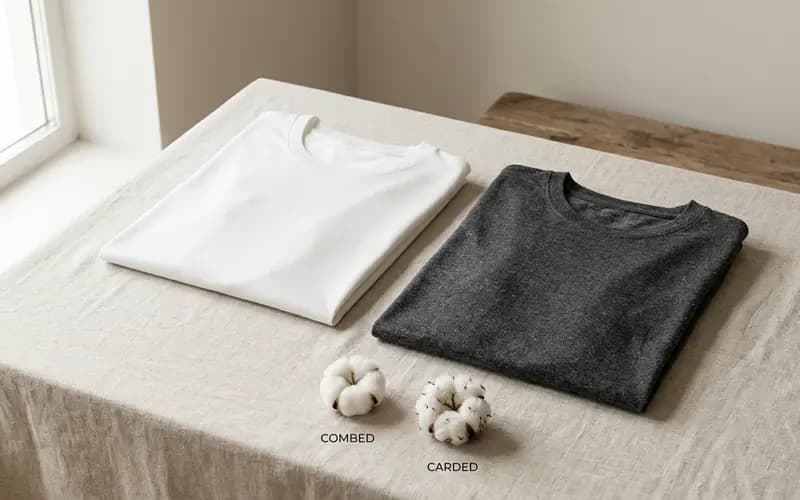
Combed Cotton vs Carded: Why It Matters
One extra step removes the short fibres that make a tee fuzz, pill, and weaken. That step is combing.
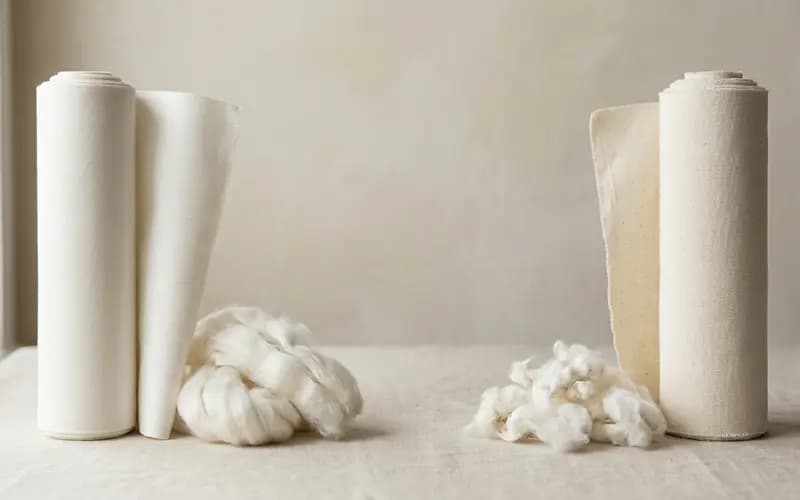
Supima vs Regular Cotton: Is Premium Cotton Worth It?
Premium cotton is heavily marketed and barely understood. Here is the honest case for long-staple cotton — and where the price tag lies.
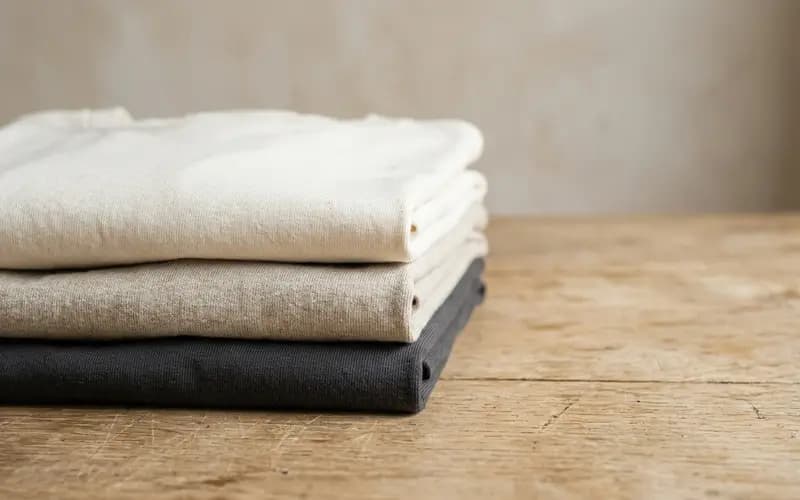
T-Shirt GSM Guide: What the Number Really Means
GSM is the most quoted, least understood number on a tee. Here is what it actually predicts about quality.
Stay in the loop
New writing, no noise
Occasional notes on fit, fabric, and dressing simply well. No spam, unsubscribe anytime.
Subscribe