Seasonal
How to Dry Clothes Indoors in Monsoon Without the Musty Smell
The musty monsoon smell is bacteria growing during slow drying. Four levers speed indoor drying enough to stop it before it starts.
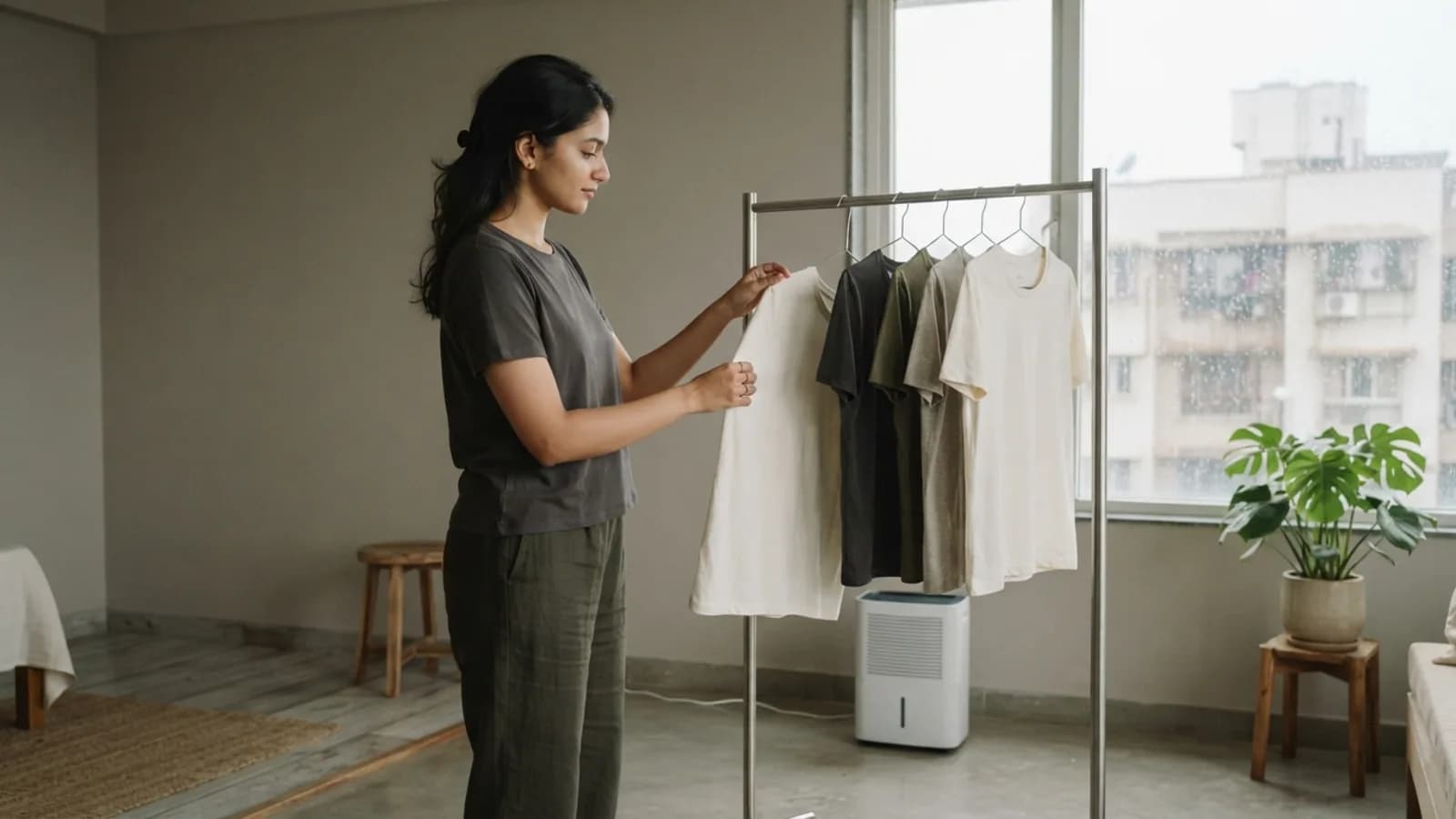
Indoor drying is a science problem, not a patience problem
Most people treat indoor drying during monsoon as a waiting game, hang the clothes, leave the room, come back in six hours and hope. That approach is why so many homes smell faintly of damp laundry from June through September.
The actual problem is physics. Air can only hold so much water vapour, and monsoon air in most Indian cities is already carrying 80 to 95 percent of what it can hold, leaving very little room for your wet clothes to release moisture into.
Hang a shirt in a closed, humid room and it is not really drying, it is just sitting wet while the air around it stays equally wet. That stalled, half-dry state for hours on end is exactly when bacteria multiply and the musty smell sets in.
This guide is about fixing the actual mechanism, moving air and reducing local humidity, rather than just hoping for the best. Get this right and indoor-dried clothes can come out smelling as clean as sun-dried ones, even in a Mumbai July or a Kolkata August.
Why clothes smell musty when they dry slowly
The smell is not the water itself, it is bacteria. Damp fabric sitting at room temperature for six or more hours is close to ideal breeding conditions for the bacteria that live naturally on skin and in the environment, and those bacteria produce the sour, musty smell people associate with monsoon laundry.
Fast drying starves that bacterial growth of time. A garment that goes from wet to dry in ninety minutes barely gives bacteria a chance to establish, while one that takes eight hours in a stagnant, humid room gives them a full workday.
This is the entire logic behind indoor drying done right: speed is not about convenience, it is the actual mechanism that prevents the smell in the first place. Our guide on why t-shirts smell after washing covers this bacterial mechanism in more depth if you want the full picture.
The four levers that actually speed up drying
There are exactly four things that control how fast a wet garment dries indoors, and most people only use one of them, usually just hanging the clothes and hoping.
Airflow
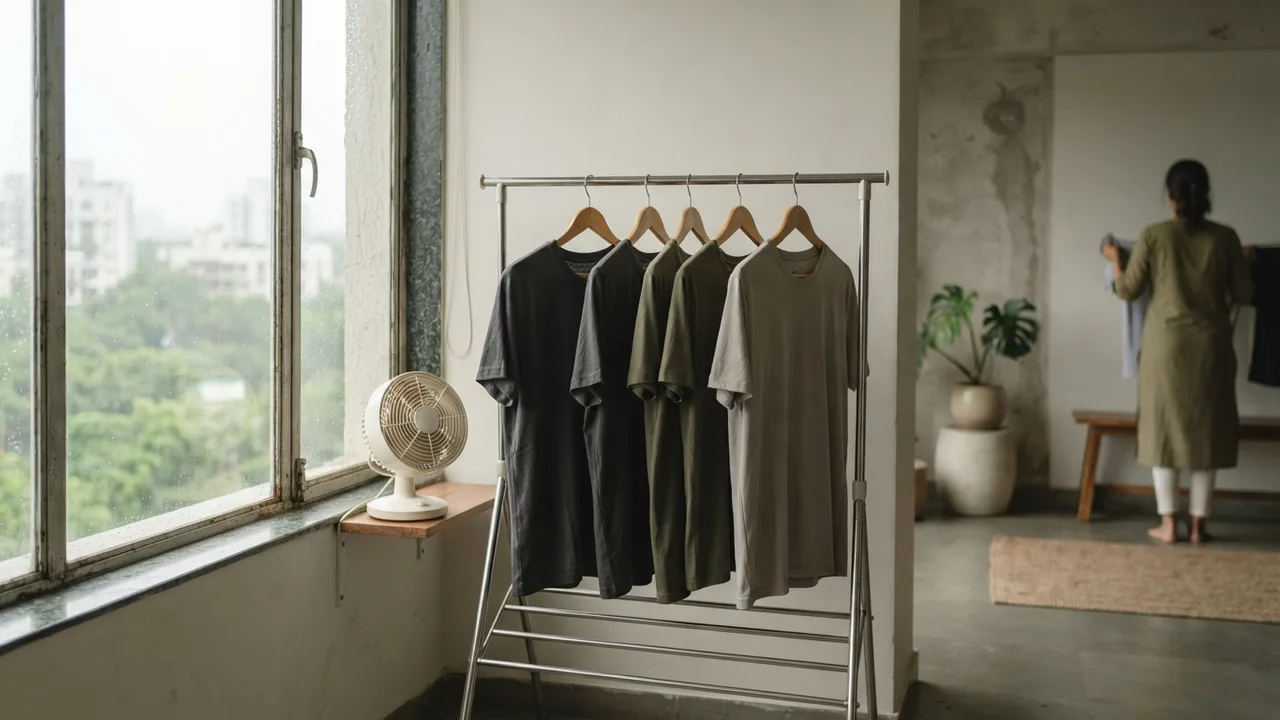
Moving air is the single biggest lever you have. A fan pointed directly at hanging laundry, even a basic table fan, roughly doubles drying speed compared to a still room, because moving air constantly replaces the saturated air right next to the fabric with slightly less saturated air.
Position the fan to blow across the clothes rather than just into the room generally, and space garments apart so air can move between them rather than through one dense clump.
Spacing
Clothes hung touching each other trap a pocket of extra-humid air between them that neither garment can dry into. Leave at least a hand's width between hanging garments, and turn heavier items like tees and towels inside out partway through so both sides get equal airflow.
Local humidity reduction
A dehumidifier, even a small one, in the room where you are drying clothes makes a measurable difference, since it actively pulls moisture out of the air rather than just moving the same wet air around. If a dehumidifier is not available, drying in the room with the least humidity in the house, often near a kitchen exhaust fan or bathroom extractor running, helps for the same reason.
Closing the door of the drying room and running the fan inside it, rather than drying in an open, humid living space, concentrates the airflow where it matters instead of losing it to the rest of the house.
Fabric choice and weight
This is the lever people control least in the moment but can plan for ahead of time. A lighter-weight cotton or a cotton-poly blend dries in roughly half the time of a heavy 240 GSM cotton tee, because there is simply less fibre holding water.
Our GSM guide covers exactly how weight changes drying behaviour, and if you know a stretch of heavy rain is coming, reaching for lighter pieces in your rotation during that window genuinely helps.
The setup that actually works
Combine all four levers into one simple routine rather than relying on any single one alone. Here is the setup that consistently gets a load of laundry dry indoors within four to six hours, even during peak monsoon humidity.
Hang clothes on a drying rack rather than a single rod, since a rack naturally spaces garments apart in a way a crowded rod does not. Position a fan roughly a metre away, angled to blow directly across the hanging clothes rather than at the ceiling or wall.
Close the door if the room allows it, so the fan is working within a contained space rather than fighting the humidity of the whole house. If you have a dehumidifier, run it in the same closed room, and if you have an exhaust fan nearby, keep it running to actively pull the humid air out rather than letting it recirculate.
Rotate heavier garments, inside out, around the halfway point so both sides dry evenly rather than one side finishing while the other stays damp against the rack.
What not to do
A few common habits actively work against fast drying, even though they feel intuitive.

Do not dry clothes in the bathroom right after a shower. The residual steam and humidity from a hot shower can leave the bathroom air more saturated than the rest of the house, which slows drying rather than speeding it up.
Do not stack wet clothes in a pile before hanging them. Even a short wait with garments bundled together lets bacteria start working before the drying process has even begun, and it also creates uneven dampness once you do hang them.
Do not rely on a closed, unventilated cupboard to finish drying an almost-dry garment. This is one of the most common mistakes, and it is exactly how a shirt that felt "basically dry" develops a musty smell overnight, since a closed cupboard has no airflow at all. Our post-monsoon wardrobe reset guide covers what to do once damage from exactly this habit has already set in.
When you have access to sun, even briefly
Monsoon does not mean zero sun, most Indian cities get windows of clear sky between spells of rain, sometimes just an hour or two. Watch for these windows and use them even for a short burst, since UV exposure kills bacteria in a way indoor drying alone cannot fully replicate.
A garment that gets even thirty minutes of direct sun after being mostly dried indoors comes out noticeably fresher than one dried indoors the whole way through. Keep an eye on the sky through the day rather than committing fully to either indoor or outdoor drying, and treat any sun window as a bonus finishing step rather than the primary plan.
Building a monsoon-ready laundry routine
If indoor drying is a regular part of your monsoon months, a few structural choices make the whole routine easier rather than fighting it every single load.
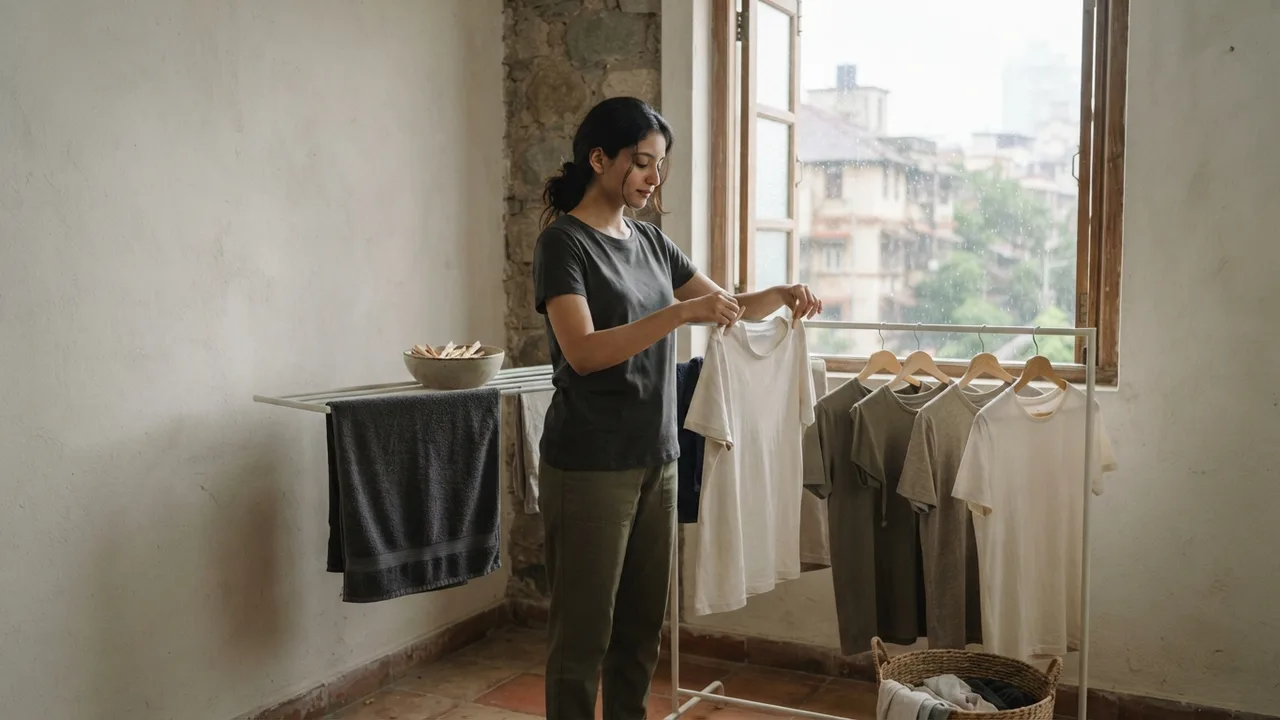
Wash smaller loads more frequently rather than one large weekly wash, since a smaller load dries faster and gives you more flexibility to catch a sun window between rain spells. Favour lighter-weight, quick-drying fabrics in your monsoon rotation specifically, saving heavier pieces for the drier months when their slower drying time is not a daily obstacle.
A well-made cotton-poly blend round-neck tee is built for exactly this kind of seasonal flexibility, comfortable enough for daily wear, light enough to dry fast when the air is not cooperating. Our full monsoon clothing guide covers the broader fabric and outfit strategy this drying routine supports.
Apartment living makes this harder, plan around it
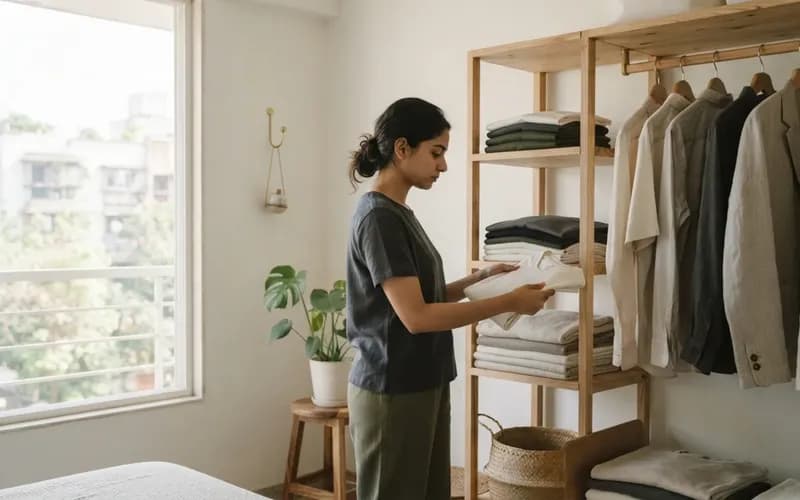
!Minimalist editorial photo illustrating a well-made cotton-poly blend [round-neck tee is built for exactly this kind of seasonal flexibility, comfortable enough for daily wear, light enough to dry fast when the air is not cooperating. our full monsoon clothing guide covers the broader fabric and outfit strategy this drying routine supports., muted neutral tones, soft natural light, premium plain t-shirt context](/images/blog/dry-clothes-indoors-monsoon/inline-3.webp)
Most urban Indian households, especially apartments in Mumbai, Bengaluru, and Delhi NCR, do not have the balcony or terrace space that made outdoor drying easy for previous generations. Smaller apartments also mean less spare room to dedicate entirely to drying laundry, which is the single biggest obstacle to the closed-room, fan-forward setup described above.
If a full spare room is not available, a bathroom with the exhaust fan running and the door closed is the next best option, since bathrooms are usually small enough for a fan and exhaust combination to meaningfully reduce humidity within a couple of hours. Balconies with any covered overhang can work for brief sun windows even during scattered showers, since a few minutes of exposure between spells still helps more than none.
The core principle holds regardless of square footage: concentrate airflow and reduced humidity into the smallest possible space around the clothes, rather than trying to dry an entire load in an open, humid living room where none of the four levers can work effectively.
What to do if a garment already smells musty
If you catch the smell before it fully sets in, a quick fix often works. Rewash the garment in the hottest water the fabric allows, adding a half cup of white vinegar to the rinse cycle, then dry it as fast as possible using every lever covered above, fan, spacing, closed room, and a sun window if you can catch one.
Vinegar neutralises the odour-causing bacteria in a way that regular detergent alone often misses, especially on garments that have already gone through one full slow-dry cycle. If the smell persists after this treatment, the bacteria have likely worked deeper into the fibre, and the garment needs the more thorough soak-and-sun-dry approach covered in our post-monsoon wardrobe reset guide.
Catching it early, within a day or two of the smell first appearing, makes the difference between a five-minute fix and a garment you eventually have to retire.
The takeaway
Indoor drying without the musty smell comes down to speed, and speed comes down to airflow, spacing, humidity control, and fabric choice working together rather than any single trick. Set up the routine once, a rack, a fan, a closed room, and it becomes a five-minute habit rather than a daily gamble.
Get this right and monsoon stops being the season your laundry routine falls apart. It just becomes one more thing you have already solved.
Boring Label
Wear the point of the article.
One honest tee. Heavyweight combed cotton, a collar that holds, a fit that actually fits. No logo, no noise.
Shop the round-neck teeFree shipping across India · Easy returns
Keep reading

Monsoon Clothing: What to Wear in the Rains
The monsoon punishes the wrong fabrics. Dress for fast-drying and you stay comfortable through it.
Why Your T-Shirt Still Smells After Washing
It looks clean but smells sour the moment it warms up. The real reason is the fabric, not your laundry routine.
The Post-Monsoon Wardrobe Reset Checklist
Monsoon humidity damages fabric even in the cupboard. A six-step checklist to reset your wardrobe before the dry season begins.
Stay in the loop
New writing, no noise
Occasional notes on fit, fabric, and dressing simply well. No spam, unsubscribe anytime.
Subscribe