Fabric
Hard water is ruining your clothes: a city-by-city problem
Mineral-heavy water dulls and stiffens fabric over months of washing. A city-by-city look at hard water severity across India and how to counter it.

Hard water is quietly wrecking wardrobes across most of India
If your whites have turned grey, your dark tees look dusty, and your towels feel scratchy no matter what detergent you buy, hard water is very likely the actual cause. Not the detergent, not the machine, not the fabric quality.
Hard water contains dissolved calcium and magnesium minerals, and those minerals react with soap and detergent to form a residue that clings to fabric fibres instead of rinsing away. Over months of washing, that residue builds up, dulling colour, stiffening the weave, and shortening how long a garment stays comfortable and good-looking.
This is a genuinely regional problem, and the severity varies a lot by city. Here is what is actually happening and what to do about it depending on where you live.
The chemistry, in plain terms
Soap and most detergents work by surrounding dirt and oil particles so water can rinse them away. In soft water, this works cleanly.
In hard water, calcium and magnesium ions react with the detergent before it can do its job properly, forming an insoluble compound often called soap scum or lime soap. That compound does not rinse out easily and instead deposits into the fabric weave.
Cotton is especially prone to this because its fibre structure absorbently holds onto mineral deposits over repeated wash cycles. Each wash in hard water adds a small additional layer of mineral buildup, and it compounds, which is why the problem tends to be invisible for the first few months of a garment's life and then becomes obvious around the six-month mark.
The visible effects: fabric that looks grey or dingy rather than the original clean white, colours that appear muted rather than fading in the usual sun-exposure sense covered in our colour fading guide, and a stiff, scratchy hand feel that no fabric softener fully resolves.
City-by-city: how bad is your local water
Water hardness in India varies dramatically by region, largely tied to local groundwater geology.
Delhi and much of the National Capital Region sit on genuinely hard groundwater, with hardness levels frequently measured well above 300 mg/L as calcium carbonate, categorized as very hard by most water quality standards. This is one of the most affected metro regions in the country.
Chennai and much of coastal Tamil Nadu also deal with hard to very hard water, driven by both groundwater mineral content and, in some areas, seawater intrusion into aquifers.
Bengaluru has more variable water hardness depending on the source, ranging from moderately hard Cauvery-supplied municipal water to noticeably harder borewell water, which many apartment complexes still rely on.
Mumbai and Pune, drawing largely from reservoir sources, tend to have comparatively softer water than the cities above, though pockets of hard groundwater still exist depending on the specific supply source.
Jaipur and much of Rajasthan face some of the hardest water in the country, a direct result of the region's mineral-dense arid geology, often requiring the most aggressive countermeasures of anywhere on this list.
If you are unsure about your own water, most municipal water boards publish hardness data, and inexpensive test strips from any hardware or aquarium supply store give a quick reading at home.
What hard water does to specific garment problems
A few common laundry complaints trace directly back to hard water, even when people assume a different cause.
Whites turning grey or yellow is very often mineral deposit, not just age or sun exposure, especially in cities like Delhi and Jaipur. The full mechanics of this specific problem are covered in our white tees turning yellow guide.
Fabric feeling stiff even after fabric softener. Softener cannot fully counteract mineral buildup already lodged in the fibre; it coats the surface temporarily rather than removing the underlying deposit.
Reduced garment lifespan overall. Mineral-stiffened fibre is more brittle and prone to breaking under normal stress, contributing to lower survival rates in long-term wear tracking like our 30-wash durability test.
Detergent seeming less effective over time, even from the same trusted brand. This is not the detergent failing; it is the mineral load in the water overwhelming the detergent's working capacity, a factor covered alongside dosing advice in our detergent guide.
Fixing it: from cheapest to most thorough
You do not need to solve hard water perfectly to see a real improvement. Here are the options in order of cost and effort.
Add a water softener to each wash. The cheapest fix, a small scoop of laundry-grade water softener added alongside your regular detergent binds the minerals before they can react with soap, letting your existing detergent work as intended.
Switch to a detergent formulated for hard water. Many detergent brands sold in India now include zeolites or polycarboxylates specifically to counteract hard water minerals; check the ingredient panel rather than trusting general marketing claims.
Add an extra rinse cycle. A second rinse gives more opportunity to flush out mineral-detergent residue that a single rinse cycle often leaves behind, a low-effort fix that noticeably improves fabric feel over a few months.
Install a whole-home or washing-machine-specific water softener. The most thorough and most expensive fix, an inline softener removes the mineral load before it ever reaches your detergent or your clothes, and is worth considering if you live in a very-hard-water city and do a high volume of laundry.
A quick reference table
| Approach | Cost | Effectiveness |
|---|---|---|
| Water softener added per wash | ✓ Low | ✓ Good, needs consistency |
| Hard-water detergent formula | ✓ Low-medium | ✓ Good |
| Extra rinse cycle | ✓ Free | ✓ Moderate |
| Inline water softener unit | ✗ High upfront | ✓ Excellent, permanent |
| Doing nothing | ✓ Free | ✗ Gradual fabric damage |
Protecting the tees you already own
If you have been washing in hard water for a while and are noticing stiffness or dullness setting in, a few sessions of washing with double the usual detergent dose plus a water softener, followed by two extra rinse cycles, can pull out a meaningful amount of accumulated mineral residue. It will not fully reverse months of buildup, but it noticeably softens fabric that has gone stiff.
Going forward, the routine matters more than any single fix. Combine a hard-water-appropriate detergent, correct dosing as covered in our detergent guide, and cold-water washing, which our wash care guide recommends for reasons beyond just hard water.
A well-made round-neck tee is built to survive a long wash life, but even the best fabric loses that battle against untreated hard water eventually. Treating the water is as much a part of care as anything you do to the garment directly.
How to actually test your water at home
Before investing in a softener or switching detergents entirely, it helps to confirm how hard your specific water supply actually is, since hardness can vary even within the same city depending on the source.
Inexpensive test strips, sold at aquarium and hardware stores, give a quick reading in parts per million or grains per gallon within a minute of dipping. A reading above roughly 120 mg/L as calcium carbonate is generally considered hard, and above 180 mg/L is considered very hard, the range much of Delhi and Jaipur regularly falls into.
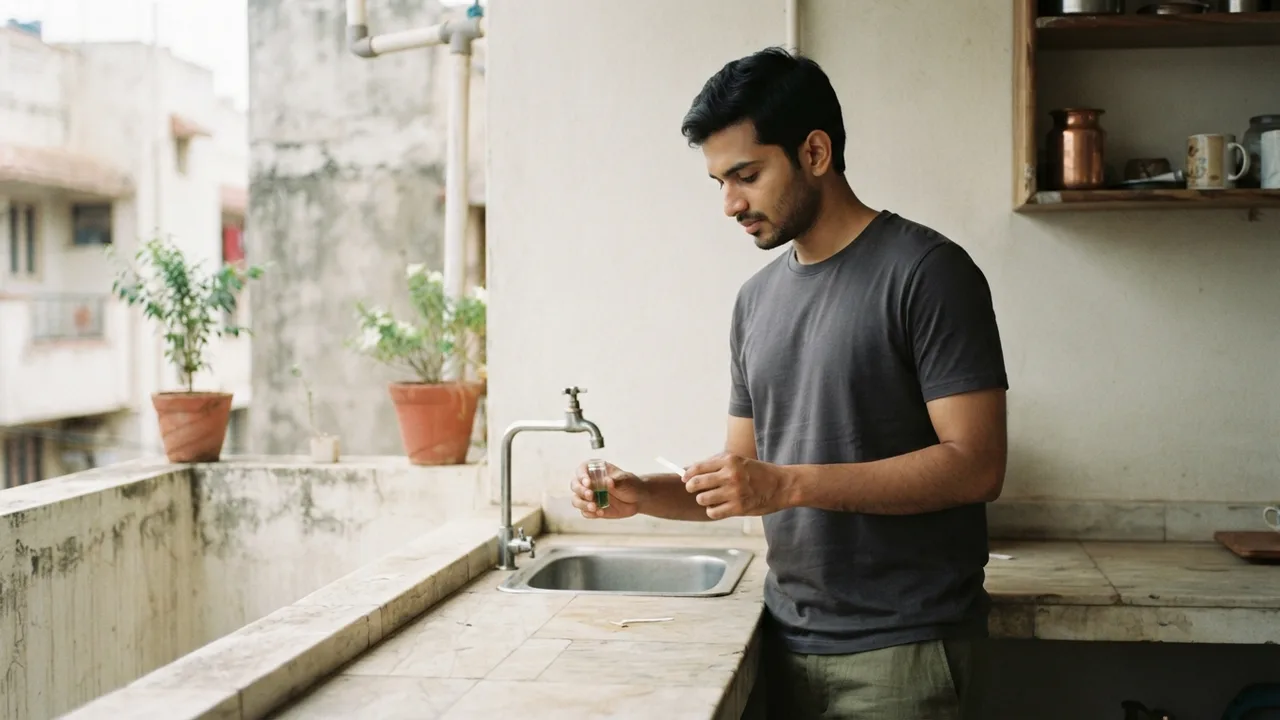
A simpler, if less precise, home test: fill a clear bottle with your tap water, add a few drops of liquid soap, and shake it. Water that lathers quickly into a rich foam is relatively soft; water that struggles to lather and instead produces a cloudy, scummy layer is a strong sign of significant hardness.
If your building relies on borewell water, which many apartment complexes in Bengaluru and parts of Chennai still do, hardness can differ noticeably from the municipal supply next door, so a direct test of your own tap is more reliable than assuming based on city-wide averages.
Beyond laundry: hard water and hair, skin, and appliances
Hard water's effect on clothes is part of a wider pattern worth knowing about, since the same water is touching your skin, hair, and home appliances every day.
Hard water is a well-documented contributor to dry skin and dull hair, through the same mineral-residue mechanism that dulls fabric, coating skin and hair strands rather than rinsing cleanly away. Many people who invest in a water softener for laundry notice this secondary benefit within a few weeks, even though it was not their original motivation.
On the appliance side, mineral buildup inside washing machines and geysers is a genuine maintenance cost over years, reducing heating efficiency and occasionally causing early wear on internal components. A whole-home or machine-specific softener addresses all of these fronts at once, which is worth factoring in when weighing the upfront cost against a fix that only targets laundry.
Quick answers to common hard water questions
Can hard water damage clothes permanently? Long-term mineral buildup does weaken fibre and dull colour in ways that are hard to fully reverse, though a good soak with softener and extra rinses helps considerably.
Is bottled or filtered water needed for laundry? No, that is unnecessary and expensive. A laundry-specific water softener added to the wash is far more practical and cost-effective.
Does vinegar help with hard water laundry problems? A small amount of white vinegar in the rinse cycle can help cut some mineral residue, though a dedicated water softener formulated for laundry is generally more effective for consistent results.
Renting versus owning: what you can actually control
Not everyone has the option to install a whole-home softener, particularly renters or those in shared apartment buildings with fixed plumbing infrastructure.
If a permanent fix is not available to you, focus on the per-wash interventions instead: a laundry-grade softener additive, a hard-water-formulated detergent, and an extra rinse cycle. Together these three habits recover most of the practical benefit of a full softener system, just without the upfront installation cost or landlord approval.
For those who do own their home or have longer-term tenancy, a compact machine-specific inline softener, installed directly at the washing machine's water inlet, is a middle-ground option that avoids the cost and disruption of a whole-home system while still delivering consistent results specifically for laundry.
The bottom line
If you live in Delhi, Jaipur, Chennai, or another hard-water city and your clothes have been quietly losing their colour and softness despite good detergent and careful washing, the water itself is very likely the missing variable. A cheap water softener added to every wash, combined with the right detergent for your local conditions, solves most of the problem without any change to how you actually do laundry.
It is one of the few genuinely underrated fixes in home laundry, and it pays off in exactly the kind of long-term fabric life that makes buying fewer, better basics worthwhile in the first place.
Boring Label
Wear the point of the article.
One honest tee. Heavyweight combed cotton, a collar that holds, a fit that actually fits. No logo, no noise.
Shop the round-neck teeFree shipping across India · Easy returns
Keep reading
The Detergent Guide for India: Top-Load, Front-Load, Bar Soap
Detergent choice and dosing matter more than the washing machine. A practical guide matched to top-load, front-load, and hand-wash habits across India.
Why White T-Shirts Turn Yellow (and How to Stop It)
The collar and armpits yellow for two different reasons - and most fixes make it worse. What is really happening, and how to stop it.
The 30-Wash Test: How to Judge T-Shirt Durability
Most tees survive the first wash. The honest test is thirty. Here is what fails, when it fails, and how to check before you commit.
Stay in the loop
New writing, no noise
Occasional notes on fit, fabric, and dressing simply well. No spam, unsubscribe anytime.
Subscribe