Fabric
Mercerised cotton: the sheen explained
Mercerisation is a century-and-a-half-old finishing process that gives cotton sheen, strength, and deeper colour. Here is what it actually improves and what it does not.

The sheen you see on premium tees has a name
Pick up two cotton t-shirts of similar weight, one plain-looking and one with a faint, almost silky shine under light. That shine is usually mercerisation, a chemical treatment that has been used on cotton since 1844.
It is not a fibre type like Supima or Pima. It is a finishing process applied to ordinary cotton yarn or fabric, and it changes three things at once: how the fabric looks, how it feels, and how well it takes dye.
This piece explains exactly what happens during mercerisation, why it produces that sheen, and whether it is worth paying more for on a t-shirt specifically, as opposed to on shirting fabric where it is more traditionally used.
If you have not yet read our guide to combed cotton versus carded cotton, start there. Mercerisation is a separate, additional step that can be applied on top of either.
What actually happens during mercerising
The process is named after John Mercer, the English chemist who patented it. Cotton yarn or woven fabric is bathed in a concentrated sodium hydroxide solution, then rinsed under tension.
Under a microscope, raw cotton fibre looks like a flattened, twisted ribbon with an irregular surface. The caustic soda bath swells the fibre, and while it is swollen, tension is applied to pull it straight.
When the fibre dries, it locks into a rounder, smoother, more cylindrical shape instead of returning to its original flat ribbon form. That rounder cross-section reflects light more evenly across its surface, which is what produces the visible sheen.
The same structural change also increases the fibre's surface area available for dye absorption, by as much as 25 percent compared to untreated cotton. That is why mercerised fabric takes colour more deeply and holds it longer.
The three real benefits
Sheen and colour depth. This is the most visible effect. Mercerised cotton has a subtle, natural lustre that reads as more refined than matte cotton, without looking synthetic or glossy the way polyester does.
Dyed mercerised cotton also produces richer, deeper colour than the same dye on untreated cotton, because more dye molecules bind to the smoother fibre surface. Deep navy and true black in particular look noticeably better mercerised.
Strength. Mercerisation increases tensile strength by roughly 20 to 30 percent, because straightening the fibre also reorganises its internal cellulose structure into a stronger configuration. This is a genuine mechanical improvement, not a marketing claim.
Reduced pilling and lint. A smoother fibre surface sheds less lint and resists the friction-driven fuzzing that leads to pilling. If you have read our piece on why t-shirts pill, you already know that surface friction between loose fibre ends is the main mechanism, and mercerisation directly reduces that.
What it does not do
Mercerisation does not make cotton cooler, more breathable, or more absorbent in a way that helps in Indian heat. If anything, the tighter fibre structure very slightly reduces the fabric's natural bulk and airflow compared to an untreated equivalent of the same weight.
It also does not make a tee shrink-resistant on its own. Mercerised cotton still shrinks with washing unless it has also been through a separate sanforising or pre-shrinking process. Our guide to whether cotton t-shirts shrink covers that separate treatment in detail, and it is worth checking a garment's label for both terms rather than assuming one implies the other.
And it is not a fibre grade. Mercerisation can be applied to ordinary carded cotton just as easily as to premium combed or Supima cotton. A mercerised low-grade cotton tee will still pill and thin out faster than an unmercerised Supima one, because the underlying fibre quality still matters more than the surface finish.
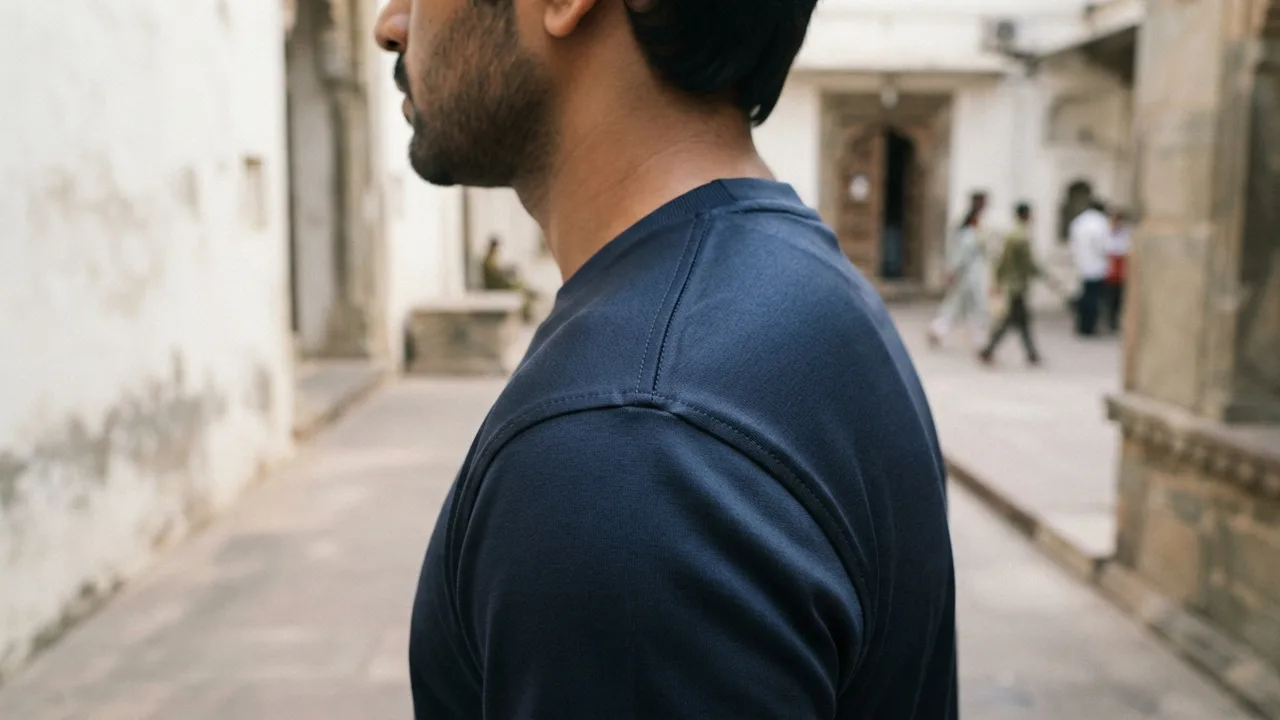
Mercerised versus untreated, side by side
| Trait | Mercerised cotton | Untreated cotton |
|---|---|---|
| Surface sheen | Subtle natural lustre | Matte |
| Dye uptake | Deeper, more saturated colour | Lighter, flatter colour |
| Tensile strength | Higher, roughly 20-30% stronger | Baseline |
| Pilling resistance | Better, smoother fibre surface | More prone to fuzzing |
| Breathability | Marginally reduced | Marginally higher |
| Cost impact | Adds to production cost | Baseline |
| Shrink resistance | Not implied, needs separate sanforising | Same, needs separate sanforising |
Why premium t-shirt brands use it
For shirting fabric, mercerisation is close to standard practice because sheen and colour depth matter enormously on a smooth, tightly woven surface. For knit t-shirt fabric, it is used more selectively, usually on the yarn before knitting rather than on the finished fabric.

The main reason brands reach for it on t-shirts is colour performance. A mercerised black tee stays a truer, deeper black through more washes than an unmercerised one, because the dye is bound more securely into the fibre.
This matters a great deal if you care about why t-shirt colours fade, since fading is largely a story of dye molecules breaking loose from the fibre surface over repeated wash and UV exposure cycles. Mercerised yarn gives the dye a better anchor to begin with.
The other reason is feel. A mercerised tee has a very slightly crisper, smoother hand than the same cotton untreated, which some people read as more premium and others find less soft than a classic brushed cotton feel. This is genuinely a preference call, not a quality hierarchy.
Is it worth paying more for
If the tee is a dark, saturated colour like black, navy, or a deep forest green, mercerisation is worth seeking out. The colour retention alone justifies the small added cost over the life of the garment, and it pairs well with the combed or ring-spun cotton base that most premium tees already use.
If the tee is a lighter shade, heather, or a pastel, the visible benefit is smaller, since there is less dye depth to protect in the first place. In that case, prioritise fibre quality and knit construction over whether the yarn was mercerised.
Our round-neck tee uses mercerised yarn on its darker colourways specifically because that is where the treatment earns its keep, not as a blanket claim across every shade. If you want to check whether a tee you are buying uses it, the label rarely says "mercerised" outright in India, so reading t-shirt label jargon correctly, and asking the brand directly if the label is silent, are your best tools.
Mercerisation is a genuinely useful, century-and-a-half-old process, not a marketing invention. The trick is knowing what it actually improves, sheen, strength, and dye retention, and not assuming it fixes breathability or shrinkage, which are separate problems entirely.
How to spot it without a label
Most Indian t-shirt tags do not use the word "mercerised" even when the yarn genuinely was treated, since the term reads as technical jargon to most shoppers and brands often skip it. That leaves you checking by eye and by hand instead of by label.
Hold the fabric up to a light source and tilt it slightly. Mercerised cotton reflects light with a faint, even lustre across the surface, distinct from the flat, diffuse look of untreated cotton and distinct from the harder, more uniform shine of a synthetic fabric.
Run your fingers across a dark-coloured area of the fabric. Mercerised cotton tends to feel very slightly smoother and cooler to the touch than the same weight of untreated cotton, a sensation closely related to what we cover in our piece on why some fabric feels cool to touch, since fibre surface smoothness is one of the mechanisms behind both effects.
Compare colour saturation against a similar tee from another brand in the same shade. If one navy or black looks noticeably deeper and more even than the other under the same light, mercerisation is a likely explanation, alongside dye quality itself.
Mercerisation and the wider premium-cotton landscape
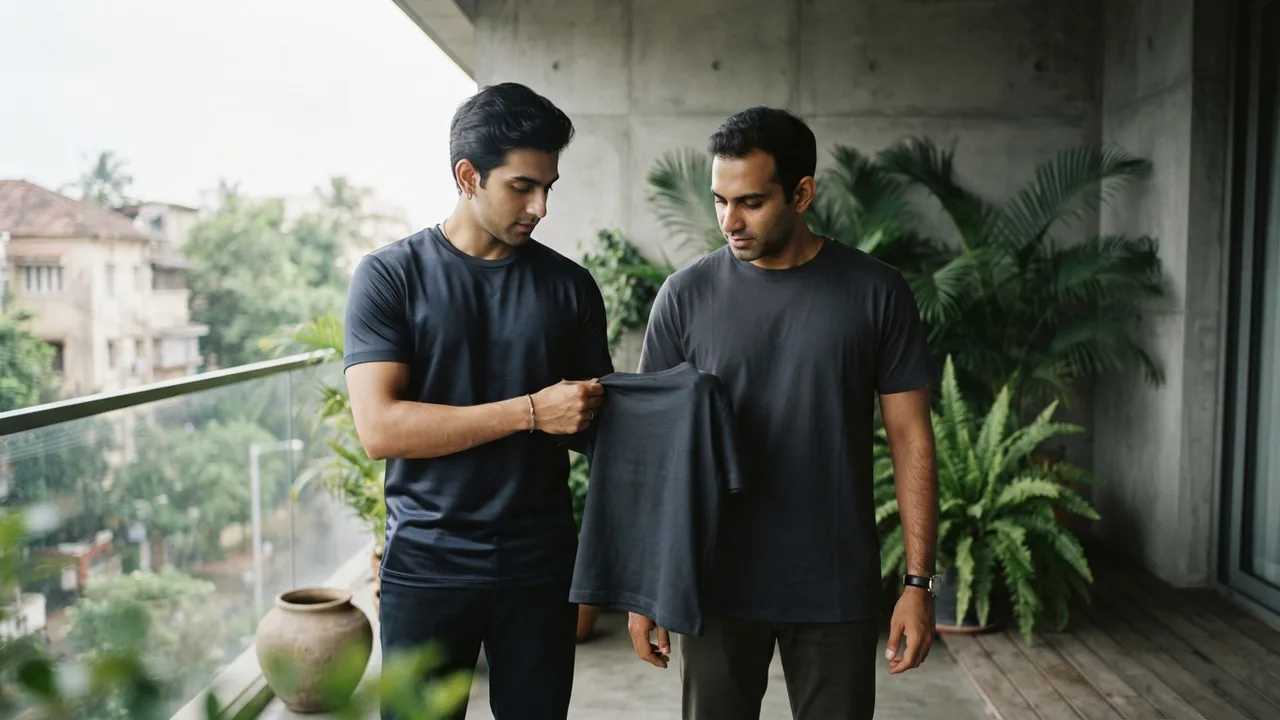
Mercerisation is one lever among several that separate a genuinely well-made cotton tee from an ordinary one, and it works best stacked with the other levers rather than standing alone. Fibre length matters more on its own, which is why our comparisons of Supima versus Egyptian versus Pima cotton and Supima versus regular cotton remain the more foundational reads if you are trying to judge overall quality rather than just surface sheen.
Think of the decision in layers. Fibre type and staple length set the ceiling on how good the yarn can possibly be.
Spinning method, ring-spun versus open-end, determines how much of that ceiling the yarn actually reaches. Knit construction determines how the yarn behaves once it becomes fabric.
And mercerisation sits on top of all three as a finishing step that polishes what is already there, rather than fixing what is not. A mercerised finish on poor-quality carded cotton will still be a poor-quality t-shirt with a bit of extra shine, so treat the treatment as the last question to ask, never the first.
The takeaway for your next purchase
If you are choosing between two otherwise similar tees and one specifies mercerised yarn, particularly in a dark or saturated colourway, it is a reasonable tiebreaker in favour of better colour retention over the garment's life. If you are choosing based on mercerisation alone while ignoring fibre quality and construction, you are optimising the wrong variable, and the tee will disappoint you in ways a shiny surface cannot fix.
A short history, because it explains the confidence in the claim
John Mercer discovered the process by accident in 1844, while experimenting with concentrated sodium hydroxide solutions on cotton fabric for a completely different purpose. He noticed the treated fabric shrank, strengthened, and gained an unexpected sheen, and he patented the discovery soon after.
For decades the process was used mainly to strengthen fabric, since the sheen was considered a secondary effect and manufacturers had not yet solved how to apply tension during the treatment to lock the fibre into its rounder shape. It was only later in the nineteenth century, once the tension step was refined, that mercerisation became known primarily for its lustre, and that reputation is the one that survives on hangtags today.
This matters because it explains why the sheen claim carries so much weight in fabric marketing. It is nearly two centuries of established, well-understood textile chemistry, not a recent invention designed to sound impressive, which is a genuinely rare thing to be able to say about a modern fabric buzzword.
Cost, and why not every tee uses it
Mercerisation adds a real processing step, and therefore a real cost, to fabric production. The caustic soda bath, the controlled tension during treatment, and the thorough neutralising rinse afterward all require specialised equipment and careful process control, which is why it shows up more consistently on premium and mid-premium fabric than on budget basics.
This is also why mercerisation is applied selectively rather than universally, even within a single premium brand's range. A brand may mercerise the yarn used for its darker, more saturated colourways specifically, where the dye-retention benefit is largest, while skipping the step on lighter or heathered shades where the visible payoff is smaller relative to the added cost.
Understanding this selective logic helps explain why two tees from the same brand, in the same fabric weight, can differ in price by a small but noticeable margin depending on colour. It is rarely arbitrary, and it is worth asking a brand directly which of its colourways use mercerised yarn if the information is not stated clearly on the product page.
Boring Label
Wear the point of the article.
One honest tee. Heavyweight combed cotton, a collar that holds, a fit that actually fits. No logo, no noise.
Shop the round-neck teeFree shipping across India · Easy returns
Keep reading
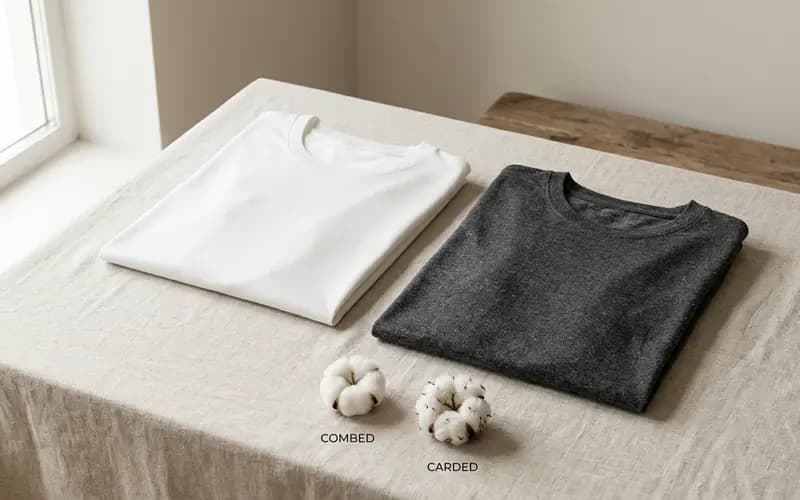
Combed Cotton vs Carded: Why It Matters
One extra step removes the short fibres that make a tee fuzz, pill, and weaken. That step is combing.
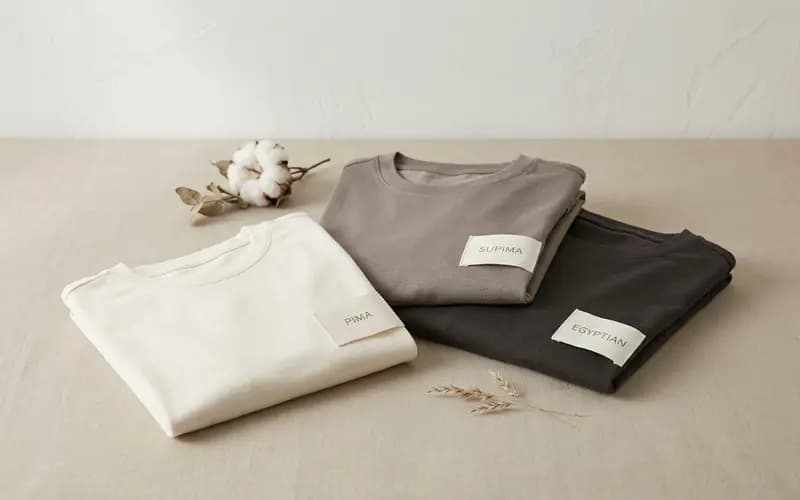
Supima vs Egyptian vs Pima Cotton: Which Is Actually Better?
Three names, a lot of marketing, and one verifiable winner. The difference is less about the plant and more about who can prove it.

Why Some Tees Feel Cool to Touch: The Fabric Science
Cool-touch fabric works through fast heat conduction on contact, a real but narrow effect. Breathability and moisture-wicking matter more over a full Indian workday.
Stay in the loop
New writing, no noise
Occasional notes on fit, fabric, and dressing simply well. No spam, unsubscribe anytime.
Subscribe