Fabric
Pre-Shrunk, Bio-Washed, GSM, Ring-Spun: T-Shirt Jargon Decoded
What pre-shrunk, bio-washed, GSM, single jersey and ring-spun really mean - and which terms are quality signals versus marketing.
The Spec Sheet Nobody Taught You to Read
Pick up almost any t-shirt online and the description reads like a small chemistry exam. Pre-shrunk.
Bio-washed. 180 GSM.
Single jersey. Ring-spun combed cotton.
Each phrase is meant to sound like a promise of quality, and most of us nod along because admitting we do not know what bio-washed actually means feels faintly embarrassing. So we let the words wash over us, glance at the price, and guess.
The trouble is that some of these terms describe something real and meaningful about how the tee will feel and last, and some of them are marketing dressed up as engineering. A few are both at once - genuinely useful when done properly, and quietly misused when they are not. The only way to stop guessing is to learn what each word is pointing at, what it can and cannot tell you, and where the wording hides more than it reveals.
This is that translation. We will take the most common terms on a t-shirt spec sheet, one at a time, and decode each honestly: what it means, why it is there, whether it matters, and how to tell when it is doing real work versus filling space. By the end you will be able to read a product page the way a buyer at a clothing brand reads it - with healthy suspicion and a clear sense of which words to trust.
Why the Jargon Exists at All
Before the glossary, it helps to understand why a plain t-shirt - arguably the simplest garment ever made - comes wrapped in so much technical language.
Part of it is genuine. A t-shirt really is the sum of several independent decisions: which cotton, how it was cleaned, how it was spun, how it was knitted, how heavy the cloth is, how it was finished and dyed.
Each of those decisions has a name, and each one changes how the finished tee behaves. A spec sheet is, in principle, an honest attempt to tell you those decisions.
The other part is less innocent. Because most shoppers cannot tell a good tee from a mediocre one by sight, sellers reach for words that sound technical and reassuring.
A term like bio-washed sounds scientific and premium whether or not it was applied well. So the same vocabulary that lets a careful maker describe real quality also lets a careless one imply quality that is not there.
The words are neutral. The intent behind them varies.
Your job as a buyer is to read past the intent.
A useful rule before we start: a term that describes the raw material or a structural choice (the cotton, the spin, the knit) tends to be more meaningful than a term that describes a finish applied at the end (the wash, the softening). Finishes can be real improvements, but they are also where the easiest shortcuts hide. Keep that distinction in mind as we go.
Ring-Spun
Ring-spun describes how the cotton fibres were twisted into yarn, and it is one of the more trustworthy words on a label.
Cotton does not arrive as thread. After it is cleaned and aligned, the loose rope of fibres has to be twisted into a continuous strand strong enough to knit with - that is spinning.
There are two common ways to do it. The cheap, fast method is open-end spinning, which produces a coarser, weaker, fuzzier yarn.
The slower method is ring spinning, where the fibres are twisted more tightly and continuously around each other, producing a finer, stronger, smoother yarn.
So ring-spun genuinely tells you something. A ring-spun tee will, all else equal, feel smoother and last better than an open-end one. It is a real upgrade and worth looking for.
But here is the catch that the word hides. Ring-spun describes the twisting, not the quality of the fibres being twisted.
You can ring-spin perfectly mediocre cotton - smoother twist, but still full of short, weak fibres. So ring-spun on its own means better than the cheapest option, not necessarily good.
The phrase you actually want is combed ring-spun cotton, which tells you both that the bad fibres were removed and that the rest was spun well. We pull this thread all the way in our piece on combed cotton versus carded cotton, because the two terms get confused constantly and the confusion costs people money.
Verdict: meaningful, and a genuine signal of care - but read it as a floor, not a ceiling. Ring-spun alone is good; ring-spun and combed is what you are really after.
Combed Cotton
Combed cotton is one of the most meaningful words you will find on a label, and one of the least talked about.
Combing is an extra step that happens after the cotton is first cleaned. The fibres are drawn across fine combs that grip the long ones and pull out the short ones - typically removing the shortest fifteen to twenty percent of the cotton entirely.
What is left is only the long, strong, smooth fibres. Those short fibres are the source of nearly every complaint people have about cheap tees: they poke out of the yarn surface, which makes the fabric fuzzy, scratchy, and prone to pilling, and they add almost nothing to strength.
So combed cotton is, quite literally, the cotton with the worst part removed. That single removal is why a combed tee feels smoother on day one, resists pilling for years, and survives more washes before it thins out. It is rare to find one decision in clothing that quietly improves so many different things at once.
Why is it rarely mentioned? Because combing costs more - it uses more raw cotton to make the same amount of yarn, plus extra machine time.
A maker who skips it has no reason to draw attention to the omission, and a maker who does it has every reason to say so. That gives you a simple read: if a product page is silent about combing, assume it was skipped.
Makers who comb their cotton tend to say so, because they paid for it.
The useful thing about combing is that you can verify it with your own hands, which is more than you can say for most label terms. Hold the fabric up to a strong light and look at the surface, not through it: combed cotton looks clean and even, while carded cotton shows a faint halo of tiny fibres standing up off the face.
That halo is the short fibres, and it is the future pilling you are looking at directly. Run a fingertip lightly across the surface too - combed cotton feels smooth and slightly cool, where carded feels fuzzy and faintly warm.
So even when a label is vague, the word combed is one of the few you can fact-check before you buy, which makes it doubly worth caring about.
Verdict: highly meaningful, and the single best word to look for. If a tee says combed and nothing else technical, it is already ahead of most.
Long-Staple, Supima, Pima, Egyptian
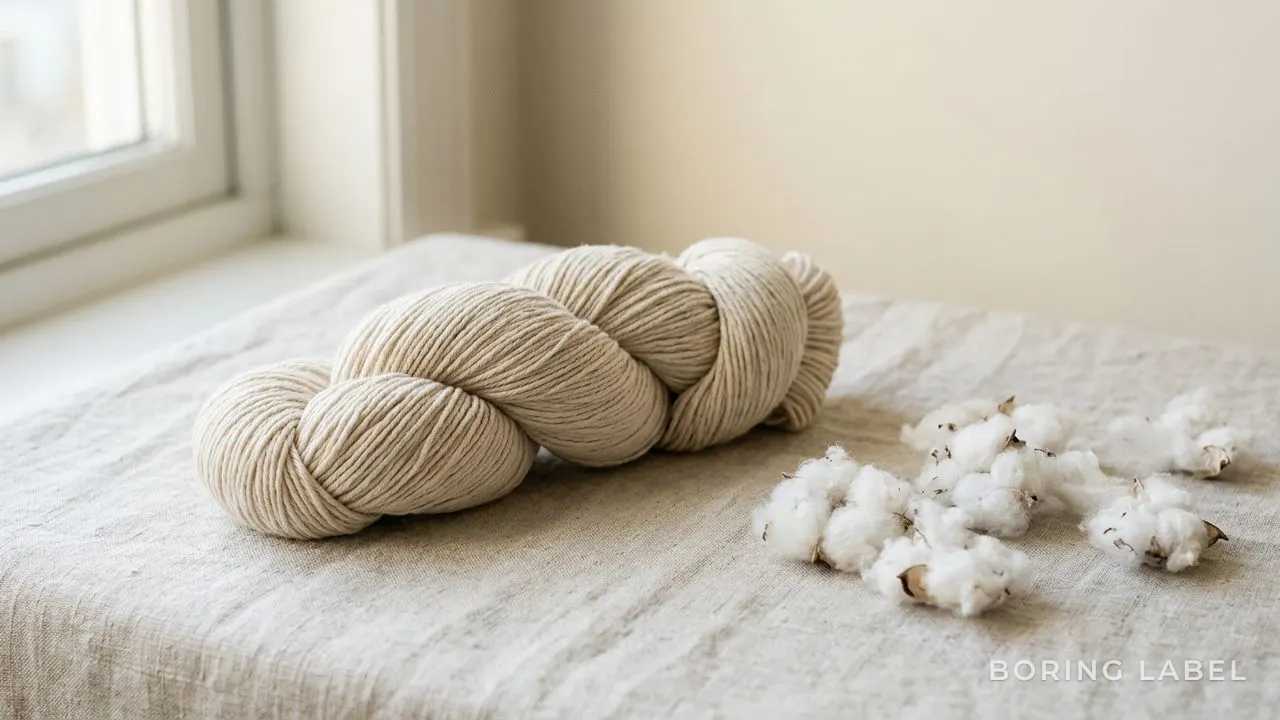
These four terms are all pointing at the same underlying thing: the length of the raw cotton fibre before anything is done to it. This is the foundation that sets the ceiling for everything else, so it is worth understanding plainly.
Cotton fibres come in different lengths depending on the plant variety. Ordinary upland cotton, the kind in most of the world's t-shirts, has fibres around twenty millimetres long.
Long-staple cottons have noticeably longer fibres - roughly thirty-five to thirty-eight millimetres. That extra length matters because longer fibres can be twisted more securely into yarn, leaving fewer loose ends to fuzz and pill, and producing a stronger, smoother, finer strand.
Long fibre is an advantage you cannot add later; it is decided by which cotton you grow.
The branded names are simply long-staple cottons with provenance:
- Supima is a trademarked name for long-staple Pima cotton grown in the United States. The trademark exists specifically to certify that the cotton is what it claims to be, which makes it one of the more verifiable quality terms on a label.
- Pima is the broader category of long-staple cotton (Supima is certified American Pima).
- Egyptian cotton refers to long-staple cotton grown in Egypt, though the name is used loosely enough that it is worth a little caution - the phrase alone is not a guarantee the way a trademark is.
The honest caveat: long-staple cotton sets a high ceiling, but it does not guarantee a great tee on its own. Long-staple cotton knitted too thin still clings; long-staple cotton finished carelessly can still disappoint.
It is the foundation, not the finished building. That said, long-staple cotton is almost always combed and ring-spun too, because no sensible maker pays for premium fibre and then spins it badly.
So when you see Supima or genuine Pima, you are usually looking at the top of the range - which is exactly the cotton we chose for our round-neck tee.
Verdict: meaningful and largely trustworthy, especially trademarked Supima. The best foundation a tee can have, with the caveat that foundation is not the whole house.
GSM
GSM stands for grams per square metre, and it is the number that gets the most attention precisely because it is a number. People treat it as a quality score.
It is not. It is a weight.
GSM tells you how much cotton is in a given area of the fabric - how heavy and dense the cloth is. A 140 GSM tee is light and airy; a 180 GSM tee is a solid mid-weight; a 220 GSM tee is heavy and structured.
That is genuinely useful information, because weight changes how a tee drapes, how opaque it is, how warm it feels, and how substantial it reads. For Indian heat in particular, a sensible mid-weight tends to beat both the flimsy and the heavy extremes, which is the whole subject of our GSM guide.
But here is the misunderstanding worth killing. A high GSM does not mean a good tee.
You can have a heavy, substantial tee that pills and fuzzes within a month because the cotton was carded and cheap. You can have a lighter tee in beautiful combed long-staple cotton that outlasts it for years.
GSM measures how much fabric you are getting, not how good that fabric is. The weight and the fibre quality are two completely independent levers, and a high number on one tells you nothing about the other.
There is even a small trap in the number itself: heavier is sometimes used to imply premium, when in a hot climate a too-heavy tee is simply less wearable. More grams is not more value if you cannot comfortably wear it half the year.
| What GSM tells you | What GSM does not tell you |
|---|---|
| How heavy and dense the cloth is | Whether the cotton is combed or carded |
| Roughly how opaque and structured it feels | Whether it will pill or stay smooth |
| How warm or cool it will likely wear | Whether the fibre is long-staple or short |
| A sensible filter for your climate | How long the tee will actually last |
Verdict: meaningful but narrow, and badly misread. Use GSM to match a tee to your climate and the look you want, never as a stand-in for quality.
Single Jersey
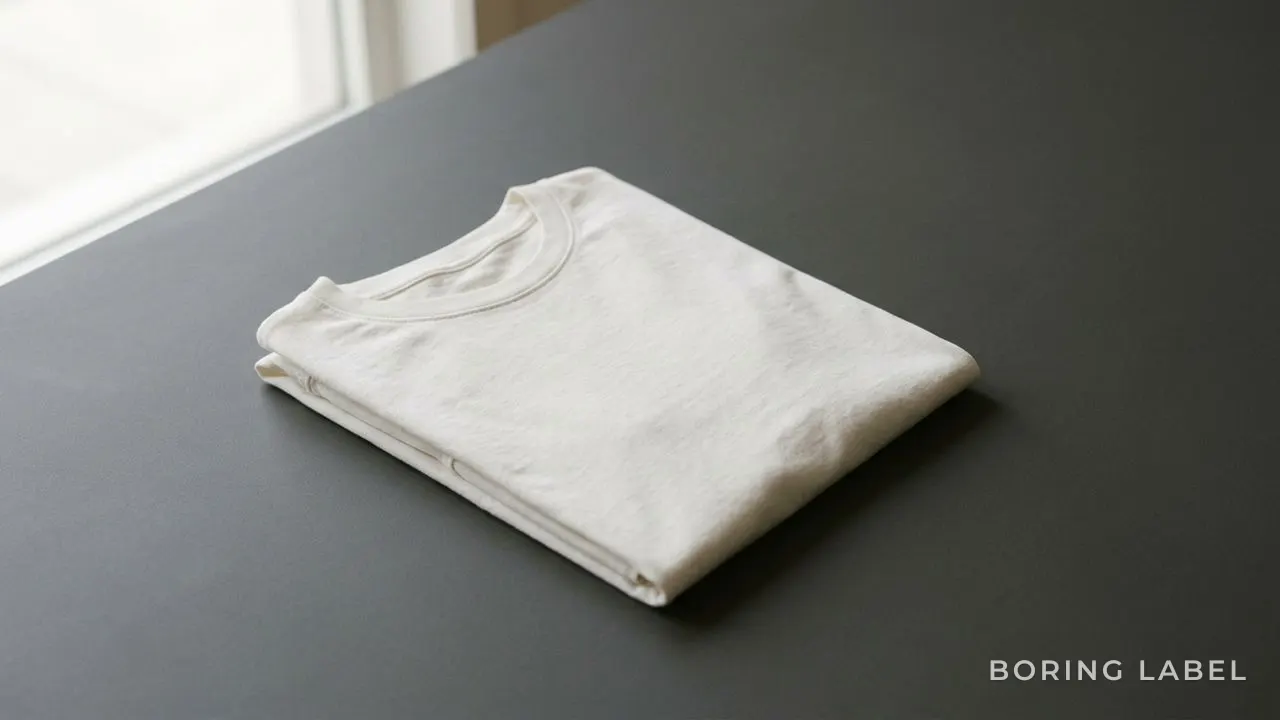
Single jersey describes the knit structure - the way the yarn is looped together into cloth - and for t-shirts it is the default you will see most often.
A single jersey is knitted on one set of needles. It has a smooth face on the front and a slightly looped, textured back, and it is light, breathable, and stretchy in one direction.
This is the classic t-shirt fabric: most everyday tees are single jersey because it drapes softly, breathes well, and suits warm weather. So seeing single jersey on a label is not a downgrade - it is simply telling you it is a normal, breathable t-shirt knit rather than something heavier.
For contrast, the alternatives are worth a quick mention so the term has meaning. Double jersey, or interlock, is knitted on two sets of needles, so it looks the same on both sides and feels thicker, denser, and more stable.
It holds its shape better and resists curling at the edges, but it is warmer and heavier - better for structured pieces than for a hot-climate everyday tee. There are also pique knits (the textured surface you see on polo shirts) and waffle and rib knits used for texture and cuffs.
The one honest quirk of single jersey: cut edges tend to curl, which is normal and not a defect - it is just how the structure behaves. A well-made tee accounts for this in how it is sewn and finished.
Verdict: descriptive and useful, not a quality claim either way. Single jersey is the right, expected choice for a breathable everyday tee; it tells you the type of fabric, not how good it is.
Pre-Shrunk
Now we move from the structural terms into the finishing terms, where the wording starts to do more concealing. Pre-shrunk is the first and most over-trusted of these.
Cotton shrinks. Knitted cotton, in particular, is held under tension during manufacturing, and the first time it meets hot water and a dryer it relaxes and contracts.
Pre-shrinking is a process - usually controlled heat, steam, and tension, sometimes a wash - meant to make most of that shrinkage happen before the tee reaches you, so it does not happen dramatically in your machine. That is a real and worthwhile thing to do, because nothing ruins a good tee faster than it turning into a crop top after one hot wash.
Here is what the word quietly does not tell you. Pre-shrunk does not mean shrink-proof.
It means most of the shrinkage has been pre-empted, not all of it - in practice a pre-shrunk cotton tee can still shrink a small amount, commonly cited in the region of a few percent, especially if you wash hot and tumble dry. So the term is honest in spirit but easy to over-read: it reduces shrinkage, it does not abolish it.
There is also a subtle overlap worth flagging. Some labels say pre-washed or garment-washed, which is related but not identical - a pre-wash actually launders the finished garment, which both shrinks it and softens it, whereas pre-shrunk can be a tension-and-heat process with no actual wash. Both reduce future shrinkage; only one necessarily softens.
Verdict: meaningful and genuinely useful, but commonly over-trusted. Read pre-shrunk as shrinkage mostly handled, then still wash cool and dry gently to protect the fit - the same care that helps any tee last, covered in how to wash t-shirts so they last longer.
Bio-Washed and Enzyme-Washed
Bio-washed - and its close relative enzyme-washed - is the term that most deserves a careful look, because it is where genuine quality and cosmetic shortcut sit closest together.
Both names describe the same family of process. The finished fabric or garment is treated with enzymes (cellulase enzymes, in practice) that gently break down the tiny fibres protruding from the surface of the cloth.
Done properly, this does two real things: it removes the surface fuzz, which makes the fabric noticeably smoother and reduces its tendency to pill, and it softens the hand of the fabric so the tee feels broken-in and pleasant from the first wear. That is a legitimate improvement, and a good bio-wash on good cotton is a lovely thing.
So why the caution? Because the same softness that bio-washing produces is exactly the softness that hides poor cotton.
A fuzzy, short-fibre carded tee can be enzyme-washed into feeling soft and smooth on the shop floor, masking the very fuzz that would otherwise warn you the cotton is cheap. The softness you feel when new is therefore an unreliable signal on its own - it can come from good fibre or from a finishing process applied to bad fibre, and your fingers cannot always tell the two apart on day one.
This is one of the quiet reasons a cheap tee can still look and feel deceptively good at first and then fall apart fast.
There is a second subtlety. A heavy enzyme wash removes surface fibre, and removing fibre, taken too far, can slightly weaken the fabric.
A light, well-judged bio-wash is purely beneficial; an aggressive one chasing maximum instant softness can trade a little longevity for a lot of showroom appeal. You cannot see which you are getting from the word alone.
Verdict: genuinely useful when done well, but the single most over-relied-upon softness signal - and the easiest one to use as a mask. Treat day-one softness as pleasant but not proof. Look for the structural words (combed, long-staple) underneath the finish; those are what tell you whether the softness will last.
A Few More Words You Will Meet
These come up often enough to decode quickly, even though none deserves a full section.
Mercerised
Mercerising is a treatment with caustic soda under tension that makes cotton fibres swell and straighten, giving the fabric a slight sheen, a smoother feel, better dye uptake (so richer colour), and a little more strength. It is a real process with real effects, more common on shirting and finer cottons than on basic tees.
On a t-shirt it is a genuine quality signal, though not an essential one. Verdict: meaningful, uncommon, mildly premium.
Compact / Compact-Spun
Compact-spun cotton is a refinement of ring spinning that reduces fibre hairiness even further, producing an especially smooth, strong yarn. It is a real upgrade and a sign of attention to detail, but it is a fine distinction most shoppers will never need to chase. Verdict: meaningful but niche.
Slub
Slub cotton has deliberate irregular thick-and-thin spots spun into the yarn for a textured, casual look. Crucially, slub is an aesthetic choice, not a quality grade - it is neither better nor worse, just a different surface.
Do not mistake the texture for either luxury or defect. Verdict: descriptive, neutral, purely a matter of taste.
Organic / GOTS
Organic refers to how the cotton was farmed (without synthetic pesticides and fertilisers), and GOTS is a certification that verifies organic and environmental standards through the supply chain. This is an ethics-and-environment claim, not a feel-or-durability claim - organic cotton is not automatically softer or longer-lasting than conventional.
Of the two, a GOTS certification is far more trustworthy than the bare word organic, because it is independently verified. Verdict: meaningful for values, neutral for performance, and trust the certification over the loose word.
Combed Ring-Spun
You will sometimes see this full phrase, and it is the one you most want to find: it confirms both that the short fibres were removed (combed) and that what remained was spun well (ring-spun). When a label bothers to state both, it usually reflects a maker who did both and wants you to know. Verdict: highly meaningful - the gold phrase.
How to Read a Whole Spec Sheet in Ten Seconds
Put the glossary together and a fast, reliable reading method falls out. The trick is to weight the words correctly rather than treat them as an equal list of virtues.
First, look for the fibre and structure words, because those are decided early and cannot be faked at the end. Combed, long-staple, Supima, ring-spun - these describe what the tee is made of and how, and they set the ceiling on everything else. A tee that scores well here is fundamentally sound.
Second, read the weight (GSM) purely as a climate-and-style filter, not a quality score. Decide whether you want light, mid, or heavy for how and where you will wear it, and ignore any implication that heavier is automatically better.
Third, treat the finishing words - bio-washed, pre-shrunk, enzyme-washed - as nice-to-haves that improve the experience but can also be used to paper over weak cotton. They are real, but they are the layer where shortcuts hide, so never let them outweigh the fibre words underneath.
Fourth, notice what is missing. The most revealing thing on many spec sheets is the silence.
A page that lists a wash and a GSM but never mentions combing or fibre length is usually quiet about those things for a reason. A maker who paid for good cotton almost always says so.
| Term | What layer | How much to trust it |
|---|---|---|
| Combed cotton | Fibre prep | High - the key quality word |
| Long-staple / Supima | Raw fibre | High - sets the ceiling (Supima verifiable) |
| Ring-spun | Spinning | Medium-high - good, but says nothing about combing |
| Single jersey | Knit type | Descriptive, not a quality claim |
| GSM | Fabric weight | Useful for climate, not for quality |
| Pre-shrunk | Finish | Useful, but not shrink-proof |
| Bio-washed / enzyme-washed | Finish | Real when done well; can mask poor cotton |
| Organic / GOTS | Farming / ethics | Trust the certification, not the loose word |
The deeper point is that these words are not a ranked list of features to collect. They are a chain, where the early links (fibre, comb, spin) set limits the later links (weight, wash) cannot exceed.
Get the foundation right and the finishes are genuine bonuses. Get the foundation wrong and the finishes are just decoration on a tee that will let you down.
If you want to see how this same logic plays out in the price, our breakdown of where a t-shirt's price actually goes traces which of these decisions cost real money and which are cheap to claim.
What the Words Are Really For
Strip away the jargon and a t-shirt is a series of honest decisions about cotton: which fibre, how cleaned, how spun, how knitted, how heavy, how finished. Every term on a spec sheet is a label for one of those decisions.
The vocabulary is not the problem. The problem is that the same words can be used by someone who made every decision carefully and by someone who made them cheaply and reached for reassuring language to cover the gap.
Now you can tell the difference. You know that fibre and structure words - combed, long-staple, ring-spun - describe choices made early that cannot be faked later, and that they matter most.
You know GSM is a weight, not a grade, and that heavier is not the same as better, especially in heat. You know pre-shrunk reduces shrinkage rather than abolishing it, and that bio-washed delivers real smoothness but can also disguise poor cotton behind day-one softness.
And you know that the most honest signal on any page is often what it declines to mention.
That is the whole skill: read the words in the right order, weight the foundation above the finish, and notice the silences. A spec sheet read this way stops being an exam you hope to pass and becomes a short, legible story about how a tee was actually made.
The makers worth buying from are the ones whose story holds up under that reading - who name the cotton, comb it, spin it well, and tell you so plainly, because they have nothing to hide behind a soft finish. Once you can read the label, you can stop trusting the adjectives and start trusting the cotton.
Boring Label
Wear the point of the article.
One honest tee. Heavyweight combed cotton, a collar that holds, a fit that actually fits. No logo, no noise.
Shop the round-neck teeFree shipping across India · Easy returns
Keep reading
T-Shirt GSM Guide: What the Number Really Means
GSM is the most quoted, least understood number on a tee. Here is what it actually predicts about quality.
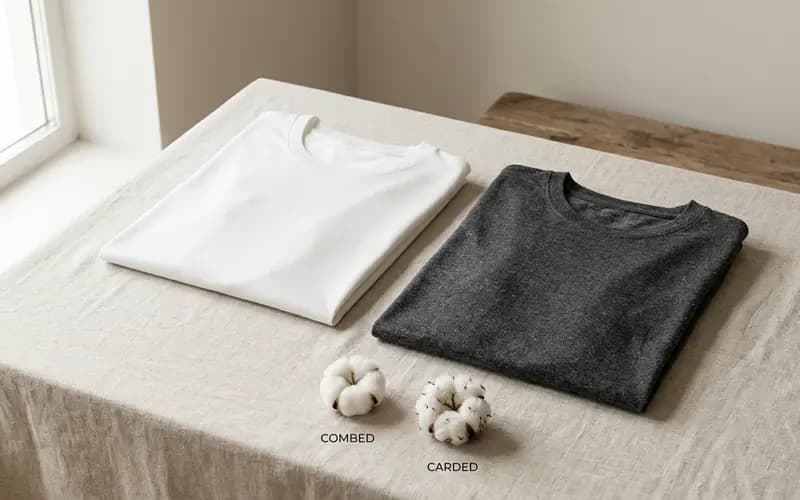
Combed Cotton vs Carded: Why It Matters
One extra step removes the short fibres that make a tee fuzz, pill, and weaken. That step is combing.
Do Cotton T-Shirts Shrink? Why, How Much & How to Stop It
Why cotton tees shrink, how much to expect, and the simple care routine that keeps a good tee its size.
Stay in the loop
New writing, no noise
Occasional notes on fit, fabric, and dressing simply well. No spam, unsubscribe anytime.
Subscribe