Capsule
The one-in-one-out rule: keeping a capsule from regrowing
Capsule wardrobes quietly regrow within a year without a maintenance habit. The one-in-one-out rule is the simplest system that keeps one in place.

A capsule wardrobe fails within a year unless one rule protects it
You spent a weekend decluttering, built a tight capsule of pieces you actually wear, and felt genuinely lighter for it. Eleven months later the drawer is stuffed again and you cannot explain how.
This is the single most common failure mode of capsule wardrobes, and it has nothing to do with willpower. It happens because decluttering is a one-time event, but shopping is an ongoing habit, and nothing was put in place to keep the two in balance.
The fix is a simple rule borrowed from minimalist practice generally and applied specifically to clothing: one in, one out. Every new item that enters the wardrobe means one existing item leaves it, no exceptions, no "I'll deal with it later."
This piece explains why the rule works, how to actually run it without it becoming a chore, and how it connects to the broader ideas in our declutter your wardrobe and capsule wardrobe for women guides.
Why a capsule wardrobe regrows on its own
A wardrobe is not a fixed container with a lid that closes. It is an open system that things enter faster than they naturally leave, because clothes rarely announce their own retirement.
A t-shirt does not stop being wearable the day it becomes redundant. It just sits there, technically fine, quietly duplicating three other tees you already own, until you own thirty shirts again and cannot explain when it happened.
Meanwhile, new items keep entering: a sale you could not resist, a gift, a "just in case" purchase for an event that may or may not happen. Each individual addition feels harmless. The accumulation is never a single decision, which is exactly why it is so hard to catch in the moment.
This is the core insight the one-in-one-out rule addresses. It does not try to stop you from buying anything new, which rarely works long-term and usually backfires into a rebound spree. It forces every addition to be paired with an equal subtraction, so the wardrobe's size becomes a maintained state rather than a one-time achievement that decays.
How the rule actually works, step by step
The mechanics are simple, but the discipline is in applying them consistently rather than as an occasional afterthought.
- Before you buy, ask what leaves. Not after the purchase, before it. If you cannot immediately name the item that will go, that is useful information about whether you actually need the new piece.
- The exit item should be genuinely comparable. Replacing a worn-out white tee with a new white tee is a clean swap. Replacing it with a new black hoodie and calling a random old t-shirt the "exit" is technically following the letter of the rule while missing its point.
- Retire the old item immediately, not eventually. Bag it, donate it, or repurpose it within the same week. An item marked for exit that sits in the wardrobe for months defeats the entire purpose, because it is still taking up space and mental bandwidth.
- Track it loosely, not obsessively. A simple note on your phone, or even just a mental habit before checkout, is enough. You do not need a spreadsheet for this to work.
The rule is deliberately symmetrical and deliberately simple, because complicated systems get abandoned within a month. Ours works precisely because it asks one question at one moment: before you buy, what goes.
Where the exiting item should actually go
Retiring an item well matters as much as retiring it at all, because "it left my wardrobe" and "it went to landfill" are very different outcomes.

Repair first, if it is worth it. Sometimes the item you are about to retire is actually one small fix away from staying useful, in which case retiring it may be premature. Our piece on repair culture and your neighbourhood tailor covers when a ten-minute, under-₹100 repair beats retirement outright.
Donate what is still genuinely wearable. Local shelters, NGOs, and clothing donation drives across most Indian cities take gently used basics, and a t-shirt with real life left in it is far more useful to someone else than sitting folded in your own drawer.
Repurpose what is past donating. A worn-out cotton tee makes a perfectly good cleaning rag, a gym towel substitute, or fabric scrap for other household use, which is a better end than the bin for something with genuine years of cotton fibre left in it.
Recycle through textile recovery where available. Several Indian cities now have textile recycling drop points through brands and NGO partnerships, which is worth using for items too worn for donation but not yet at the "cleaning rag" stage.
Our wardrobe declutter guide goes deeper on sorting logic for a first-time big clear-out; the one-in-one-out rule is really the maintenance layer that keeps you from needing that big clear-out again in twelve months.
The psychology behind why this works better than "just buy less"
Telling yourself to "buy less" is a vague, effortful instruction that competes against genuine advertising pressure, social proof, and the small dopamine hit of a new purchase, every single time you shop. Vague resolutions lose to specific triggers most of the time, which is well documented in behavioural research on habit formation.
The one-in-one-out rule works differently because it converts a vague resolution into a concrete, checkable action tied to a specific moment: the point of purchase. You are not trying to resist buying in the abstract.
You are answering one specific, low-effort question right before checkout: what is leaving to make room for this. That question does two things at once.
It forces a moment of reflection that a frictionless "add to cart" click otherwise skips entirely. And it makes the true cost of a purchase visible, not just in money but in wardrobe space, which is often the more honest cost that drives regret later.
Our piece on items you never wear explores exactly what happens without this friction: closets quietly fill with purchases that felt necessary at checkout and forgettable within a month.
When the rule should flex, and when it should not
Rules that never bend get abandoned the first time life does not cooperate, so it is worth being clear about legitimate exceptions versus excuses dressed up as exceptions.
Legitimate flex: genuine category gaps. If you have zero warm layers going into winter, or you have lost significant weight and none of your current tees fit anymore, buying without an immediate one-out swap is filling a real gap, not growing the wardrobe past its intended size. In these cases, do a batch review afterward: buy what you need, then do one deliberate purge pass to bring the total count back to where you want it.
Not a legitimate flex: "it was a really good deal." Sale pricing is the single most common reason people override their own rules, and it is worth naming explicitly as the trap it is. A discount does not change whether you need the item; it only changes what you paid for something you may not have needed regardless.
Not a legitimate flex: gifts you did not ask for. Gifts are genuinely tricky, since declining feels rude, but the rule still applies once the gift is in your hands. If a new gifted tee enters the drawer, something else leaves, exactly as if you had bought it yourself.
What size wardrobe the rule is protecting
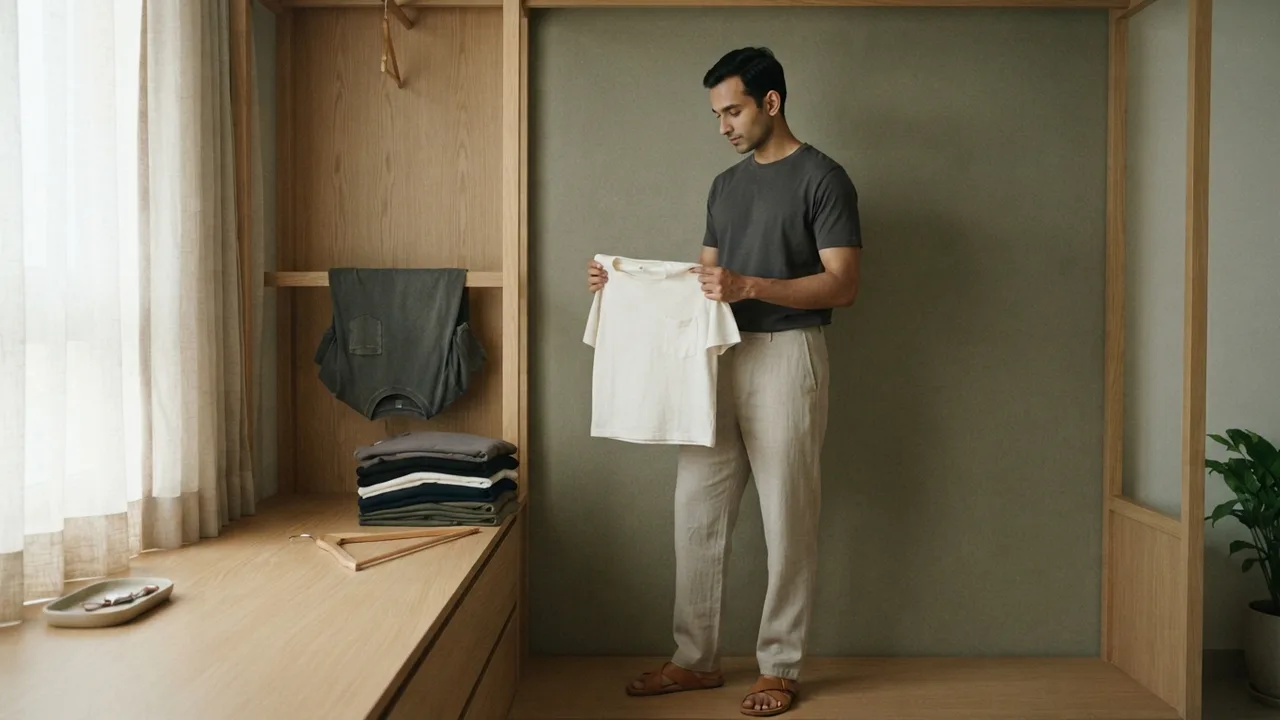
The one-in-one-out rule only makes sense once you have a target size in mind, otherwise "one out" has no real anchor. Our guide on how many t-shirts you actually need walks through a practical range for most people, generally landing between eight and fourteen everyday tees depending on laundry frequency and lifestyle.
Once you have settled on a number that fits your actual week, the one-in-one-out rule is what keeps you there permanently, rather than the number being a one-time target you drift away from within a season. This is the same logic behind uniform dressing, where a small, deliberately chosen rotation removes decision fatigue precisely because it stays small.
Building the rule around pieces worth keeping
The rule works best, and feels easiest to follow, when the wardrobe it is protecting is made of pieces genuinely worth the effort of holding onto. A capsule of fast-fashion basics that fall apart within a season makes one-in-one-out feel like a losing battle against your own clothes' short lifespan.
A wardrobe built around durable, well-made basics, the kind that survive the 30-wash durability test rather than thinning out by month three, makes the rule genuinely sustainable rather than a constant chore of premature replacement. This is why we build our round-neck tee to hold its shape and colour well past the point most basic tees start looking tired, so that the "out" side of your ledger stays a rare, deliberate event rather than a monthly necessity. Our care page covers the washing habits that stretch that lifespan even further.

A simple way to start this week
If the rule sounds reasonable but abstract, the easiest way to start is with your very next purchase, not a grand overhaul of your existing closet.
The next time you add a t-shirt to your cart, whether online or in a store, stop before you pay and pick the exact item that will leave your drawer to make room for it. Write its name in a note on your phone if that helps make it concrete.
Then actually follow through within the week: bag it for donation, hand it to a tailor for repair if that is the better outcome, or repurpose it as a cleaning cloth. Do this once, honestly, and the habit starts to feel automatic within two or three repeats, the same way any small daily discipline eventually stops requiring conscious effort.
You do not need to declutter your entire wardrobe today to start protecting it. You only need to make the very next purchase a swap instead of an addition, and let that one decision set the pattern for the ones after it.
The takeaway
A capsule wardrobe is not a state you achieve once. It is a habit you maintain, and the one-in-one-out rule is the smallest, most concrete habit that actually holds a capsule in place against the daily pull of new purchases.
The rule costs you nothing beyond one honest question before you buy: what is leaving. Answer it every time, retire the exiting piece properly rather than letting it linger, and the wardrobe you built during that one good weekend will still be the wardrobe you have a year from now, not a memory of what it briefly looked like.
Boring Label
Wear the point of the article.
One honest tee. Heavyweight combed cotton, a collar that holds, a fit that actually fits. No logo, no noise.
Shop the round-neck teeFree shipping across India · Easy returns
Keep reading
How to Declutter Your Wardrobe (and Keep It That Way)
Decluttering is easy once; keeping it decluttered is the real skill. Here is the system.
How Many Plain T-Shirts Does a Man Need?
Do the laundry maths, land on your real number, and discover why repetition beats variety in the drawer.

Repair Culture: The Case for Your Local Tailor
A neighbourhood tailor can fix most t-shirt damage for under Rs 100. Here is what is worth repairing, what is not, and why repair beats replacing.
Stay in the loop
New writing, no noise
Occasional notes on fit, fabric, and dressing simply well. No spam, unsubscribe anytime.
Subscribe