Capsule
A Drawer Full of Tees You Never Wear - Why It Happens and How to Fix It
Decluttering empties the drawer. The rebuy decision is what stops it refilling with tees you never wear.
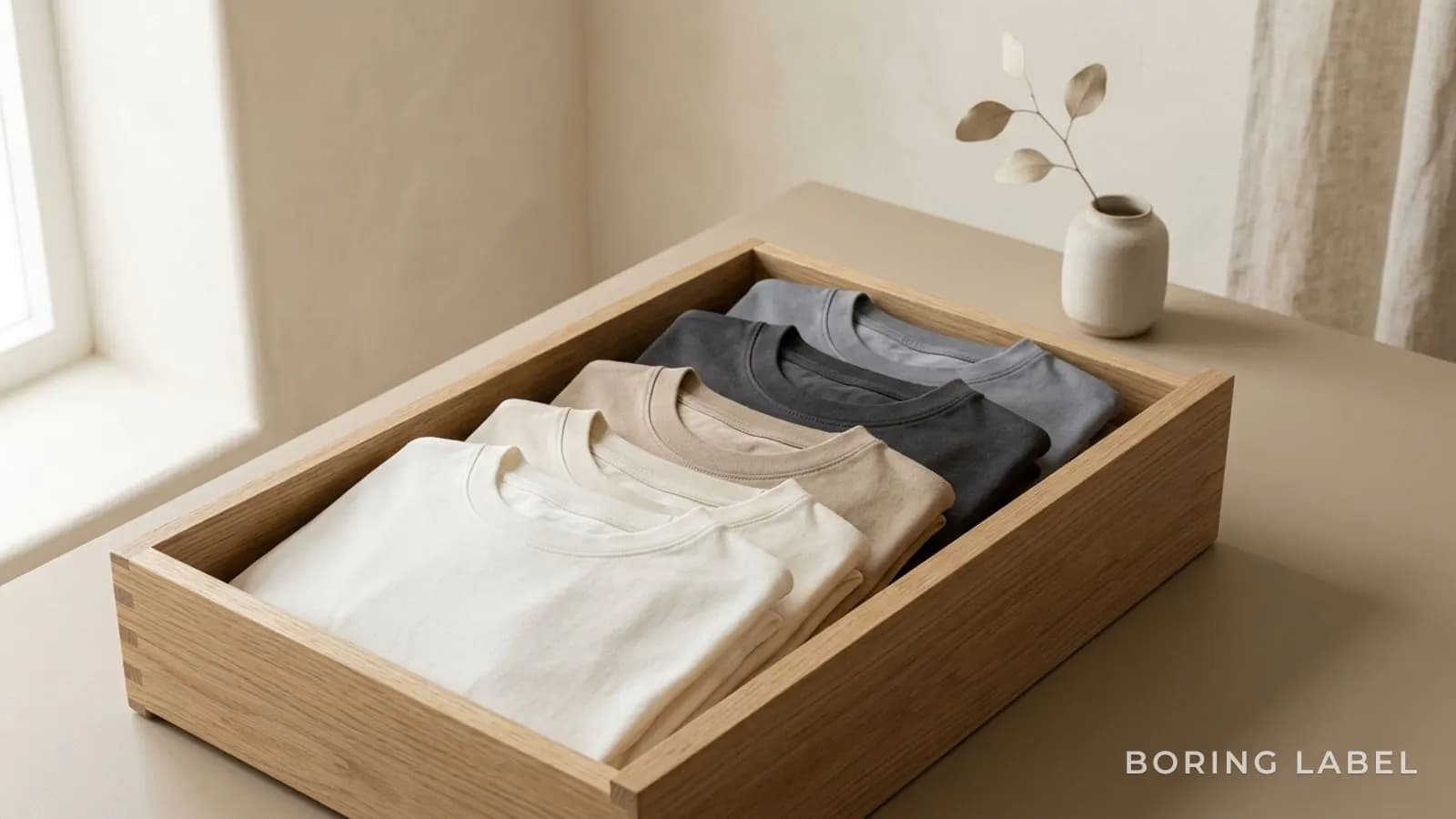
The Drawer You Already Know About
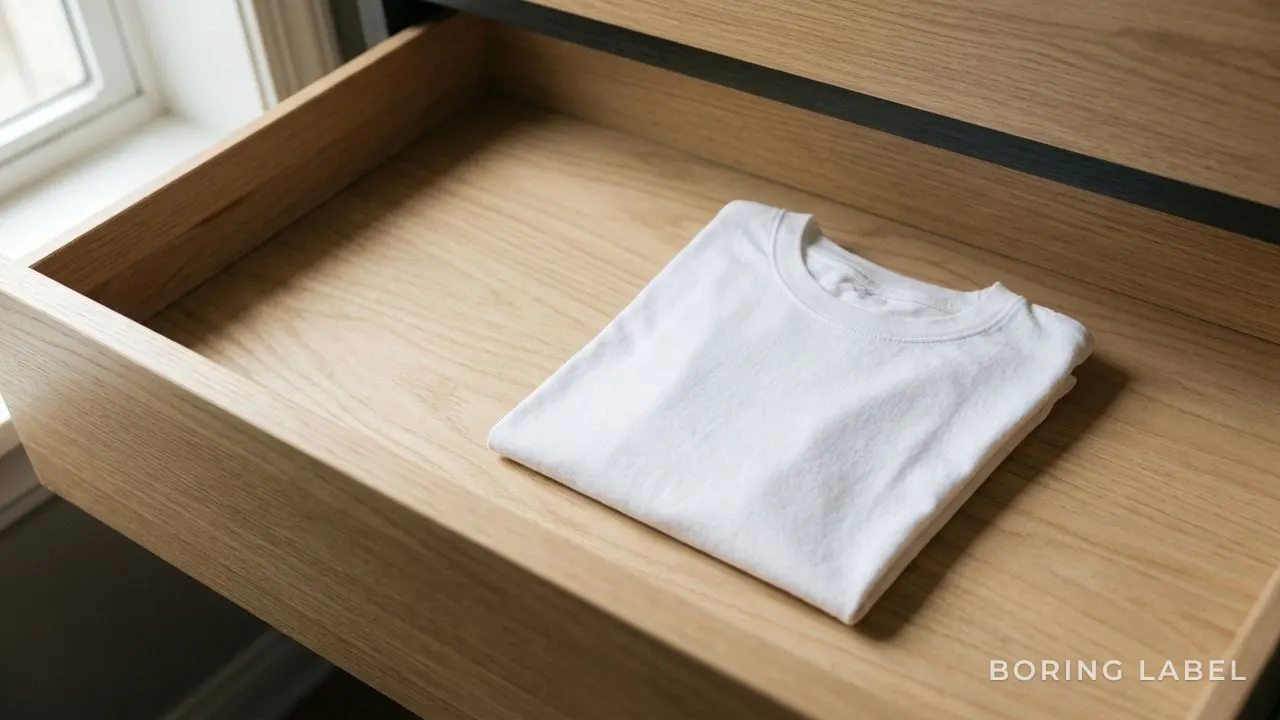
You have a drawer like this. Most people do.
It is the one you open every morning, push a few things aside, and pull out the same three or four tees you actually wear. The rest just sit there - a soft, folded archive of decisions that did not work out.
A colour that looked good on a screen and wrong on you. A fit that seemed fine in the trial room and felt off by lunchtime.
A tee you genuinely loved once, now so thin and bobbly you would not wear it outside the house. None of it gets worn.
None of it gets thrown away either. It just stays.
This is one of the most common quiet frustrations in any wardrobe, and it almost never gets named properly. We talk endlessly about what to buy and barely at all about why we keep things we will never put on again.
The result is a drawer that is full and useless at the same time - the clothing equivalent of a fridge stuffed with food you will not eat. You are not short of tees.
You are short of tees you reach for.
This piece is about fixing that, and specifically about the decision most people skip: not just what to clear out, but what to rebuy. Decluttering empties the drawer.
It does not stop it filling back up with the same mistakes. The real skill is learning why dead stock accumulates, sorting honestly what stays from what goes, and then rebuilding the gap with a small number of basics reliable enough that they never become dead stock again.
That last step is where the drawer actually gets fixed.
Why the Dead Tees Pile Up in the First Place
Before you can clear a drawer sensibly, it helps to understand why it filled with things you do not wear. This is not laziness or bad taste. It is a handful of very ordinary mental habits, and once you can name them, they lose most of their grip.
The first is the sunk-cost trap. You paid for the tee, so getting rid of it feels like admitting you wasted the money.
Keeping it lets you avoid that admission, even though the money is gone either way. The discomfort is real - researchers who study this describe the act of discarding something you paid for as genuinely unpleasant, close to a small loss.
So the unworn tee stays in the drawer as a way of not feeling that loss, which is why a drawer of dead stock is really a drawer of postponed decisions.
The second is the endowment effect: we value things more simply because we own them. The same tee you would not buy again at full price feels harder to give away once it is yours.
Ownership inflates its worth in your head, so you keep weighing it against an imaginary version that might still come good - the day you finally style it right, the trip you will pack it for, the weight you plan to lose. That day rarely arrives, but the possibility of it keeps the tee in the drawer.
The third is the quietest and the most powerful. A lot of unworn clothing represents a version of yourself you were trying to become and did not.
The bold colour you bought to be a bolder person. The tight fit for the body you meant to have.
The trend piece for the version of you that follows trends. Letting those go means gently admitting that person did not turn up, and that is a small grief, not a wardrobe task.
It is also why the hardest tees to part with are often the ones you have worn the least - they carry the most unspent hope.
Stack those three together and you get the typical drawer. Commonly people notice they wear a small fraction of what they own most of the time - the often-quoted idea that you wear roughly twenty percent of your clothes eighty percent of the time.
The exact ratio does not matter and is not a hard fact; the pattern is what is real. A few tees do nearly all the work, and the rest are kept for reasons that have nothing to do with wearing them.
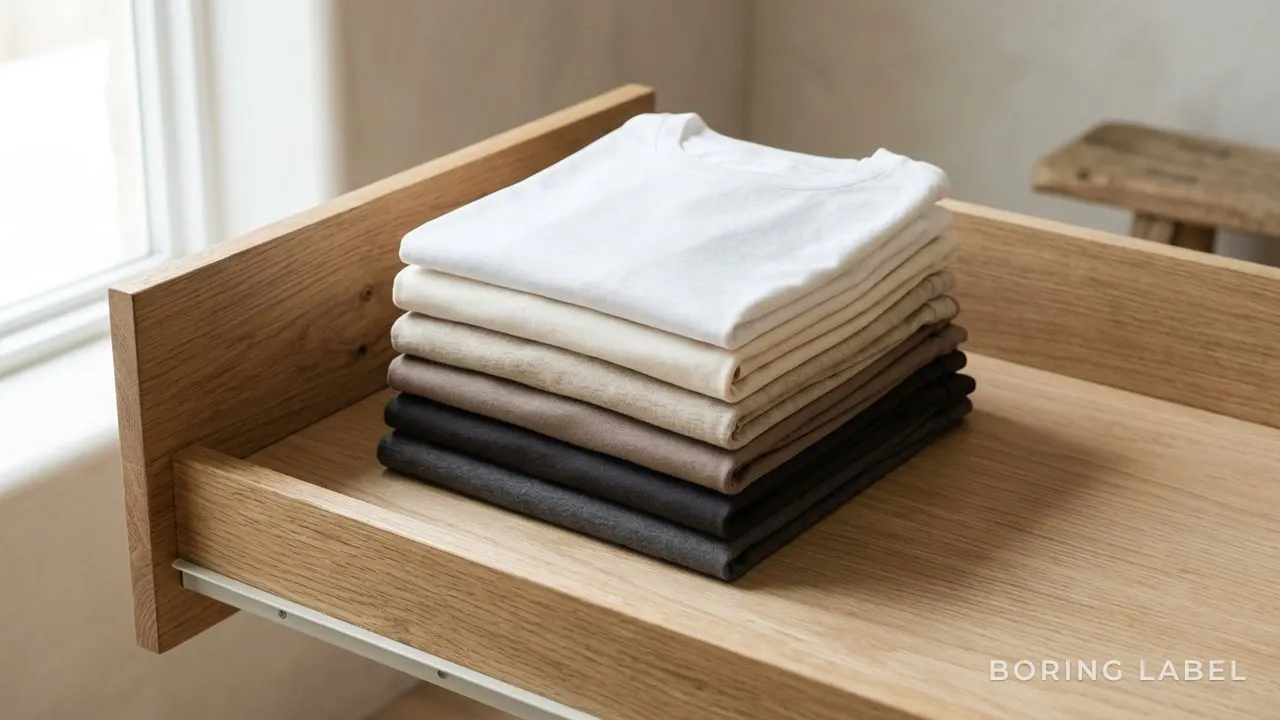
The Honest Audit: Three Piles, One Rule
The way out is not a vague decluttering mood. It is a short, deliberate audit with a single governing question.
Take every tee out of the drawer and put it on the bed - all of it, so you can see the true volume. Then pick up each one and ask one thing: would I wear this, as it is right now, this week, if it were clean and in front of me?
Not would I wear it someday. Not did I love it once.
Not could I wear it if I lost weight or styled it differently. Would I wear it this week, as it is.
That present-tense framing cuts straight through sunk cost and the endowment effect, because it ignores what you paid and what you hoped and asks only what you actually do. Sort into three piles as you go.
Pile One: The Keepers
These are the tees you already reach for - the three or four that do most of the work, plus any genuine favourites that still look good. They fit right, the colour suits you, the fabric is still smooth and the shape has held.
You wear them without thinking. This pile is usually smaller than people expect and it is the most important one, because it is your real wardrobe.
Everything else is either supporting it or pretending to.
Look hard at this pile, because it is also your shopping list in disguise. The tees you keep tell you exactly what works for you - the necks, the weights, the colours, the fit. We will come back to that, because it is the single most useful output of the whole exercise.
Pile Two: The Wrong Ones
These fit your body or your life wrongly and no amount of waiting will fix that. The neckline that sits oddly.
The fit that is too tight or too boxy for how you actually dress. The colour that drains your face.
The fabric that felt cheap from day one and pills if you look at it. The novelty print you have outgrown.
Be ruthless here, because every one of these is a decision you already made and got wrong, and keeping it does not unmake the mistake - it just stores it.
The useful move is to learn from this pile rather than mourn it. A wrong-fit tee is information: it tells you which cut not to buy again.
A wrong-colour tee tells you which shade to avoid. Read the pile before you bag it.
If you want a sharper eye for why some of these read as cheap, the signals in why a t-shirt looks cheap will help you spot the same problem in a shop before you buy it again.
Pile Three: The Worn-Out Ones
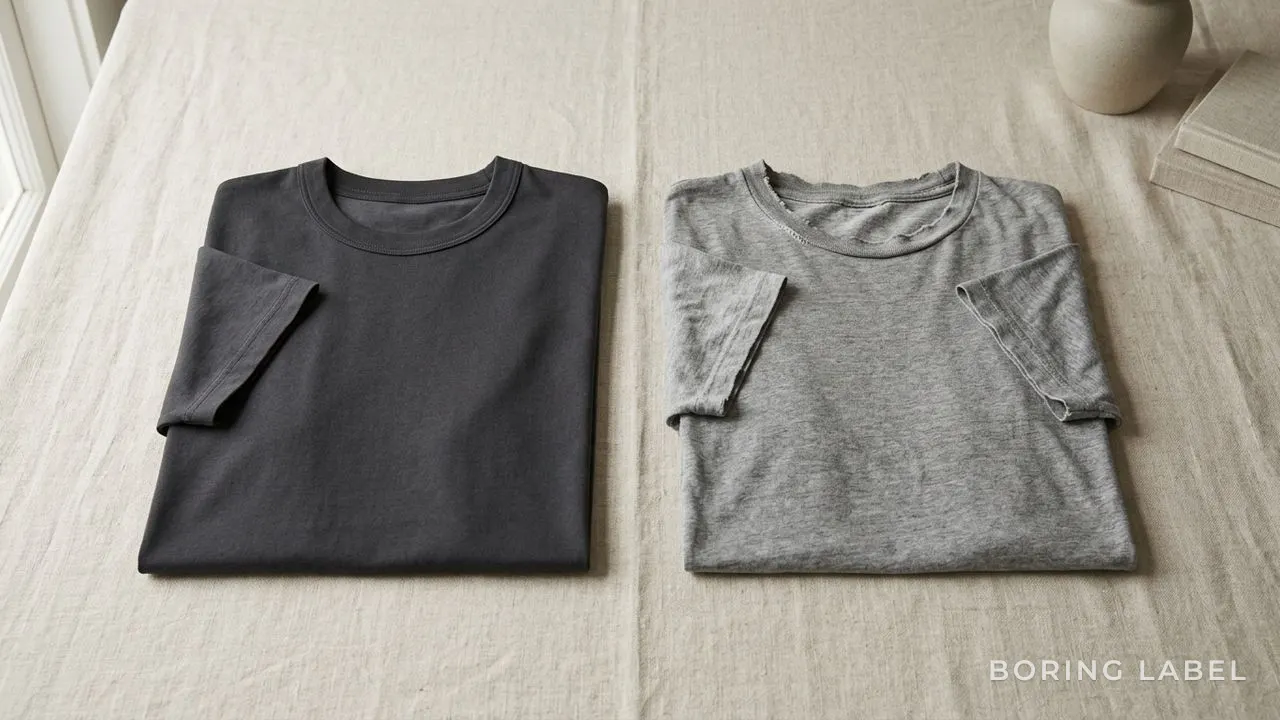
These are tees you loved and used well, now past saving. Thin and see-through at the shoulders.
Greying at the collar. Stretched out of shape at the neck.
Pilled all over the body. These are not mistakes - they are the opposite, the tees that earned their keep and then wore out, which is exactly what a good basic is supposed to do.
They feel hard to discard precisely because they served you, but a worn-out tee in the drawer is not a keeper. It is a gap pretending to be filled.
This pile matters most for the rebuy decision, because it tells you which tees you wear so hard that you destroy them. That is not a warning.
That is a green light. A tee you wore to death is a tee worth replacing with a better version of the same thing.
What Stays, What Goes - The Decision Rules
Three piles are easy. The borderline calls are where most audits stall, so here are simple rules for the tees that do not sort themselves.
If you have not worn it in a full year, it goes. A year covers every season and every occasion you actually have.
A tee you skipped through all of them is not waiting for its moment; its moment came and you chose something else, every time. The only fair exception is genuinely occasion-specific clothing, and a plain tee almost never qualifies.
If it does not fit the body you have today, it goes. Not the body you had, not the body you are planning.
Clothes that fit the present are worn; clothes kept for a future body sit unworn and quietly nag at you every time you open the drawer. If your size changes later, you can buy for the new body then - and you will enjoy buying fresh far more than you enjoy the guilt of the old tee in the meantime.
If you would not buy it again today at full price, it goes. This is the cleanest test for beating the endowment effect.
Forget that you already own it. Standing in a shop, money in hand, would you pick this exact tee again?
If the honest answer is no, ownership is the only reason it is still in your drawer, and ownership is not a reason to keep wearing something - it is just a reason you have not let go.
If it is worn out beyond what you would wear in public, it goes - onto the rebuy list, not back in the drawer. A tee too shabby for outside is fine as a paint rag or a gym throwaway, but it should not occupy prime drawer space pretending to be available. Demote it honestly or let it go.
What stays is short: tees you wear, in colours that suit you, in fits that work, in fabric still good enough to keep wearing. If that leaves you with very few, that is not a problem to solve by keeping the rejects.
It is the gap you are about to fill properly. A smaller drawer of things you genuinely wear is the entire goal - the logic behind it is laid out well in buy less, wear more, and it is worth holding onto as you clear.
The Step Everyone Skips: The Rebuy Decision
Here is where most wardrobe advice stops and most drawers quietly refill. You clear out fifteen tees, feel briefly virtuous, and within a few months the drawer is full of dead stock again - because the audit removed the mistakes but never fixed the buying that made them.
Decluttering is subtraction. The drawer only stays fixed when you also do the addition properly: deciding what to rebuy, and buying it well.
The rebuy decision is different from the buy decision because you are not guessing any more. You have just done an audit.
You are holding the data - three piles that tell you precisely what works on your body and in your life and what does not. Most shopping is hope.
Rebuying after an honest audit is the rare moment when you actually know. The trick is to use that knowledge instead of wandering back into the same shops in the same vague mood that filled the drawer the first time.
Start from the keepers and the worn-out pile, not from the shop. Those two piles are your brief.
The keepers tell you the exact specification of a tee you will wear - this neckline, this weight, this colour family, this fit. The worn-out pile tells you which of those you wear hard enough to destroy, which is to say which ones are worth buying again, possibly in a better version.
Between them they describe a small, specific set of tees you know you will reach for, because you already do. That is a shopping list built from evidence rather than aspiration.
Rebuy the Roles, Not the Items
Think in roles, not in individual shirts. A worn-out white crew is not really one item to replace - it is a role in your wardrobe: the clean white tee that goes under everything and stands alone in summer.
A faded black tee is the role of the easy dark layer that hides everything and dresses up or down. When you rebuy a role rather than a specific old shirt, you stop chasing the exact thing you lost and start asking the better question: what is the most reliable version of this role I can own, so I do not have to rebuy it again for years?
That reframing changes what you look for. For a role you wear constantly and wash weekly, you want the version that survives that punishment - smooth long-staple combed cotton that resists pilling, a sensible mid-weight that is not see-through, a fit that flatters the body you have now.
For a role you wear rarely, you can spend less, because cost-per-wear forgives a cheap tee you barely touch and punishes a cheap tee you live in. The maths behind that trade-off is worth internalising; cost per wear makes the case plainly, and it is the number that should govern every rebuy.
Buy the Boring Version on Purpose
The tees that become dead stock are almost always the interesting ones - the bold colour, the unusual cut, the print. The tees that survive every audit are almost always the boring ones - the plain crew in a colour that suits you, in a fit that works, in fabric that lasts.
So when you rebuy, lean deliberately boring. The plain tee is the workhorse precisely because it has nothing to date, nothing to clash, nothing to tire of.
It is the opposite of the impulse buy, and that is exactly why it stays in rotation while the exciting purchases gather dust.
This is the core of building a wardrobe that does not refill with regret. A small set of reliable, plain, well-made basics in your proven colours and fits will out-wear a large set of interesting ones every time. The full logic of that approach is laid out in the minimalist capsule wardrobe for men, but the short version is simple: rebuy fewer tees, more boring, much better, and the drawer stops being a graveyard.
A Practical Rebuy List From a Typical Audit
To make this concrete, here is what the rebuy list usually looks like after an honest audit, for most people most of the time. Yours will differ in the details, but the shape tends to hold.
| Role | Why it earns a rebuy | What to look for |
|---|---|---|
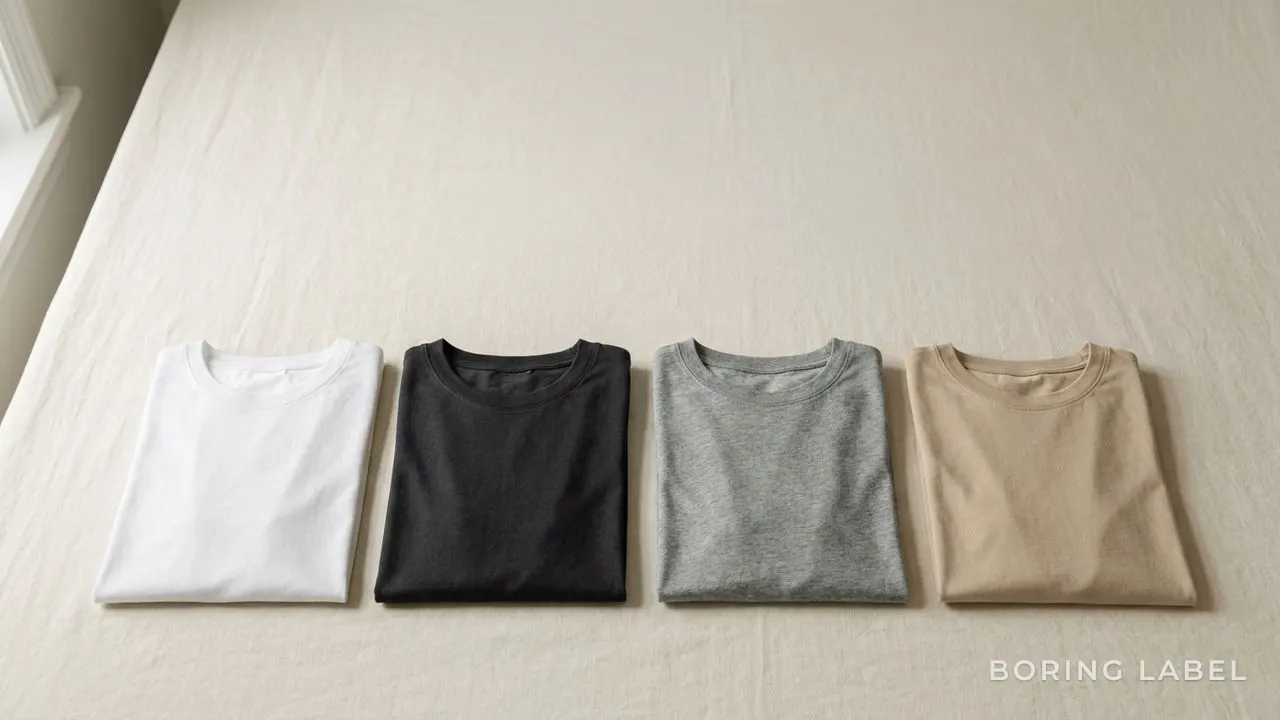
| Plain white crew | The hardest-working tee, worn under things and alone, washed constantly | Smooth combed cotton, mid-weight so it is not see-through, fit that suits you |
| Plain black crew | The easy dark layer, hides everything, dresses up or down | Deep black that resists fading, same trusted fit, durable fabric |
| A neutral mid-tone | Quiet variety without buying loud colours - grey, navy, sand, olive | A shade you proved suits you in the keepers pile, not a screen-bought guess |
| A second white | Whites wear out and grey fastest, so the role often needs a spare | Identical spec to your proven white so they are interchangeable |
Notice what is not on the list: anything you only thought you might wear. The rebuy list is built strictly from roles you already wear hard enough to wear out.
If a colour or a cut never made it into your keepers pile across a whole year, it does not belong on the rebuy list either, however tempting it looks in a shop. Choosing the right small set of shades is its own small skill, and essential t-shirt colours is a sensible place to settle that before you spend.
The quiet power of this list is its smallness. Four or five tees, all plain, all in colours and fits you have already proven on your own body, all in fabric chosen to last.
That is a drawer that works every morning and refills with nothing you will not wear, because everything in it earned its place by evidence. The opposite - a constant trickle of interesting tees bought on impulse - is exactly the machine that produced the dead stock you just cleared.
Why Reliable Basics Never Become Dead Stock
It is worth being precise about why a plain, well-made tee resists the dead-stock fate while an interesting one tends to fall into it. This is not aesthetic preference. It is a few concrete properties that determine whether a tee gets worn or abandoned.
A reliable basic goes with everything, so it is never stranded. Most dead stock is dead partly because it only worked with one other thing you owned, and once that thing was in the wash or gone, the tee had no role.
A plain tee in a neutral colour pairs with whatever else is clean, which means there is no morning where it is the wrong choice. That alone keeps it in rotation.
The same thinking is why uniform-style dressing works so well, and uniform dressing explains how leaning into a small repeatable set of pieces removes the friction that strands clothes in the first place.
A reliable basic also holds up, which is the difference between the keepers pile and the worn-out pile being a slow story rather than a fast one. A cheap tee crosses from wearable to shabby in a few months, so even a good plain tee can become dead stock if the fabric gives out early.
Combed long-staple cotton stays smooth and resists pilling far longer, which means the tee stays in the wearable zone for years rather than weeks - it is the version of a basic that earns its place by lasting, not just by matching. If you want to understand why the fabric choice matters this much, combed cotton versus carded is the clearest explanation of what actually wears out and why.
And a reliable basic is never an aspiration, so it never carries the grief that strands the interesting purchases. You do not buy a plain tee to become a different person; you buy it to be reliably dressed as the person you already are.
There is nothing to grow into, no future self attached, no trend to time. That emotional neutrality is precisely what keeps it being worn, while the aspirational buy sits unworn waiting for a version of you that never arrives.
The plain tee asks nothing of you except that you put it on, and that is why you do.
Keeping the Drawer Honest Over Time
A clean drawer is a state, not an event. The buying habits that filled it the first time do not vanish because you did one audit, so the drawer will drift back unless you keep two small habits. Neither is hard, and together they make the fix permanent.
The first is one-in, one-out, applied honestly. When a tee wears out and you rebuy the role, the old one leaves the same week - it does not get demoted to a vague maybe-pile that is just dead stock by another name.
The drawer holds the set you actually wear, and the moment something stops being worn, it either goes back into rotation deliberately or it leaves. This keeps the count flat and the contents live, which is the whole point.
The second is buying against the audit, not against the mood. The reason the drawer filled the first time is that most tee purchases happen on impulse - a colour caught your eye, a sale was on, you fancied a change.
Every one of those is how dead stock is born. The discipline is to buy only what is on the rebuy list, only when a role actually needs filling, and to walk past the interesting tee that is not on the list however much it tempts you.
That sounds austere, but in practice it is the opposite - it is what frees you from the cycle of buying, regretting, and storing. A full account of why fewer, deliberate purchases beat constant small ones is in fast fashion versus slow fashion, and it is the mindset that keeps the drawer from refilling.
There is a deeper version of this too, which is to clear the drawer only once, properly, and then never need a big declutter again - because nothing dead ever enters it. That is the real prize.
The audit is a one-time correction; the rebuy discipline is what makes it stick. A drawer maintained this way stays small, stays worn, and stays honest, and you stop having the quiet daily friction of pushing past things you will never put on.
If you want the full method for that one-time clear-out, how to declutter a wardrobe covers the subtraction side in depth - this piece is the addition side that keeps it from coming back.
The Honest Limits
A few caveats, because pretending the method is perfect would undercut the point of an honest audit.
Buying better basics costs more per tee, and that is a real trade for some budgets. The cost-per-wear logic holds - a tee you wear two hundred times is cheap even at a higher price - but only if you actually wear it that much, and only if the fabric lasts the way it should.
If money is genuinely tight, a carefully chosen cheaper tee, washed gently, beats an expensive one bought carelessly. The premium is worth paying on the roles you wear hardest, and not on the ones you barely touch; spreading it evenly is a mistake.
Audits also catch you in a single mood on a single day, and moods change. The present-tense test is powerful precisely because it ignores the future, but occasionally it is too harsh - there is the rare tee you genuinely will want next season that you would skip today.
The fix is not to abandon the test but to allow yourself a tiny, named exception or two, not a whole pile of them. The discipline survives a couple of honest exceptions; it does not survive turning every reject into one.
And no system stops you outgrowing your own taste. The colours and fits that suit you now will shift over a few years, and the keepers pile that feels perfect today will quietly date.
That is normal and fine - it just means the audit is a thing you repeat occasionally, not a permanent solution you do once. The rebuy discipline keeps the drawer from filling with mistakes between audits; it does not freeze your taste forever, and it should not try to.
The Real Fix Is Subtraction Plus the Right Addition
The drawer full of tees you never wear is not a storage problem or a discipline problem. It is the visible residue of dozens of small buying decisions made on hope, on impulse, on a screen-true colour or a trial-room fit that did not survive contact with your actual life. Clearing it out feels good and is necessary, but clearing alone is only half the job, because the same buying habits will refill it within months if nothing else changes.
The half that actually fixes the drawer is the rebuy. After an honest audit you are not guessing any more - you are holding a precise brief written by your own wardrobe: these necklines, these weights, these colours, these fits are the ones you wear, and these are the ones you wear so hard you destroy them.
Use that. Rebuy the roles, not the items.
Buy the boring version on purpose. Choose the fabric that survives the washing you will put it through.
Buy few, buy proven, buy to last - and the drawer stops being a graveyard of aspirations and becomes a small, working set of tees you reach for without thinking.
That is the whole quiet trick. A wardrobe that works is not a large one carefully managed; it is a small one honestly chosen and reliably rebuilt.
The plain, well-made tee is the workhorse of that wardrobe precisely because it has nothing to outgrow, nothing to date, and nothing to regret - it just gets worn, washed, worn again, and eventually wears out, at which point you replace it with the same reliable thing and carry on. The drawer you never open is full of the clothes that promised to make you someone else.
The drawer that works is full of the clothes that simply let you get dressed. Build the second one, and the first one stops happening to you.
Boring Label
Wear the point of the article.
One honest tee. Heavyweight combed cotton, a collar that holds, a fit that actually fits. No logo, no noise.
Shop the round-neck teeFree shipping across India · Easy returns
Keep reading
How to Declutter Your Wardrobe (and Keep It That Way)
Decluttering is easy once; keeping it decluttered is the real skill. Here is the system.
Buy Less, Wear More: A Practical Guide
The greenest tee is the one you wear two hundred times. Buying less is the whole strategy.
Minimalist Capsule Wardrobe for Men: The Guide
A capsule is not fewer clothes for its own sake. It is a small set that combines into many good outfits.
Stay in the loop
New writing, no noise
Occasional notes on fit, fabric, and dressing simply well. No spam, unsubscribe anytime.
Subscribe