Fit
How a Great T-Shirt Drapes - and How to Judge It Before You Buy
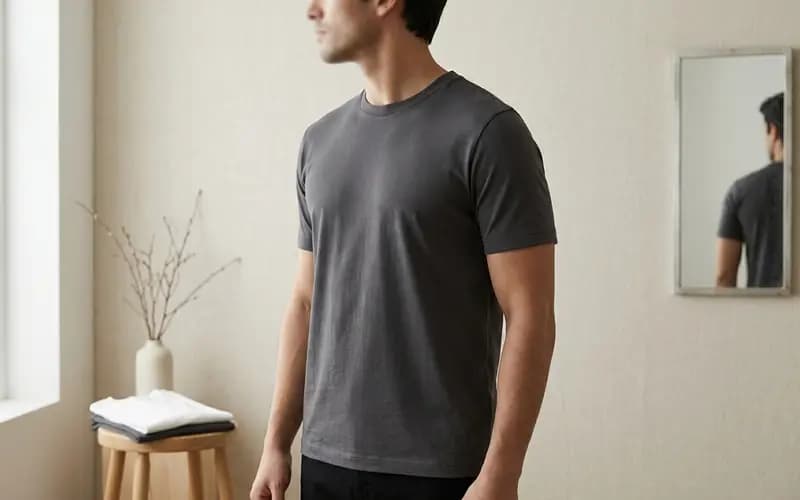
A great tee does not stand to attention. It falls. Drape is the difference between looking dressed and looking propped up.
What drape actually is
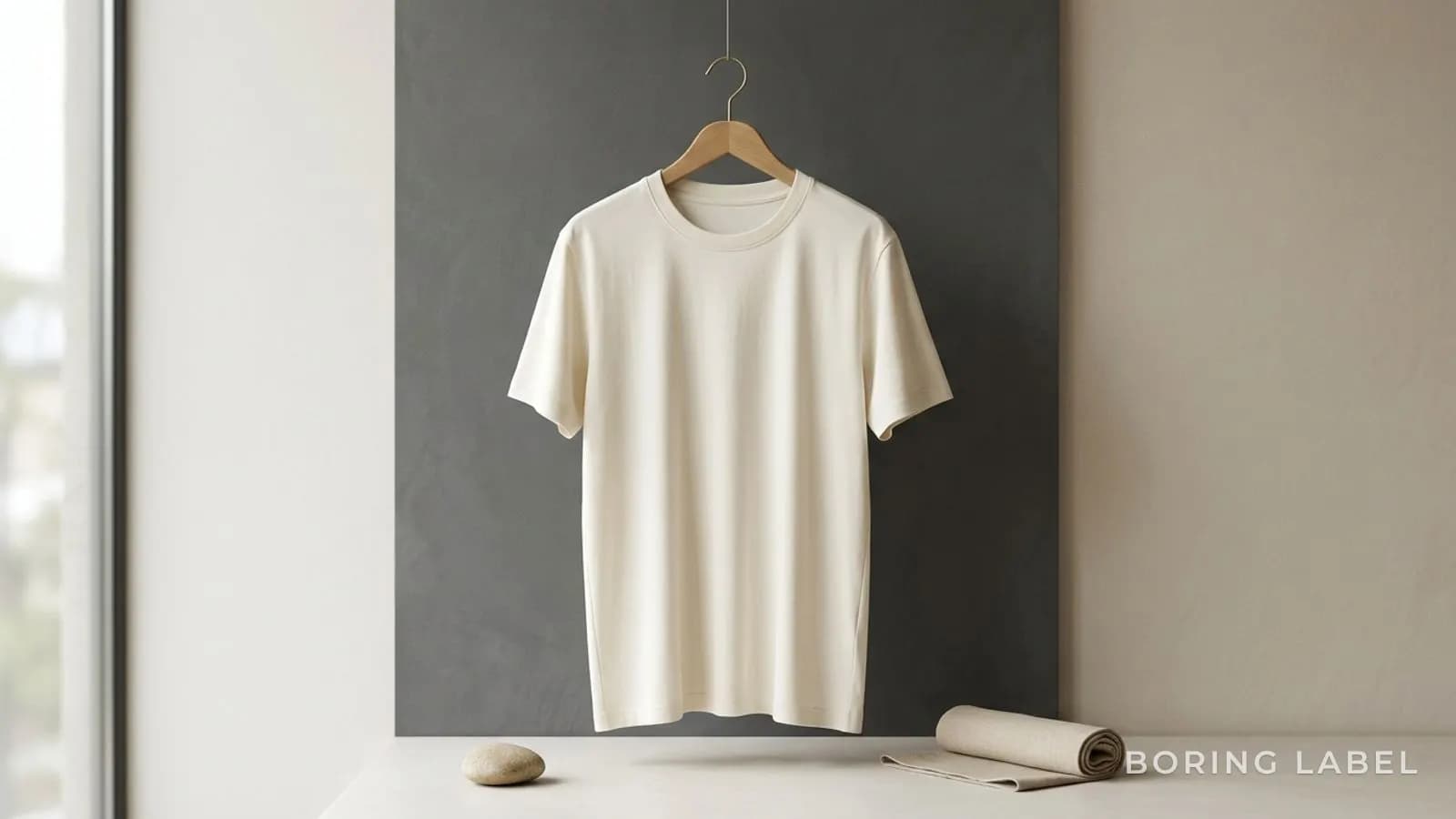
Pick up a t-shirt and hold it by the shoulders so it hangs free. Watch what the fabric does.
A good tee falls in soft vertical folds, settling close to the body without grabbing it. A bad one stands away in a stiff, boardy bell, or collapses into a thin clinging sheet.
That difference - how a fabric behaves under its own weight - is drape, and it is most of the reason one tee looks considered and another looks like it came free with a magazine.
Textile people have a number for this. It is called the drape coefficient, and it is measured by laying a circular disc of fabric over a smaller round pedestal and seeing how far the edges fall.
The more the fabric droops and folds, the higher the coefficient. A stiff fabric barely moves and reads low; a fluid one cascades into deep folds and reads high.
You do not need the lab number to shop well, but it helps to know the property is real and measurable, not a vibe a marketing team invented. When a brand says a tee "drapes beautifully", there is an actual physical behaviour underneath the phrase, and it is one you can test with your own hands in about ten seconds.
Here is the thing worth getting straight early, because almost everyone gets it backwards. Drape is not about thinness, and it is not about weight, and it is certainly not about price.
It is about how the fabric was built - the fibre, the yarn, the knit, and the finishing all pulling in the same direction. A cheap thin tee can have terrible drape, all cling and no fall.
An expensive heavy tee can have terrible drape too, all board and no movement. Drape is a quality of construction, and once you can see it, you stop being fooled by either the price tag or the heft.
This guide is about learning to see it. We will start with the five things that actually control drape, then sort out the confusion between drape, structure, and cling, then walk through how to judge a tee in your hands and how to read it from a product page. By the end you will be able to pick up any tee and know, fast, whether it is going to hang well or hang badly.
The five things that decide how a tee drapes
Drape is not one property. It is the sum of five decisions a maker takes, and a tee can be let down at any of them. Understanding the five is the difference between guessing and knowing.
Fibre length
This is the one most people have never heard of and the one that matters most. Cotton comes as fibres of a certain length - the staple length - and that length quietly decides almost everything about how the finished tee behaves.
Regular cotton has short staples, roughly a centimetre. Pima and other extra-long-staple cottons run longer, and Supima, the variety we use, runs longer still, well over three centimetres.
Why does it matter for drape? Because shorter fibres mean more loose ends sticking out of every length of yarn.
To make a yarn out of short fibres, you have to join many of them end to end, and each join is a tiny weakness and a tiny bump. The result is a yarn with a rough, hairy surface, and a fabric that catches against itself instead of flowing.
Long fibres need far fewer joins, so the yarn comes out smooth and even, and a smooth yarn slides over itself and falls cleanly. Long-staple cotton drapes better for the same reason it pills less and lasts longer - there is simply less loose, broken fibre in the cloth.
The single most reliable predictor of good drape in a cotton tee is the length of the fibre it was spun from, and it is the one number cheap brands never quote.
Yarn fineness
Once you have your fibre, it gets spun into yarn, and how finely you spin it matters too. Finer yarn, packed more densely, gives a smoother surface and a more fluid fall.
Coarse, thick yarn gives a chunkier, stiffer hand. There is a sweet spot for tees - go too fine and the fabric gets flimsy and sheer, go too coarse and it gets boardy - but within that range, the finer, cleaner yarn drapes better.
Finer yarn is also where long fibre pays off again, because you can only spin a smooth fine yarn if the fibres are long enough to hold it together. The two go hand in hand.
A tee spun from short cotton into coarse yarn is stiff twice over.
Knit structure
Almost every plain tee is made from single jersey, the basic flat knit, and that is exactly what you want. Single jersey is thin, flexible, and falls close to the body - it is the knit that drapes best, which is precisely why it became the t-shirt standard.
The alternative you will meet is piqué, the slightly waffled, textured knit used for polo shirts. Piqué is a double-knit construction with a raised pattern, and it is deliberately thicker and stiffer so a collar can stand up.
It holds its shape rather than falling, which is right for a polo and wrong for a tee. So if you are looking at a "t-shirt" and the surface has a visible waffle texture, that is not a soft draping tee - it is a structured shirt in disguise, and it will hang accordingly.
Fibre composition
This is where a lot of "drapey" tees cheat, and it is worth being honest about. Cotton is not the most fluid fibre on earth.
Regenerated cellulose fibres - modal, viscose, rayon - drape far more, with a liquid, almost silky fall, because the fibre itself is finer and smoother than cotton. Blends lean on this.
A tri-blend of cotton, polyester, and rayon will feel slinky and drape softly, and a lot of people read that as quality.
The catch is what you trade for it. Viscose and modal are weaker, especially when wet, and they wear out faster - think two or three years against seven or more for good cotton.
They get their lovely drape from the fibre being intrinsically soft, not from being well made, and they pay for it in durability. So a modal tee out-drapes a cotton one on day one, and is gone long before the cotton tee shows its age.
This is the trade most people do not realise they are making. Pure long-staple cotton is the harder thing to pull off - getting fluid drape out of a durable fibre takes good cotton and good making, rather than a slippery synthetic doing the work for you.
We will come back to this, because it is the heart of the drape-versus-durability confusion.
Finishing
The last step is the one nobody sees and everybody feels. After a fabric is knitted, it goes through finishing - and good finishing transforms how it drapes.
Singeing passes the cloth over a flame to burn off the tiny surface hairs, leaving a clean, smooth face that falls better and pills less. Softening, mechanical or otherwise, relaxes the fibres so the fabric moves instead of standing stiff.
Sanforising pre-shrinks it so it holds its shape and size after washing. Skip these steps - as cheap manufacturers do, because each one costs time and money - and you get a tee that feels rough and boardy out of the bag, the surface fuzzy, the hand stiff.
A lot of what people register as "cheap feel" is simply unfinished or under-finished fabric. Finishing is invisible on a spec sheet and obvious in the hand.
Weight ties all five together, which is why GSM gets so much attention - and so much misplaced attention. Weight does influence drape, but only as one ingredient among the five, and reading it alone will mislead you. Here is roughly how the weight bands behave for a plain cotton tee:
| Weight (GSM) | Typical drape behaviour |
|---|---|
| Under 150 | Very fluid, often too fluid - tends to cling and turn sheer |
| 150 to 200 | Balanced fall, drapes close without clinging - the premium tee range |
| 200 to 250 | More structured, holds shape, drapes less freely |
| Over 250 | Stiff and architectural, stands away from the body - jackets, not tees |
Read that table the right way round. It does not say lighter is better or heavier is better.
It says weight changes the kind of drape you get, and the everyday tee window sits in the middle, where the fabric has enough body to fall cleanly but not so much that it goes rigid. Crucially, a 200 GSM tee in good long cotton will out-drape a 230 GSM tee in cheap short cotton every time, because weight is only one of five levers and fibre is the strongest.
If you want the full argument about why the number on the label tells you less than you think, we wrote a whole guide to GSM - the short version is that weight is real, useful, and routinely overrated.
Drape, structure, and cling are three different things
Most shopping mistakes come from collapsing three separate properties into one vague sense of "feels nice" or "feels cheap". Pull them apart and the whole thing gets clearer.
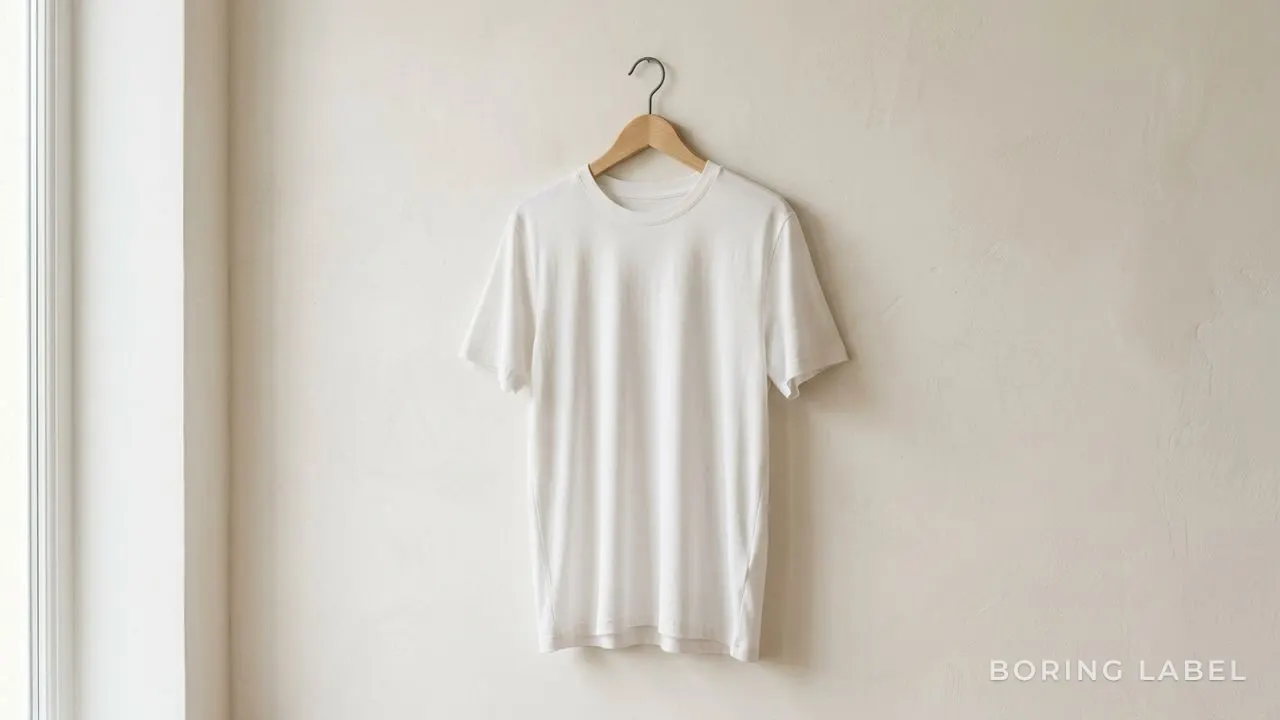
Drape is fall - how the fabric moves and folds under its own weight. Good drape falls in soft vertical lines and settles close to the body without gripping it.
Structure is the opposite tendency - the fabric's wish to hold a shape and stand away from the body. A heavy tee, a piqué polo, a stiff oxford shirt all have structure.
Structure is not bad; it is just a different goal. A boxy oversized tee needs some structure to look intentional rather than collapsed.
Cling is the failure mode people most often mistake for drape. Cling is what thin, light fabric does when it has no body of its own - it simply follows whatever is underneath, sticking to the chest and stomach and showing every line.
People feel a thin tee draping softly over their hand in a shop and think "fluid, premium", then put it on and discover it clings to them in exactly the way you do not want. Soft fall over a hand and unflattering cling on a body can be the same fabric.
The test is not whether it moves, but whether it has enough quiet body to fall close without grabbing.
The tee you actually want sits between these. Enough drape to fall in clean lines, enough body that it skims the body instead of clinging to it, and only as much structure as the cut calls for.
A fitted summer tee can run lighter and softer because the cut gives it shape. A relaxed or boxy tee needs a touch more weight and structure or it just looks baggy.
Which is why drape can never be judged completely apart from fit - the two have to agree, and we get into how the cut should sit in the fit guide. For now, hold onto the three words.
When you next pick up a tee, ask which of the three it is doing, and whether that is what you wanted.
How to judge drape in your hands
You cannot measure a drape coefficient in a shop, but you do not need to. Three quick tests tell you almost everything, and none of them looks odd to anyone watching - shop assistants see people do this constantly.
The hanger drop
Leave the tee on its hanger, or hang it on your fingers by the shoulders. Slide a hand underneath, lift the body of the shirt up toward the collar, then let it go and watch it fall.
A well-made tee drops straight back into clean vertical folds, smooth and settled, with no bunching. A poor one folds awkwardly, holds wrinkles where your hand was, or springs out into a stiff shape that refuses to fall.
This is the closest thing to seeing how the tee will hang off your own shoulders, because it is the same motion - fabric falling from a high point under gravity. If it will not fall cleanly off a hanger, it will not fall cleanly off you.
The hand scrunch
Take a fistful of the front of the tee, squeeze hard for about five seconds, then open your hand and watch. Good long-staple cotton springs back, the creases relaxing and smoothing out within ten or fifteen seconds.
Cheap short-staple cotton holds the wrinkles, sitting there rumpled and creased long after you have let go. This is testing fibre elasticity and memory, which is the same property that decides whether your tee looks fresh by lunchtime or looks slept in.
It is also, not coincidentally, a test of the exact fibre quality that drives good drape - the long, smooth fibres that fall well are the same ones that recover from a crease. One squeeze tells you both.
The drape-over-hand
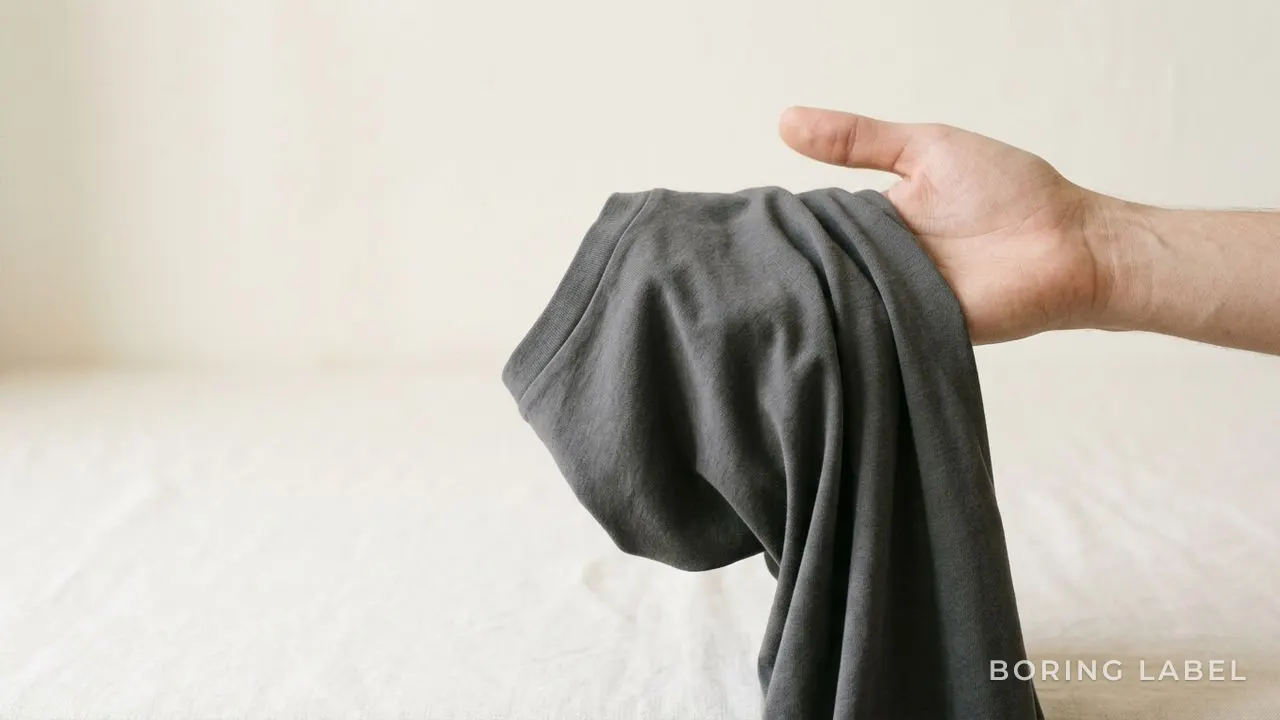
Lay the tee over one flat hand, palm up, with a good span of fabric hanging off the edge, and look at the part that falls. Fluid, well-made fabric breaks into soft folds and hangs straight down off your hand.
Stiff fabric juts out at an angle and refuses to fold; over-light fabric clings flat to your skin instead of falling. This one isolates the fabric from your body heat and from the cut of the garment, so you are reading the cloth itself.
Do it on two tees side by side and the difference is usually obvious in a second - one pours off your hand, the other sits on it.
While your hands are on the fabric, two more checks cost nothing. Hold the tee up to the light: a good tee is opaque, the weave even, no thin patches or stray slubs where the yarn ran thick and thin.
And run your eye down the seams and hems - straight, tight stitching with the threads trimmed says someone cared about the parts you cannot see, which usually means they cared about the parts you can. Drape lives in the same tees that get the boring details right.
How to judge drape from a screen
Buying online takes the hands away, which is most of why drape is so hard to shop for on a website. But the information is usually there if you know what to read, and learning to read it is the best defence against a tee that looks great in the photos and hangs like a bin bag in real life.
Start with the words. A brand that understands its own product tells you the things that drive drape: the exact fibre, not just "premium cotton" but the type and ideally the staple length; the knit, ideally "single jersey"; whether the cotton is combed and ring-spun; the weight in GSM; and care instructions that respect the fabric.
Specifics are a good sign, because a maker who skimped on the fibre has no reason to draw your attention to it. Vagueness is the tell.
"Luxuriously soft premium fabric" with no fibre, no weight, and no knit named is a description written to sound expensive while saying nothing, and the silence is usually hiding short cotton and skipped finishing. Watch too for care instructions like "machine wash warm, tumble dry" on something sold as premium cotton - that often points to a synthetic-heavy blend chosen for easy care rather than for how it falls.
Then read the photos, and read them sceptically. Flat-lay shots, where the tee is laid out on a surface, are the easiest to fake - a sheet of tissue tucked underneath can give a stiff tee soft-looking folds it does not actually have.
On-model photos are far more honest, because fabric cannot pretend on a body. Look for the tee hanging straight from the shoulders, skimming the torso without clinging, with natural soft folds under the arms rather than either hard wrinkles or a rigid bell.
Movement shots - someone walking or turning - are the gold standard, because you can see the fabric actually move, and stiff fabric cannot fake fall. Close-up macro shots should show a smooth, even surface with no fuzz, no pilling, no loose threads.
The single most honest source, though, is customer photos. Studio shots are lit and styled to flatter; a photo someone took in their bedroom under a ceiling light, after the tee has been through the wash a few times, shows you the truth.
Reviews that mention how a tee "falls", "drapes", "holds up after washing", or "still looks new" are worth more than any amount of brand copy, and a tee shown on a range of real bodies tells you how consistently it drapes. This honesty is exactly why we lean on real specifications and real customer photos rather than only studio shots - it is harder to hide a badly draping tee when the people wearing it are doing the photography.
If a "premium" tee is priced like fast fashion and the page names no fibre, no weight, and no knit, you already have your answer, whatever the marketing says.
Why cheap tees feel boardy and good ones feel fluid
Put a genuinely cheap tee and a genuinely good one side by side and the difference in fall is dramatic, and now you know exactly why. Every shortcut a cheap tee takes works against drape, and they cluster together because they all come from the same instinct to shave cost.
The cheap tee starts with short-staple cotton, full of loose ends, spun on the cheap into coarse, uneven yarn. It is knitted fast, often a little too tight or too loose, and then the finishing steps that would smooth and soften it get trimmed or skipped to save money.
Sometimes a little starch or resin is added to fake body and opacity, which makes the boardiness worse. The result is a fabric that is stiff and hairy at once - it stands away from the body in a rigid way, yet has no real structure, so it also wrinkles instantly and refuses to recover.
Wash it a few times and it gets worse, not better: the short fibres start breaking and migrating to the surface as pills, the cloth goes simultaneously rougher and thinner, and whatever fall it had is gone. That boardy feeling people associate with cheap tees is not bad luck.
It is the predictable sum of cheap fibre and skipped finishing.
The good tee inverts every one of those decisions. Long-staple cotton, combed and ring-spun into smooth fine yarn, knitted properly, then actually finished - singed, softened, pre-shrunk.
The fabric comes out clean-faced and supple, with enough body to fall close to the body without clinging and enough smoothness to move instead of catch. It drapes on day one and, because the fibres are long and strong, it keeps draping.
The cheap tee is built to look acceptable on the shelf and fall apart in your wardrobe; the good one is built to do the opposite. If you want the full field guide to spotting the difference - collar, seams, surface, and all - we laid it out in why your t-shirt looks cheap.
Drape is one chapter of that same story, and it happens to be the one you can read fastest.
The drape-versus-durability myth
Here is the belief that costs people the most: that you have to choose between a tee that drapes and a tee that lasts. Drapey fabric feels delicate, sturdy fabric feels stiff, so the trade seems obvious. It is mostly wrong, and the misunderstanding is worth clearing up properly because it pushes people toward exactly the wrong purchases.
The confusion comes from treating weight as the whole story. If you only ever compare cotton tees by GSM, then yes, the lighter ones tend to drape more and the heavier ones tend to last longer, and a trade-off looks real.
But weight is one of five levers, and the strongest lever - fibre length - improves drape and durability at the same time. Longer fibres make smoother yarn that falls better, and longer fibres also make stronger yarn that pills less and lasts longer.
So the property that gives good cotton its fall is the same property that gives it its life. A 200 GSM tee in long-staple cotton can genuinely drape better and last longer than a 250 GSM tee in cheap short cotton.
There is no trade there. There is just better cotton beating worse cotton on both counts.
Where a real trade-off does exist is at the extremes, and across different fibres rather than within good cotton. Push for maximum fluidity and you end up in viscose and low-twist modal, which drape gorgeously and wear out fast, weak when wet and quick to snag.
Push for maximum toughness and you end up in heavyweight canvas and twill, which last forever and barely drape at all, fine for a workwear jacket and miserable as a summer tee. Those are genuine trade-offs.
But they live out at the edges. The middle - long-staple cotton at a sensible everyday weight - quietly gives you both: the fall of a much lighter fabric and the lifespan of a much heavier one.
The either-or only looks compulsory if you are choosing between a slinky synthetic and a stiff board, which are simply the two ways of doing it badly. Good cotton refuses the choice.
That is the whole reason we build around Supima rather than a cheaper cotton or a drapey blend. It is not nostalgia for natural fibres.
It is that extra-long-staple cotton is the one material that lets a tee fall well and survive years of washing, instead of forcing us to pick one and apologise for the other. The drape and the durability come from the same fibre, so we do not have to choose, and neither do you.
Good cotton drapes better with age
There is a final point that turns the whole cheap-versus-good comparison on its head, and it is the one that should change how you think about spending more. A cheap tee is at its best the day you buy it and goes downhill from there. A good long-staple cotton tee is the other way round - it gets better for a while before it plateaus.
The reason is in the fibre again. Long, strong cotton fibres do not break and shed the way short ones do.
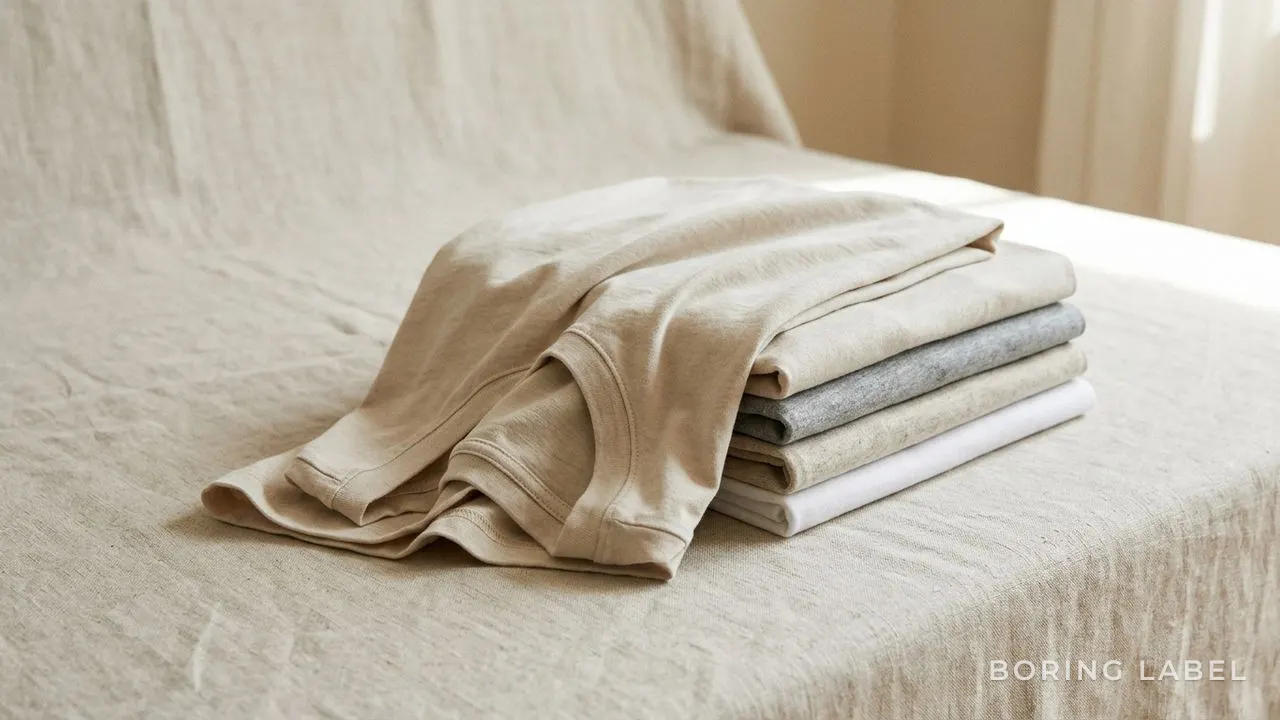
So instead of pilling and thinning, a good tee softens. The first few washes relax the yarn and the finishing, the fabric loses its very slight initial firmness, and it starts to fall a little more freely against the body.
This is structural softening - the cloth settling into itself - not the chemical-softener trick that fades after a few washes and leaves the fabric worse than before. The drape genuinely improves, and because the fibres are long enough to hold together, it improves without the surface breaking down.
A well-made tee a year in often hangs better than it did new, which is the exact opposite of what a cheap tee does over the same year.
This is the quiet argument for paying more once instead of less repeatedly. The cheap tee that drapes acceptably in the shop is borrowing against its future, and the bill comes due in a few months as boardiness, pilling, and a collar gone wavy.
The good tee asks for more up front and then keeps paying you back, getting softer and falling better while the cheap one falls apart. Spread the cost over the years you actually wear it and the expensive tee is usually the cheaper one.
None of this is magic - it is just what long fibres do when you treat them well, which mostly means washing cool, turning the tee inside out, and skipping the hot tumble dryer that cooks the life out of any cotton.
The bottom line
Drape is the fastest read you can get on a t-shirt, and now you can take it. It is how the fabric falls under its own weight, it comes from five things - fibre length, yarn fineness, knit, composition, and finishing - and it is controlled far more by the quality of the cotton than by the weight on the label.
Long fibres, smooth fine yarn, single jersey, real finishing: that is a tee that falls in clean soft folds and keeps falling well for years. Short fibres and skipped corners give you board on day one and pills by month three.
You do not need a lab. Hang it and let it drop, scrunch it and watch it recover, drape it over your hand and see if it pours or sits.
Online, read the specifics and trust the customer photos over the studio ones. And throw out the idea that you have to choose between a tee that drapes and a tee that lasts - in good cotton, the same fibre gives you both, which is the entire point of building a round-neck tee from extra-long-staple Supima rather than something cheaper or slinkier.
At ₹1,299, with no fade, no shrinkage, and a 30-plus-wash guarantee behind it, the promise is simple: a tee that falls right out of the bag and falls better the longer you own it.
A great tee does not stand to attention. It falls.
Boring Label
Wear the point of the article.
One honest tee. Heavyweight combed cotton, a collar that holds, a fit that actually fits. No logo, no noise.
Shop the round-neck teeFree shipping across India · Easy returns
Keep reading
T-Shirt Fit Guide: How a Tee Should Actually Fit
Most tees fail at the shoulder, not the size label. Here is how a t-shirt should actually sit on your body.
T-Shirt GSM Guide: What the Number Really Means
GSM is the most quoted, least understood number on a tee. Here is what it actually predicts about quality.
Why Your T-Shirt Looks Cheap (and the Fix)
It is rarely the price. It is the collar, the GSM, and the seam — three things you can spot in seconds.
Stay in the loop
New writing, no noise
Occasional notes on fit, fabric, and dressing simply well. No spam, unsubscribe anytime.
Subscribe