Fit
The T-Shirt Fit Guide
Most tees fail at the shoulder, not the size label. Here is how a t-shirt should actually sit on your body.
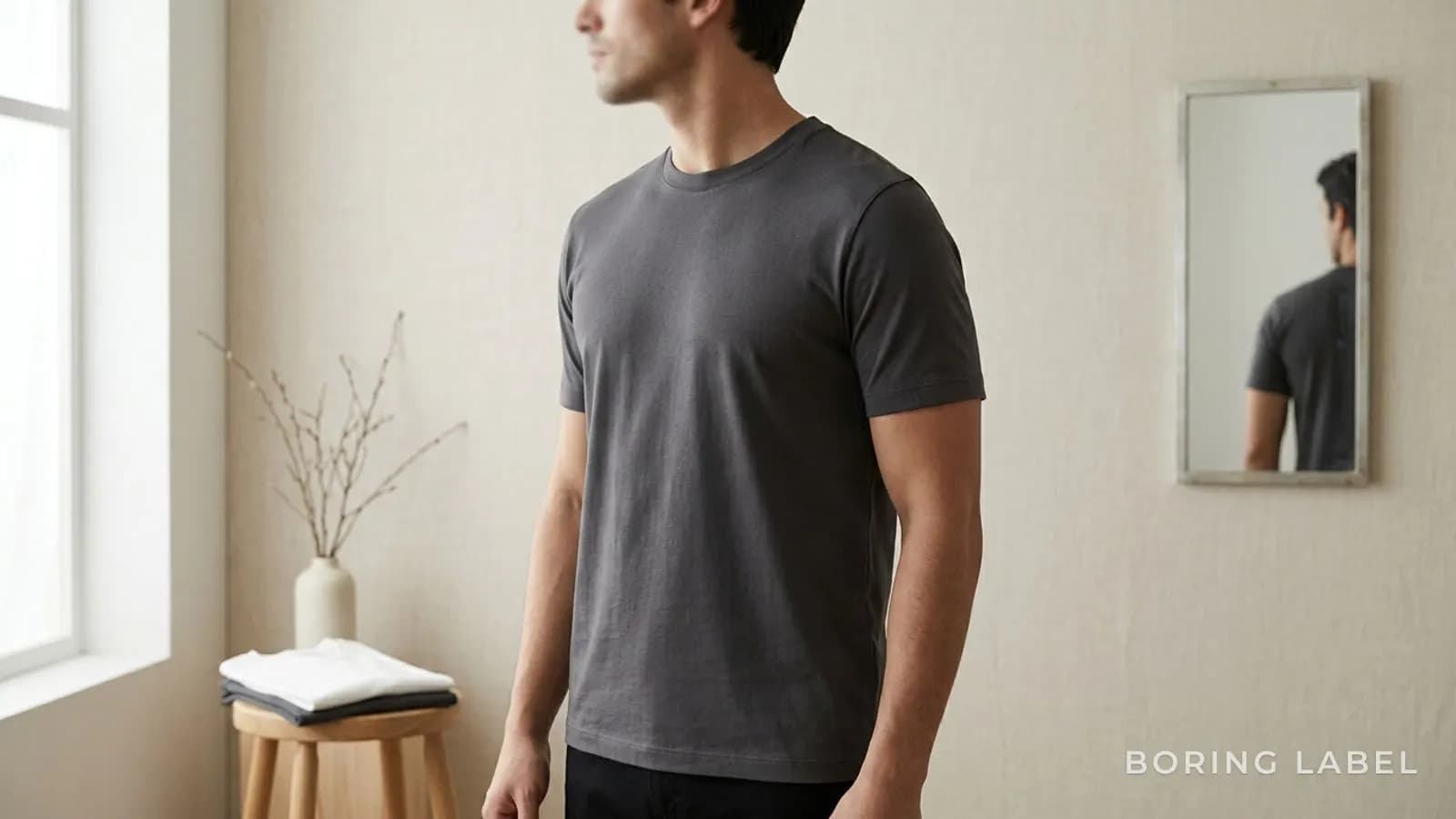
Fit beats size, every time
Walk into any store, pick up a medium, and try it on. If it does not sit right, the instinct is to size up or size down.
That instinct is usually wrong. A t-shirt has four independent fit points, and your label size only loosely controls one of them.
You can wear the "correct" size and still look like the tee was bought for someone else.
The single most important point is the shoulder. Get the shoulder right and the body, sleeves, and hem fall into a forgivable range.
Get the shoulder wrong and nothing else can save the tee - not a good fabric, not a flattering colour, not a clever tuck. This is why two people with the same chest measurement can wear the same shirt and one looks sharp while the other looks swamped.
In this guide we walk through each of the four fit points, in order of how much they matter, with a mirror check you can do in ten seconds before you buy. None of it requires a tailor or a measuring obsession. It just requires knowing where to look.
The short version: a t-shirt should follow your frame without gripping it. It skims, it does not cling, and it does not drown. Everything below is the long version of that one sentence.
The four fit points, ranked
- Shoulder seam - where the sleeve meets the body. The one that makes or breaks the tee.
- Body width and taper - how much room there is through the chest and waist.
- Sleeve length and width - where the sleeve ends and how loosely it hangs.
- Hem length - where the bottom of the tee sits relative to your hips and zip.
People obsess over the last two and ignore the first two. That is backwards. Spend your attention where it pays off.
The shoulder seam decides everything
Stand square in front of a mirror, arms relaxed at your sides. Find the seam that runs along the top of each shoulder, joining the sleeve to the body.
On a tee that fits, that seam sits right at the edge of your shoulder - the bony corner where your shoulder ends and your arm begins. Not on top of the shoulder muscle, not halfway down your upper arm.
At the corner.
This is the whole game for regular and slim fits. When the seam lands at the corner, the sleeve hangs straight down your arm and the fabric across your chest lies flat. The tee reads as "made for this body."
When the seam falls inside the corner, pulling up toward your neck, the tee is too small in the shoulder. You will feel it tug when you reach forward, and the sleeves ride up your biceps. No amount of sizing the body up fixes this, because the body and shoulder are cut together.
When the seam falls outside the corner, down your upper arm, the tee is too big in the shoulder - or it is a drop-shoulder cut, which is a deliberate design choice we cover in a moment. On a regular fit that is meant to sit at the corner, a dropped seam makes you look smaller and softer than you are, because the shoulder line of the garment no longer matches the shoulder line of your body.
The ten-second mirror check
- Seam at the bony corner of the shoulder: correct.
- Seam pulled toward the neck, sleeves gripping your arms: too small, go up a size.
- Seam halfway down your arm on a fit that should sit at the corner: too big, go down a size.
Do this first, before you look at anything else. If the shoulder is wrong, put the tee back. The rest does not matter.
Drop shoulder is a different rulebook
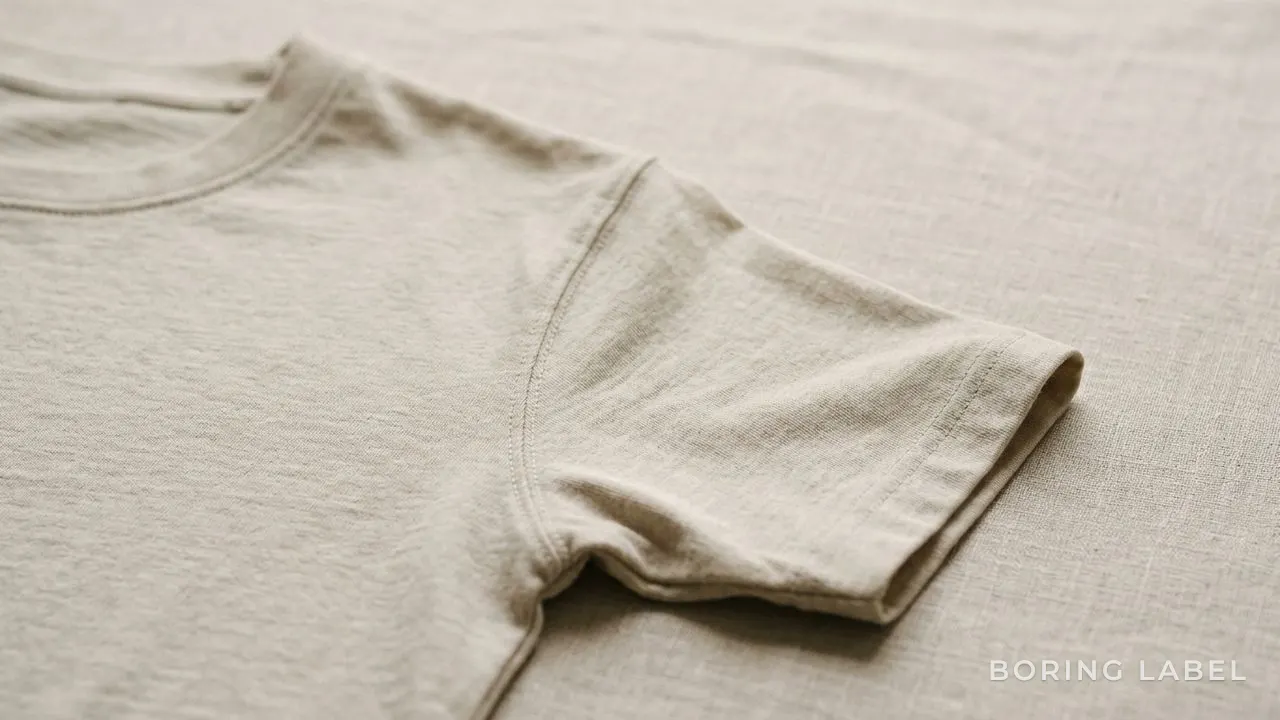
A drop-shoulder tee moves the seam deliberately past your shoulder, down the arm, so the fabric drapes from a lower point. This is the defining feature of oversized and relaxed cuts, and it is not a fit fault - it is the look.
The catch is that drop shoulder only works when the rest of the proportions are designed around it. A regular tee that happens to be too big in the shoulder is not the same thing as a well-cut drop-shoulder tee, even though the seam sits in a similar place.
One looks intentional. The other looks borrowed.
If you are deciding between the two silhouettes, the full breakdown is in our guide to oversized versus regular fit. For now, the rule is simple: on a regular fit, the seam belongs at the corner. On a drop-shoulder fit, it belongs lower, and that is fine.
Body width: skim, do not cling, do not drown
Once the shoulder is right, look at the body. A good tee skims your torso.
You should be able to pinch a small amount of fabric at your chest or stomach - roughly two to four centimetres on each side - without it billowing out into a tent. That pinch test is the quickest read on body fit.
Too tight, and you will see horizontal pull lines stretching across your chest or stomach, and the tee will outline every contour you would rather it did not. Too loose, and the fabric hangs off your chest like a sheet, adding visual weight and making you look bigger and shapeless. The sweet spot is close enough to suggest your frame, loose enough to move.
Taper matters more than total width
The width at your chest is one number. The width at your waist is another.
A tee with taper narrows slightly from chest to hem, following the natural V of a torso. A tee cut as a straight tube - same width top to bottom - hangs boxy, which can read as either relaxed-cool or shapeless-cheap depending on how the rest fits.
For most people on a regular fit, a little taper is flattering because it implies a shape rather than draping over one. If you are broader through the middle, slightly less taper and a touch more length tends to sit better than a tight, tapered cut that grips the waist. There is no universal "right" amount; there is only what follows your particular frame.
The fabric changes how fit reads
Two tees cut to identical measurements can fit very differently depending on the cloth. A heavier, structured fabric holds its shape and skims; a thin, flimsy one clings and shows everything underneath.
This is one of the biggest reasons a tee can look cheap even when the measurements are correct - the fabric collapses onto the body instead of holding a clean line. We go deep on this in why a t-shirt looks cheap, but keep it in mind here: fit and fabric are not separable.
A well-built tee in a good weight gives you margin for error on fit. A flimsy one punishes every millimetre.
Sleeve length and width
Sleeves are where personal taste has the most room, but there are still some lines worth not crossing.
For a standard short-sleeve tee, the sleeve should end somewhere on the upper arm, between the top of the bicep and the midpoint of it. Ending higher, near the shoulder, gives a more fitted, athletic look and shows more arm.
Ending lower, past the midpoint toward the elbow, reads more relaxed and covers more. Both are fine.
What you want to avoid is the sleeve ending right at the widest part of a heavier arm and gripping it, which draws a hard line exactly where you do not want one, or a sleeve so long and loose it flaps near the elbow on a fit that is meant to be trim.
The sleeve opening
Look at how the sleeve hem sits around your arm. On a fitted tee it should follow the arm with a little breathing room - not a tourniquet, not a flared bell.
A sleeve that grips leaves a red mark and bunches; a sleeve that flares out wide makes the arm look thin and the tee look ill-judged. A clean, gently tapered sleeve opening is one of those quiet details that separates a considered tee from a careless one.
| Sleeve end point | Reads as | Best for |
|---|---|---|
| High on the bicep | Athletic, fitted | Showing arms, slimmer build |
| Mid-bicep | Balanced, classic | Most people, most settings |
| Toward the elbow | Relaxed, casual | Bigger arms, easy looks |
Hem length: the half-zip rule
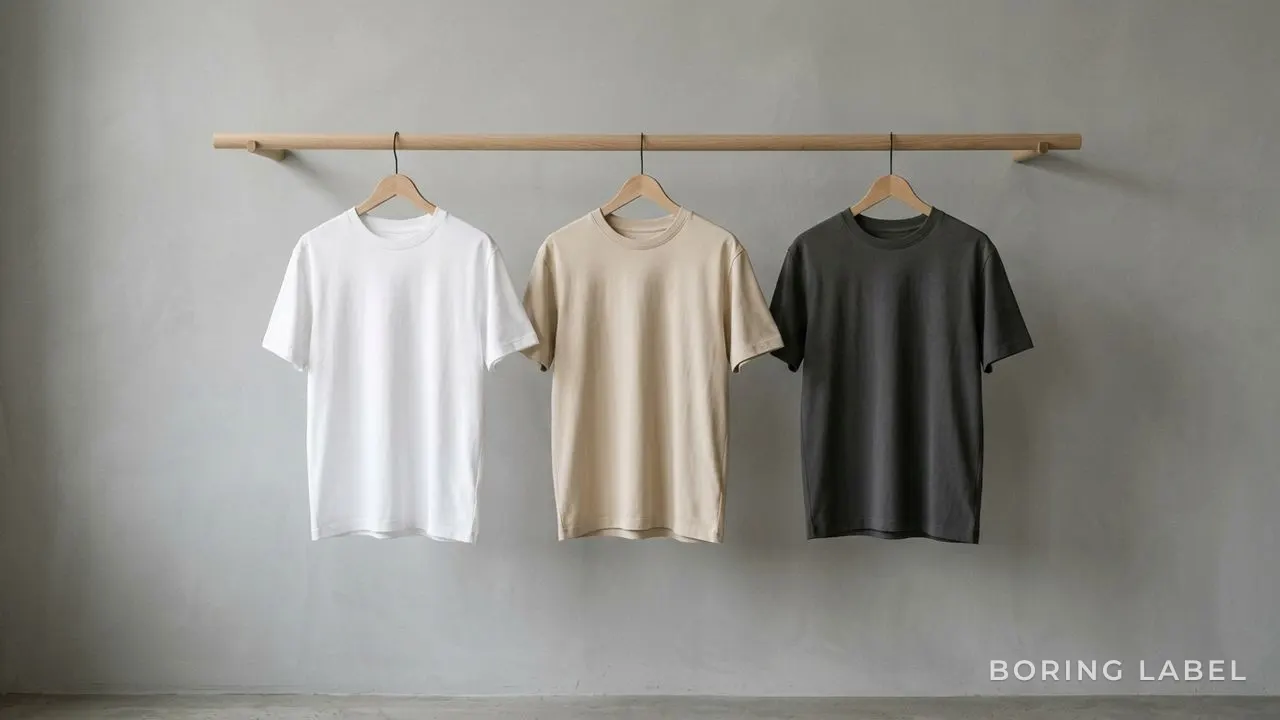
The bottom of the tee should land somewhere around the middle of your trouser zip, give or take. That is the rule of thumb that works across most heights and builds.
Too short, and the tee rides up when you raise your arms or sit, exposing a strip of stomach and untucking itself constantly. Too long, and it covers your hips and the top of your thighs, shortening your legs visually and making you look stockier. The half-zip landing keeps the proportions balanced: enough length to stay tucked-or-untucked at your choice, not so much that it eats your lower half.
Tuckability is a fit signal
A tee that fits well at the right length can be worn untucked, fully tucked, or front-tucked, and look intentional in all three. A tee that is too long looks sloppy untucked and bunches when tucked.
A tee that is too short cannot be tucked at all without pulling free the moment you move. If you find yourself unable to tuck a tee without it escaping, the length - or the body fit - is off.
Side seams should run straight
Glance down at the side seam, the line running from armpit to hem along your side. It should fall straight, perpendicular to the floor.
If it spirals around toward your front or back - a fault called twisting - the tee was cut or finished poorly, and it will get worse after washing. Twisting is not a fit issue you caused; it is a construction defect, and it is one of the clearest signs of a corner-cut tee.
A straight side seam after a couple of washes is a sign of a tee made properly.
A quick fit-test you can run anywhere
Before buying, in the changing room or at home with a delivered tee, run through this in order. Stop at the first failure.
- Shoulder. Seam at the bony corner? If no, wrong size or wrong cut. Stop.
- Body pinch. Can you pinch two to four centimetres at the chest? Less means too tight, much more means too loose.
- Reach test. Raise both arms overhead. Does the hem stay near your waist, or does it ride up to your ribs? A good tee barely moves. A short or tight one exposes your stomach.
- Sleeve. Does the sleeve end on the bicep without gripping?
- Hem. Does the bottom land around mid-zip?
- Side seam. Does it run straight down, not spiralling?
Five out of six is usually fine. Failing the shoulder or the reach test is a hard no, because those two control how the tee behaves all day, not just how it looks standing still.
Sit down before you decide
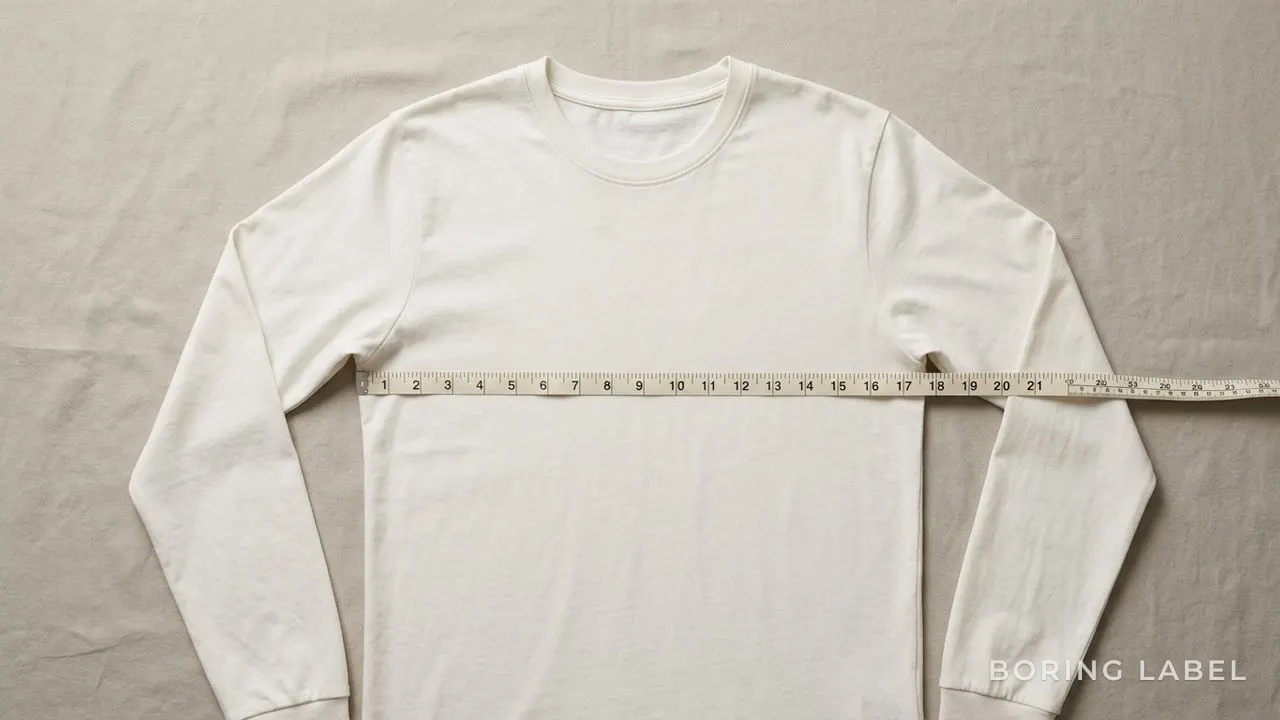
Most people judge a tee standing still in good lighting. You do not live standing still.
Sit down. Cross your arms.
Reach for something. A tee that looks perfect at attention but chokes you when you sit or exposes your stomach when you reach is not a good fit - it is a good photograph.
Real fit is fit in motion.
Body type adjustments
The numbers above are starting points, not laws. Different frames want slightly different things, and the goal is always the same: a clean line that follows you.
If you are slim or lean
You have the most freedom. A fitted cut with light taper flatters a lean frame and avoids the "swimming in fabric" look that thin people get in boxy tees. If you want the relaxed look, go for a deliberate oversized cut rather than just buying a size up in a regular fit, because a too-big regular fit on a slim frame reads as ill-fitting, while a designed oversized cut reads as a choice.
If you carry weight through the middle
Avoid two traps: the too-tight tee that grips and outlines, and the too-big tee bought to "hide" things, which actually adds bulk. The flattering middle is a regular fit with a clean shoulder, modest taper, and enough length to sit past the waistband.
A slightly heavier fabric helps, because it skims instead of clinging. The shoulder rule matters even more here - a correct shoulder seam pulls the whole silhouette into shape.
If you are broad or muscular
Your problem is usually the opposite of everyone else's: tees that fit your chest and shoulders are too loose at the waist, and tees that fit your waist choke your shoulders. Prioritise the shoulder and chest fit, accept a little extra room at the waist, and look for cuts with some taper so the waist does not balloon. Athletic-fit tees exist precisely for this reason.
If you are shorter
Watch the hem length above all. A standard-length tee can hang past mid-zip on a shorter frame and visually cut your legs short.
Look for shorter body lengths or be ready to wear it tucked. Cleaner proportions do more for apparent height than any single garment ever will.
Common fit mistakes, and how to read them
Most bad fits fall into a handful of repeating patterns. Once you can name them, you can spot them across a rail of tees in seconds and stop wasting changing-room time.
The "I'll grow into the look" mistake
Buying a size up because you want the relaxed, draped look almost never works on a regular-fit cut. A regular tee sized up does not become a stylish oversized tee; it becomes a regular tee with the shoulder seam in the wrong place, sleeves that flap, and a hem that hangs at an accidental length.
The relaxed look you want comes from a tee designed to be loose, not a fitted one bought big. If you want drape, buy drape on purpose - the difference between the two silhouettes is laid out in oversized versus regular fit.
The "it shrank, so I'll size up everything" mistake
A tee that shrank tight was probably washed hot and tumble-dried, not bought wrong. Sizing up your whole wardrobe to compensate means every new tee starts too big and only reaches "correct" if you abuse it in the wash the same way.
Fix the laundry instead of the size. Cold wash, air dry, and your correctly-sized tees stay correctly sized.
The "fitted means tight" mistake
This is the most common one. People hear "fitted" and buy something that grips.
Fitted means the tee follows your shape with a couple of centimetres of room to pinch - it does not mean it outlines your navel. Pull lines across the chest, a collar that gaps when you move, sleeves that leave marks: all signs of too-tight, not well-fitted.
A genuinely fitted tee looks sharp and still lets you breathe, reach, and eat dinner.
The "all-black hides everything" mistake
Dark colours hide a little, but a badly-fitting black tee is still a badly-fitting tee - the shape is just harder to photograph, not actually better. Do not let colour talk you out of checking the shoulder and the reach test. A well-fitting white tee beats a poorly-fitting black one in person, where it counts.
How fit changes through the day
A tee does not hold one shape from morning to night, and judging fit only at the moment of purchase misses this. Cotton relaxes as you wear it - body heat and movement let the fibres give slightly, so a tee that felt snug in the changing room often eases by mid-afternoon. This is normal and worth planning for.
The practical consequence: if a tee is perfect-snug when brand new and unwashed, it may end up a touch loose after a day of wear plus a wash or two. And if it is already a little loose new, it can drift into baggy.
The ideal new-tee feeling is "clean and close with a hint of room," knowing it will settle toward "comfortably skimming." Slightly snug-but-not-tight when new tends to land in the right place once it has lived a little.
Why the first wash matters for fit
The first proper wash is when a cotton tee finds its true size. It may shrink slightly in length, and the fabric settles into its final hand.
This is why the benchmark-tee method - measuring a tee that has already been washed several times - gives more reliable numbers than measuring something fresh off the shelf. If you are judging fit, judge it on a tee that has been through the laundry at least once, or mentally allow for a small settling.
What fit cannot fix, and what it can
Fit is the highest-leverage thing you control on a t-shirt. It costs nothing extra once you know what to look for, and it does more for how you look than spending double on the wrong cut. A correctly fitted budget tee beats an expensively-fitted-wrongly one every time.
But fit sits on top of two things it cannot replace: fabric and construction. A perfect shoulder seam on flimsy, see-through cloth still looks cheap.
A flawless taper on a tee whose collar goes slack after three washes still looks tired by month two. Fit, fabric, and build are three legs of the same stool.
Knowing how to measure a tee you already love so every future order matches is the next skill worth having, and we cover it in how to measure your t-shirt size.
If you take one thing from this guide, take the shoulder. Train your eye to find that seam at the bony corner, and you will never again buy a tee that fits like it was meant for someone else.
Everything else - the pinch, the reach, the hem, the seam running straight - is just confirming what a good shoulder already promised. Build that one habit, and a plain tee like our round-neck tee stops being a gamble and starts being a sure thing.
The takeaway
Stop shopping by the letter on the label. S, M, and L are rough buckets, not promises, and they vary wildly between brands.
What is consistent is your body and the six checks above. Run them in order, lead with the shoulder, judge the tee in motion rather than at attention, and adjust for your own frame rather than some imaginary average one.
A t-shirt that fits well is not loud. Nobody will say "great fit" the way they might say "great jacket."
They will just register, without quite knowing why, that you look put-together. That quiet, unremarkable rightness is the entire point of a basic done properly.
Get the fit right and the cheapest part of your wardrobe starts doing the most work.
Boring Label
Wear the point of the article.
One honest tee. Heavyweight combed cotton, a collar that holds, a fit that actually fits. No logo, no noise.
Shop the round-neck teeFree shipping across India · Easy returns
Keep reading
Slim vs Relaxed vs Regular Fit: Pick by Body Type
Stop blaming your body for a bad tee. A simple decision tree for picking slim, regular, or relaxed by your actual build.
Round Neck vs Crew vs V-Neck: Which Suits You
Round, crew or V-neck? How each neckline reads against your face and build - and the honest everyday pick.
Best T-Shirt Fit for Broad Shoulders & Gym Build
Why most tees pull at the chest and balloon at the waist on a muscular build, and exactly what to look for instead.
Stay in the loop
New writing, no noise
Occasional notes on fit, fabric, and dressing simply well. No spam, unsubscribe anytime.
Subscribe