Buying
How to Tell Good Cotton From Bad When You Can't Touch It
The touch test is gone when you shop online. Here are the six proxy signals that tell good cotton from bad before you spend.
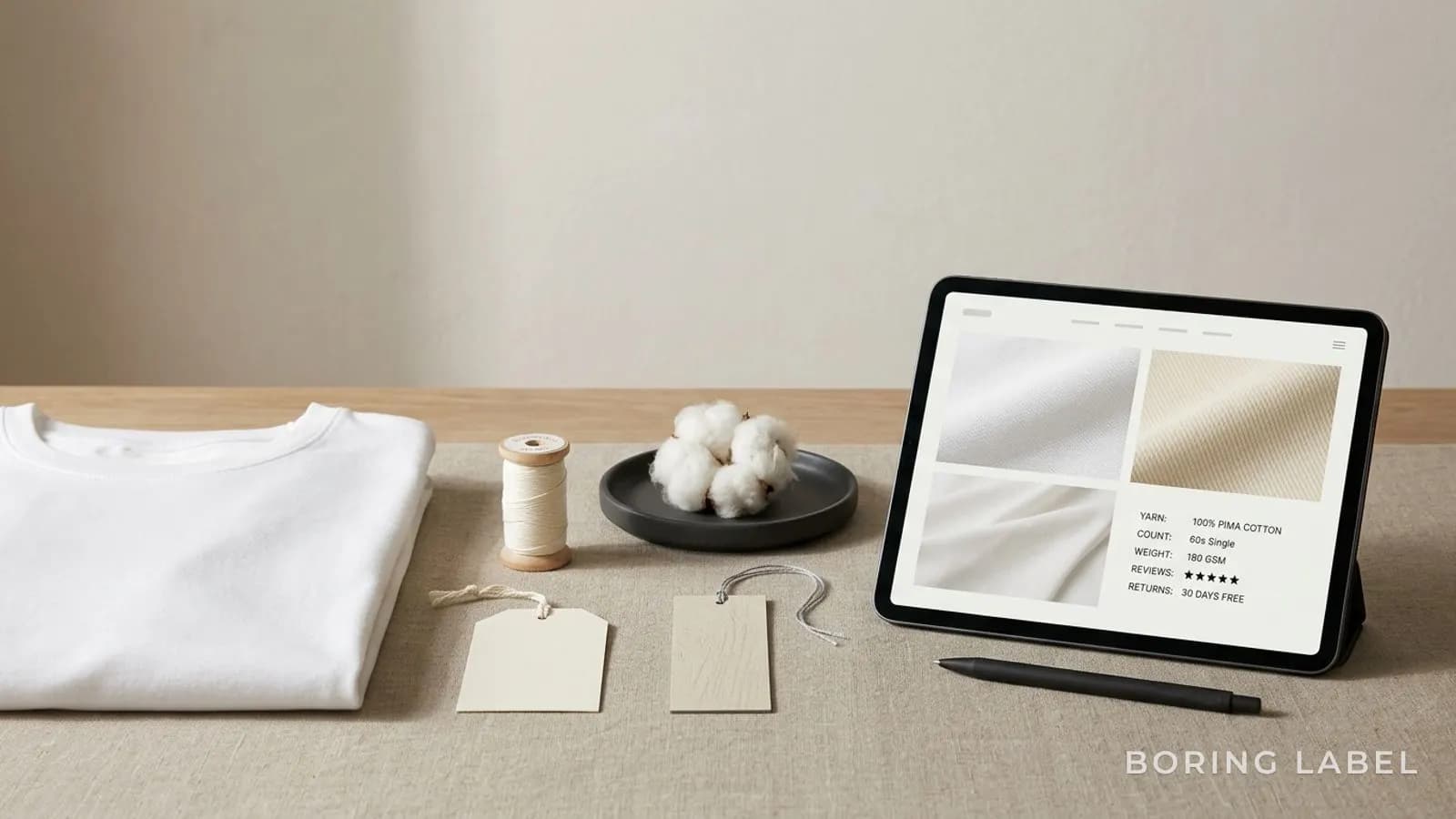
Buying Cotton With Your Eyes Instead of Your Hands
In a shop, you settle the question of cotton quality in about four seconds. You pinch the fabric, drag a fingertip across it, hold it to the light, give it a little stretch, and your hands tell you almost everything: smooth or fuzzy, dense or flimsy, alive or dead. The touch test is the oldest and most reliable way to judge a tee, and almost everyone does it without being taught.
Online, that whole channel of information is gone. You are buying a photograph and a paragraph.
You cannot feel the smoothness, you cannot weigh it in your palm, and you cannot catch the faint halo of short fibres that warns of pilling to come. So you do what most people do: you trust the price, trust the photos, and hope.
And a surprising amount of the time, the tee that arrives feels thinner, rougher, and cheaper than the one in your head.
The good news is that the touch test has substitutes. Cotton quality leaves fingerprints all over a product page - in the spec sheet, in the exact words a brand chooses, in how the photos are lit, in what the reviews complain about, and in the small print of the return policy.
None of these proxies is as good as your hand on the fabric. But stacked together, they get you most of the way there, and they let you tell an honest tee from a hopeful one before you spend a rupee.
This is how to read them.
Why Online Cotton Is So Easy to Fake
Start with the uncomfortable truth: the online format quietly favours the seller. A photograph can be styled, retouched, and lit to flatter a fabric that would disappoint you in person.
A description can lean on warm words - premium, luxury, buttery soft - that mean nothing and cost nothing to print. And the one thing your hands would have caught instantly, the cheapness of the cotton itself, is exactly the thing a photo hides best.
There is a deeper reason the cheap stuff thrives online, and it is worth naming because it reframes everything that follows. In a shop, a bad tee gets found out at the rack and put back.
Online, the bad tee gets found out only after it ships, after you have paid, and often after the easy return window has lulled you into keeping it. The cost of a bad decision lands on you, later, not on the seller at the point of sale.
That asymmetry is why so much of what sells online is mediocre cotton dressed in good photography.
So your job, reading a product page, is to act as your own quality inspector - to reconstruct the touch test from the evidence the page leaves lying around. Some of that evidence is on the spec sheet, stated plainly.
Some of it is in what the brand carefully does not say. The skill is reading both.
A quick grounding before the signals, because two facts do most of the heavy lifting. First, what makes cotton feel good and last long is mostly fibre length.
Long-staple cottons - fibres roughly 35 to 38mm long, like Supima or other Pima and Egyptian types - spin into smoother, stronger, less fuzzy yarn than ordinary upland cotton, whose fibres are closer to 20mm. Second, combing - an extra step that strips out the shortest fibres before spinning - cleans up whatever cotton you started with, which is why a combed tee resists pilling far better than a carded one.
Long-staple plus combed is the top of the range, and we go deep on that pairing in combed versus carded cotton. Hold those two facts; every proxy signal below is really a way of guessing at them from a distance.
Signal 1: The Spec Sheet - and the One Number Everyone Misreads
The spec sheet is the closest thing to an honest handshake a product page offers, because numbers are harder to fudge than adjectives. But you have to read it correctly, and most people fixate on the one number that tells them the least.
GSM Tells You Weight, Not Quality
GSM - grams per square metre - is the headline spec on most tees, and it is genuinely useful, but only for what it actually measures: how much fabric there is, not how good it is. A rough rule of thumb that holds up in practice: under about 150 GSM is lightweight and often see-through, 150 to 200 GSM is the everyday mid-weight zone, and over 200 GSM is heavyweight and substantial. For Indian heat a sensible mid-weight usually beats a heavy slab of cotton, and we walk through the numbers in the GSM guide.
Here is the trap. A high GSM number is easy to hit with bad cotton.
Pack a fabric with cheap, short-fibre carded yarn and you can push the weight up while the tee still feels rough and pills within a month. Buyers see 220 GSM, assume premium, and get a heavy fuzzy disappointment.
GSM is a measure of quantity wearing the costume of quality. Respect it as a weight figure; never read it as a quality figure on its own.
We unpack that confusion further in the GSM guide, but the one-line version is: weight is how much cotton, not how good it is.
Yarn Count Is the Number That Actually Talks About the Cotton
If GSM is the number everyone watches, yarn count is the number worth watching instead - and it is the one most brands quietly leave off, which is itself a signal. Yarn count describes how fine the spun yarn is, usually written as a number followed by an "s" or "Ne": 20s, 30s, 40s.
Counter-intuitively, a higher number means a finer, thinner yarn. And here is why it matters: you can only spin a fine, high-count yarn from good, long fibres.
Short, coarse cotton simply cannot be spun that fine without falling apart. So a high yarn count is an indirect promise about fibre quality that is hard to fake.
In rough terms, a lot of cheap basics sit around 20s - coarse, coarse-feeling yarn. Better everyday tees land around 30s.
Fine, smooth, premium-feeling tees often use 40s or finer, frequently combed and ring-spun to get there. When a product page bothers to state the yarn count at all, it is usually because the number flatters them.
When it states GSM loudly and stays silent on count, you can often guess why.
The Ply Trick, Borrowed From the Bedsheet Aisle
There is one number-game worth knowing because it migrates across textiles: ply inflation. In bedsheets, sellers twist two or three weaker, lower-count yarns together and then add up their counts to advertise an enormous "thread count" - a 500-count fabric sold as 1000 by counting the plies.
The headline number balloons while the underlying yarn stays mediocre. The same instinct shows up wherever a single big number can be inflated to look impressive.
The defence is the same everywhere: distrust a lone hero number, and look for the boring supporting specs - fibre type, staple, count, single versus multi-ply - that a confident maker states plainly and an evasive one omits.
What an Honest Spec Sheet Actually Lists
Put it together and you can score a spec sheet in seconds by what it is willing to tell you:
| Spec | What it tells you | The honest version states it |
|---|---|---|
| Fibre type | Whether it is long-staple (Supima/Pima) or ordinary upland | Names the cotton, not just "100% cotton" |
| Combed vs carded | Pilling and smoothness over time | Says "combed" or "combed ring-spun" explicitly |
| Yarn count (20s/30s/40s) | How fine - and indirectly, how good - the cotton is | Gives a number; finer is dearer |
| GSM | How much fabric - weight only | States it, but does not pretend it means quality |
| Spinning (ring-spun vs open-end) | Smoothness and strength of the yarn | Says "ring-spun" where true |
The pattern that matters is not any single row. It is how many rows the brand is willing to fill in.
A page that names the cotton, states the count, and says combed ring-spun is handing you its homework. A page that shouts one big GSM number and goes vague on everything else is hoping you will not ask.
The richness of the spec sheet is itself the signal.
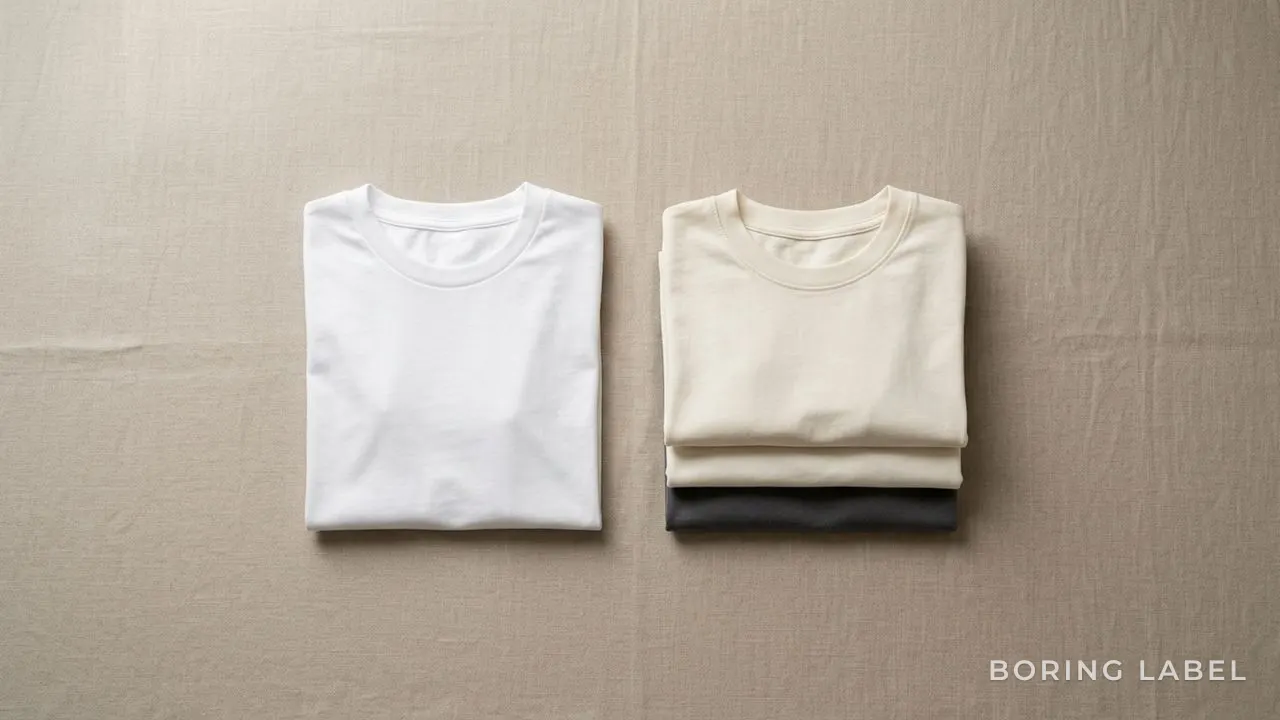
Signal 2: Reading the Words - What Brands Say and Carefully Don't
Once the numbers are exhausted, language is your next instrument. Marketing copy is written to persuade, so the trick is to separate the words that carry information from the words that carry only feeling.
Vague Adjectives Are Noise
Premium. Luxury.
Buttery. Soft.
High-quality. Superior.
These words appear on the best tees and the worst ones equally, because they are free to type and impossible to disprove. They tell you the brand wants you to feel good; they tell you nothing about the cotton.
When a description is built almost entirely from this kind of vocabulary, treat the silence underneath it as the real message. A maker who has genuinely good cotton tends to reach for specifics, because specifics are their advantage.
A maker who does not, reaches for adjectives, because adjectives are all they have.
Specific Nouns Are Signal
Now contrast that with the language that actually means something: long-staple, Supima, Pima, combed, ring-spun, 100% cotton, 40s count, bio-washed, garment-dyed, double-needle stitched. These are checkable, falsifiable claims.
A brand that writes them is exposing itself to being wrong, which is precisely why the words are worth more. The density of concrete, verifiable nouns in a description is one of the most reliable quick reads you have.
Skim a product page and silently sort the words into "feeling" and "fact". If the fact pile is thin, lower your expectations accordingly.
The Tell-Tale Phrasing Around Cotton Type
A few specific phrasings are worth decoding, because they sit in the grey zone between honesty and suggestion:
- "100% cotton" and nothing more. True, but uninformative - it confirms the fibre and stays silent on staple, combing, and count. Assume ordinary carded cotton unless told otherwise; makers who combed their cotton almost always say so, because they paid for it.
- "Made with premium cotton" / "high-quality cotton". This is an adjective dressed as a spec. It names no cotton. Read it as a near-confession that there is no specific cotton worth naming.
- "Ring-spun" on its own. A real upgrade in spinning method - smoother and stronger than basic open-end yarn - but it describes the twist, not the fibre, and ring-spun cotton can still be carded. Good, not the whole story.
- "Supima" / "Pima" / "Egyptian" / "long-staple". Genuine fibre claims about naturally longer fibres, and these are almost always combed and ring-spun too. This is the language of the upper end. We compare the headline case in Supima versus regular cotton.
The meta-lesson holds across all of them: brands tend to state their strongest true fact and go quiet on their weakest. So the gaps in a description are as informative as the claims.
If a page trumpets the dye and the fit and the "premium feel" but never once names the cotton or its construction, the cotton is probably the part they would rather you did not examine. Some of the same evasions explain why a cheap-looking tee looks cheap in the first place - flat colour, fuzzy surface, and a spec sheet that changes the subject.
Signal 3: Reading the Photographs Like an Inspector
Photos are the part of the page closest to the touch test, and most people look at them entirely wrong - they look at the styling, the model, the vibe. An inspector ignores all that and hunts for the few frames that accidentally tell the truth about the fabric.
Demand the Macro Shot
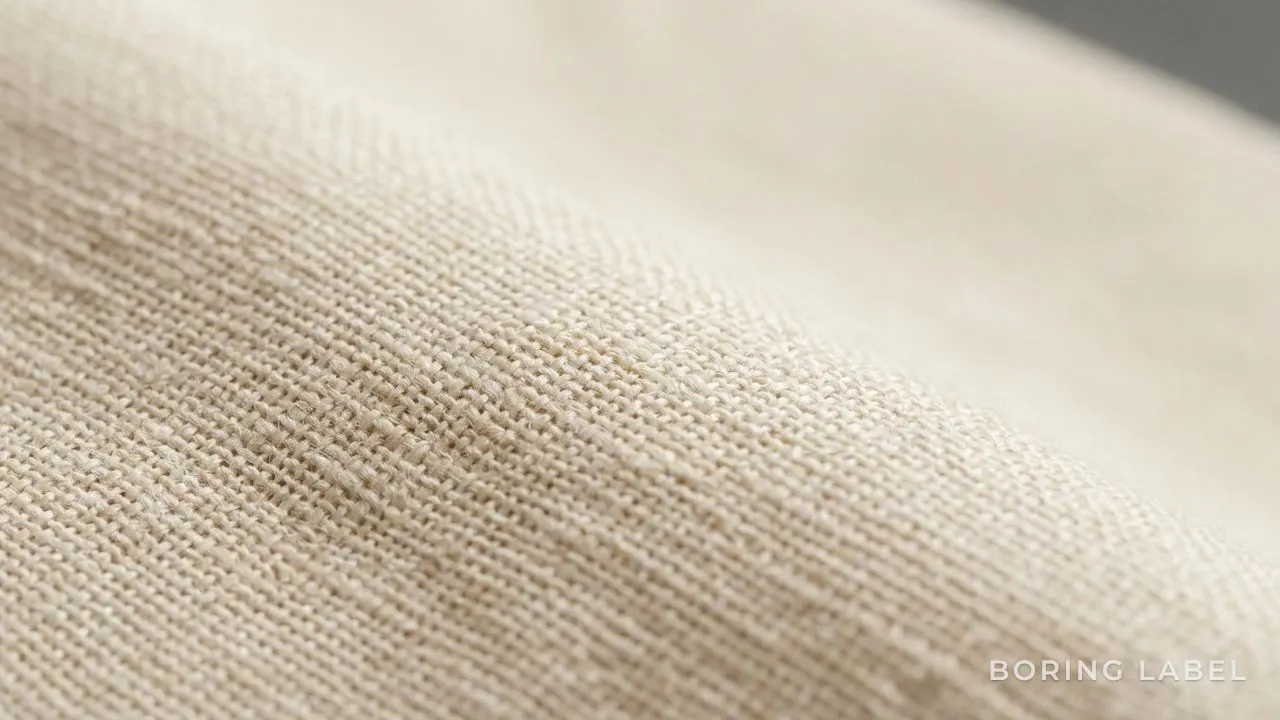
The single most useful image a brand can publish is an extreme close-up of the fabric surface - a macro shot where you can see individual yarns and the knit structure. This is the closest a screen gets to letting you run a finger over the cloth.
A confident maker includes it because the fabric rewards scrutiny. A nervous one shows you everything except the surface up close.
The mere presence or absence of a true macro shot is a signal before you have even analysed it.
When the macro shot exists, read it the way your fingers would read the fabric:
- Surface hairiness. A smooth, clean knit face suggests combed cotton. A surface furred with a faint halo of tiny standing fibres is the carded look - and that halo is the future pilling, photographed in advance. This is the single most valuable thing a macro shot can reveal.
- Evenness of the yarn. Look for thick-and-thin spots along the yarns. Uniform, even yarn suggests good fibre and good spinning; visibly irregular yarn suggests a cheaper, less consistent spin.
- Knit tightness. A dense, regular knit with small even loops tends to wear better than a loose, gappy one. Loose knits also read as see-through, which the next test catches.
The Backlight and Drape Tests
Two more things photos quietly reveal if you know to look. First, opacity: if any product or model shot has light behind the fabric and you can see straight through it, the tee is thin, regardless of the GSM number on the spec sheet.
Cheap thin tees are often shot only against dark backgrounds for exactly this reason. Second, drape: watch how the fabric falls on the body or the hanger.
Quality mid-weight cotton drapes with a little structure and weight; very cheap thin jersey hangs limp and clings, while over-stiff fabric can mean heavy finishing chemicals that wash out and leave the tee feeling cheaper than it photographed.
What Heavy Styling Is Hiding
Be most suspicious of the pages that are all atmosphere and no fabric: moody lighting, fabric never shown flat or close, every shot at a flattering angle and distance. Styling is not a crime - good brands style well too - but styling in the total absence of a single honest, close, flat, well-lit fabric shot is a pattern.
The brand is selling you a feeling because it would rather you did not study the cloth. The fix on your side is simple: before you judge a tee online, go looking specifically for the unglamorous frames - the flat lay, the macro, the back-of-the-neck stitching detail.
If they do not exist, that is your answer.
Signal 4: Mining the Reviews for the Information You Can't See
Reviews are the one place where the fabric has already been touched, washed, and worn by someone with no incentive to flatter it. Used well, they are the closest substitute for handling the tee yourself - but only if you read them for the right things and discount them for the right reasons.
Read for Time, Not for Stars
A five-star review written the day a parcel arrived tells you the tee photographs well and shipped on time. It tells you almost nothing about cotton quality, because every quality that matters - pilling, fading, thinning, shape loss - only reveals itself after weeks of wear and repeated washing.
So when you mine reviews, hunt specifically for the ones that mention time and laundry: "after ten washes", "six months in", "still looks new", or the reverse, "pilled after the first wash", "went thin at the shoulders", "shrank badly". These time-stamped, wash-tested reviews are pure gold; the day-one reviews are mostly noise.
The Complaints Are More Honest Than the Praise
Praise tends to be vague ("love it, so soft"); complaints tend to be specific ("the collar went wavy", "see-through in sunlight", "bobbled all over after two washes"). That specificity makes negative reviews more diagnostic.
You are not counting them to decide if the tee is "good" or "bad" - you are reading them for the failure mode. A handful of complaints all pointing at the same flaw - pilling, shrinking, thinning, a collar that loses shape - is a far stronger signal than an average star rating, because it tells you exactly how this tee is likely to let you down.
If the recurring complaint is pilling, you have just learned the cotton is probably short-fibre carded, no matter what the photos suggested. The mechanism behind that, and why some tees are doomed to bobble, is in why t-shirts pill.
Discounting for Care and for Fakery
Two honest caveats, because reviews are not gospel. First, a lot of "it pilled" and "it shrank" complaints are really care failures - hot washes, tumble dryers, overloading.
A tee abused in a hot dryer will fail no matter how good the cotton is, so weight a complaint more heavily when the reviewer clearly cared for the garment and it still failed; learning to wash tees so they last longer closes much of that gap. Second, reviews can be gamed - clusters of generic five-star lines posted in a short window, all praising "quality" without a single concrete detail, are a pattern worth distrusting.
Real reviews are specific, varied, and spread over time. The fake ones are vague, similar, and bunched.
Read for texture, not for the number.
Signal 5: Price as a Signal - Useful, but a Liar on Its Own
Price feels like it should settle the question. It does carry real information - but it is the proxy people most overtrust, and it lies in both directions, so it needs careful handling.
Why Price Is Informative at All
Good cotton genuinely costs more to make. Long-staple fibre costs more than upland.
Combing throws away the shortest 15 to 20 percent of the cotton and bills you for the absence of it. Ring spinning is slower than open-end.
Better dyeing and stitching add cost. So below a certain price, certain quality is simply not physically possible: a tee cannot contain combed long-staple cotton, careful construction, and a fair margin and still sell for the price of a vada pav.
A suspiciously cheap "premium" tee is making a claim the price cannot support. In that sense a rock-bottom price is a reliable negative signal - it rules things out.
Why a High Price Proves Nothing
The reverse does not hold, and this is where most people get burned. A high price is easy to print.
Plenty of expensive tees are ordinary carded cotton wearing a designer label and a fat margin - you are paying for the logo, the marketing, and the shop rent, not the fibre. Price tells you the most the brand thinks it can charge; it does not tell you what went into the cloth.
So price can rule quality out at the bottom, but it can never rule quality in at the top. A dear tee with a vague spec sheet is a worse bet than a modest one that names its cotton and states its count.
The Number That Actually Matters: Cost Per Wear
The honest way to use price is to stop looking at the sticker and start looking at cost per wear - the price divided by how many wearable months you will actually get. A cheap carded tee that fuzzes, pills, and thins within a season can easily cost more per wear than a dearer combed long-staple tee that still looks good after two years, because you replace the cheap one three times.
This is the maths that quietly defends buying better basics, and we lay it out fully in cost per wear and in the broader affordable versus premium tee question. Judged this way, the "expensive" tee is often the cheaper one, and the bargain is often the expense.
Price per wear is the only price number that tells the truth about value.
Signal 6: The Return Policy as a Confidence Tell
This is the proxy almost nobody thinks to read, and it is one of the more honest ones, because it costs the brand real money to offer. A return and exchange policy is a brand betting its own cash on whether the tee will satisfy you in person.
Think it through. A brand that knows its cotton feels as good in your hands as it looks on screen has little to fear from a generous, no-questions returns window - few people send back a tee that delivers.
A brand quietly aware that the fabric underwhelms in person has every reason to make returns awkward: short windows, restocking fees, "final sale" on the items most likely to disappoint, return shipping pushed onto you. The friction is a hedge against their own product.
So a confident, easy, clearly-stated return and exchange policy is a small wager the brand is placing on its own quality - and that wager is information. It does not guarantee good cotton, but it tells you the brand expects you to be happy enough to keep the tee, which is not nothing when you cannot touch it first.
Read the policy the way you read the spec sheet: for what it is willing to commit to. Easy exchanges and a fair window lean honest.
A maze of conditions on exactly the products most likely to underdeliver leans nervous. As with everything else on the page, the confidence is the signal.
Putting the Signals Together: A Pre-Purchase Routine
No single proxy is reliable on its own. GSM lies if you read it as quality; price lies if you read it as proof; a good photo can flatter bad cloth; reviews can be gamed; a generous return policy can wrap a mediocre tee.
The method is not to trust any one of them - it is to stack them and watch whether they agree. Good signals tend to travel together, and so do bad ones.
The honest tee usually names its cotton, states its count, shows the macro shot, collects time-stamped reviews that hold up, prices itself sensibly, and returns easily. The hopeful tee usually shouts one big GSM number, leans on adjectives, hides the fabric behind styling, gathers vague day-one praise, and makes returns a chore.
So before you buy a tee you cannot touch, run a quick sweep:
- Spec sheet. Does it name the cotton (long-staple? combed?) and state a yarn count, or does it only shout GSM? Count the rows it is willing to fill in.
- Language. Sort the words into "feeling" and "fact". Is the fact pile real - long-staple, combed, ring-spun, a count - or all premium-buttery-luxury?
- Photos. Find the macro shot. Smooth and clean, or a faint fuzzy halo? Can you see through it in any backlit frame? Does any honest flat, close fabric shot exist at all?
- Reviews. Skip the day-one stars. Read the time-stamped ones and the specific complaints. What is the recurring failure mode, if any?
- Price. Too cheap to physically contain the cotton it claims? Or expensive with a vague spec sheet? Reframe it as cost per wear.
- Returns. Easy and confident, or a maze of conditions on the riskiest items?
Five minutes of this beats an hour of staring at flattering photos, because you are reading the page for evidence instead of for vibes. You will be wrong sometimes - no proxy beats the hand - but you will be wrong far less often, and you will stop paying premium prices for carded cotton in good lighting.
The Honest Limits of Buying Blind
It would be dishonest to end without admitting the ceiling on all of this. Even a perfect read of every signal is still a read of proxies.
A determined seller can publish a real macro shot of a good sample and ship a worse batch; reviews can be early or skewed; a spec sheet can technically state "combed" for a fabric that combs poorly. The proxies narrow the odds; they do not eliminate them.
The first wash is still the moment of truth, and your hands on the actual fabric are still the final judge. Anyone who tells you that you can be completely certain about cotton from a screen is selling you that certainty.
What you can do is shift the odds heavily in your favour and, just as importantly, learn to recognise the kind of brand that makes the read easy. Because here is the quiet pattern under all six signals: a brand that states its specs honestly is making your job as an inspector simple on purpose.
Naming the cotton, publishing the count, showing the unflattering close-up, letting the time-stamped reviews stand, pricing for value, returning without friction - none of that is an accident. It is what a brand does when it is confident the fabric survives scrutiny, and it has decided the most persuasive thing it can do is simply let you scrutinise it.
That is the whole philosophy behind the way we describe what we make. Our round-neck tee is long-staple combed cotton, made at a sensible mid-weight for Indian heat, priced at ₹1,299 - and we say exactly that, plainly, because the cotton is the part we want you to examine, not the part we want you to overlook.
We would rather hand you the spec sheet than the adjectives. When you cannot touch the fabric, the next best thing is a brand that tells you the truth about it and then dares you to check - and increasingly, that honesty itself is the signal worth shopping for.
Learn to read the page, reward the brands that make it easy, and you will buy good cotton blind far more often than you buy regret.
Boring Label
Wear the point of the article.
One honest tee. Heavyweight combed cotton, a collar that holds, a fit that actually fits. No logo, no noise.
Shop the round-neck teeFree shipping across India · Easy returns
Keep reading
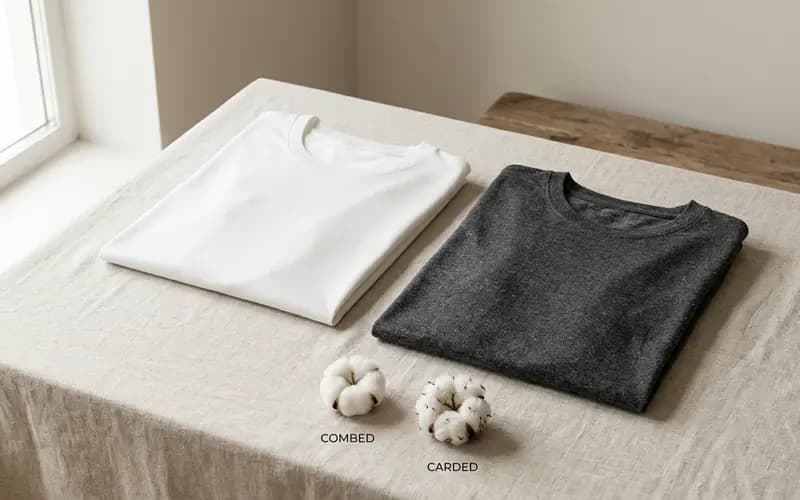
Combed Cotton vs Carded: Why It Matters
One extra step removes the short fibres that make a tee fuzz, pill, and weaken. That step is combing.
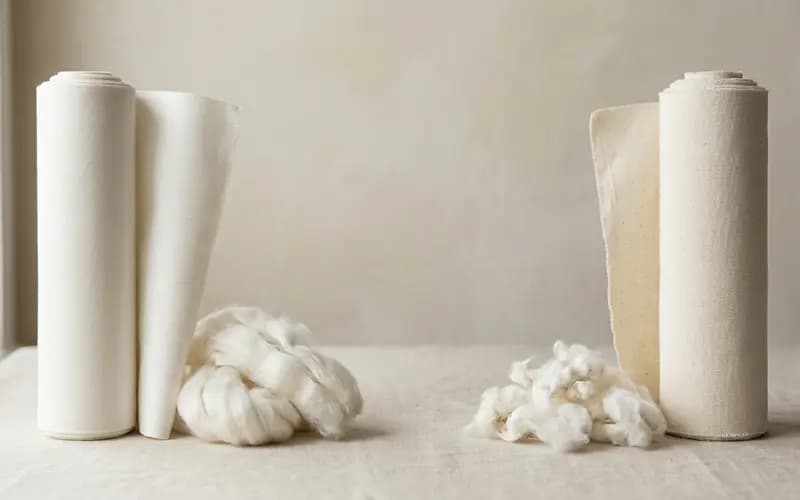
Supima vs Regular Cotton: Is Premium Cotton Worth It?
Premium cotton is heavily marketed and barely understood. Here is the honest case for long-staple cotton — and where the price tag lies.
T-Shirt GSM Guide: What the Number Really Means
GSM is the most quoted, least understood number on a tee. Here is what it actually predicts about quality.
Stay in the loop
New writing, no noise
Occasional notes on fit, fabric, and dressing simply well. No spam, unsubscribe anytime.
Subscribe