Fabric
Gym-to-street: can one tee do workouts and coffee after?
Gym fabric and street fabric want opposite things. Here is the honest verdict on whether one t-shirt can genuinely handle both, and the blend that gets closest.
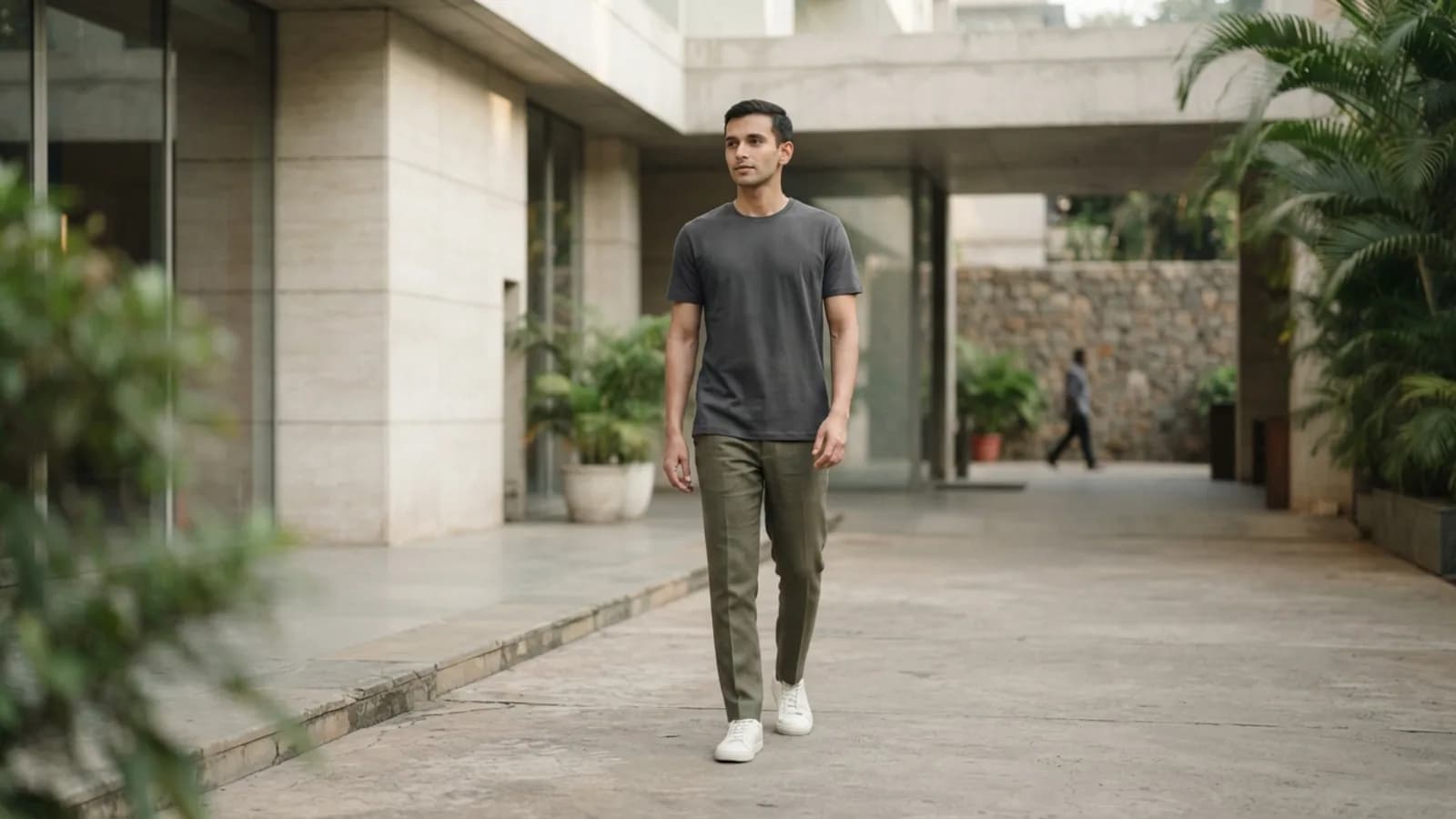
The one-tee question everyone asks eventually
Can a single t-shirt survive a gym session and then walk straight into a coffee shop without anyone noticing the switch?
The honest answer is: mostly, if you pick the right fabric and fit, but not perfectly, because gym performance and street style pull in genuinely opposite directions on a few specs.
A gym tee wants to wick sweat, stretch with your shoulders, and dry fast between sets. A street tee wants to drape well, hold its shape all day, and look intentional rather than technical.
Those are not the same design brief, which is why most "hybrid" gym-to-street tees end up compromising on both ends rather than nailing either. This guide breaks down where the compromise is worth it, where it is not, and what to actually buy if you want one tee to genuinely pull double duty.
Why gym and street fabrics are built differently
A performance gym tee, whether it is a Nike Dri-FIT or an Indian activewear brand's polyester blend, is engineered around moisture management. The fibre itself barely absorbs water, so sweat sits on the surface and evaporates fast, which is exactly what you want mid-workout.
The tradeoff is texture and drape. Polyester and poly-spandex blends have a slight sheen, a synthetic hand-feel, and they cling to sweat and body heat in a way that reads as "just left the gym" rather than "put together."
A street-style tee, especially the quiet luxury and minimalist kind, is built around cotton, usually combed and often mid-to-heavy weight in the 180 to 220 GSM range. Cotton absorbs moisture into the fibre itself rather than wicking it away, which is why it feels soft and cool in short bursts but stays damp far longer once you have actually sweated in it.
This is the core tension. The fabric that performs best under exertion is the one that looks and smells worst two hours later at a cafe, and the fabric that looks best at the cafe is the one that turns into a damp sponge mid-set.
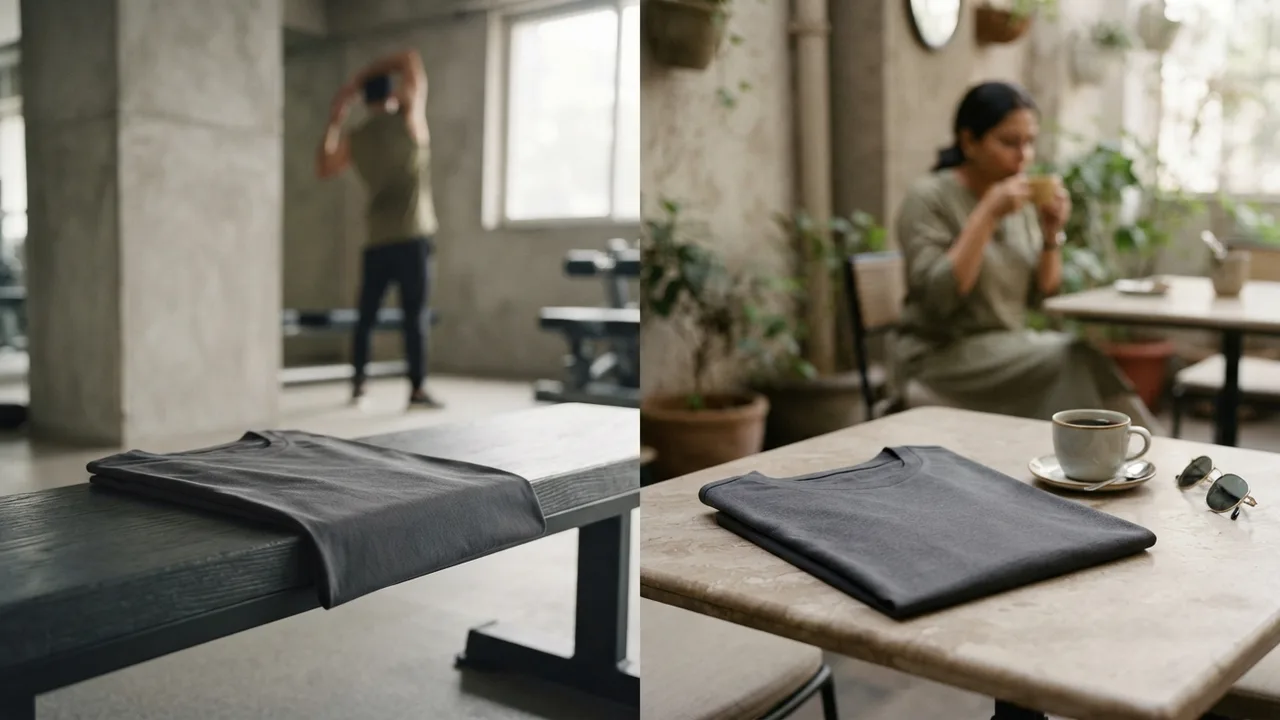
The middle ground: cotton-poly blends
The practical answer for most people is not choosing one extreme, but finding a blend that leans close enough to cotton for street credibility while borrowing enough polyester behaviour to survive a moderate workout.
A 60/40 or 70/30 cotton-poly blend, in the 180 to 200 GSM range, is the sweet spot most brands land on for this exact reason. It absorbs less than pure cotton, dries meaningfully faster, and still has enough natural fibre content to avoid the plasticky sheen and odour retention of full synthetics.
Our detailed breakdown of modal vs cotton vs poly blends goes deeper into how these ratios actually behave against skin and under stress, but the short version for this use case is clear: pure cotton above 200 GSM is too slow-drying for anything beyond light activity, and pure polyester is too synthetic-feeling for daily street wear.
Here is how the common options actually compare for someone who wants one tee to do both jobs.
| Fabric type | Gym performance | Street look | Odour retention | Verdict |
|---|---|---|---|---|
| 100% polyester | Excellent | Poor (sheen, cling) | High | Gym only |
| 100% combed cotton, 220+ GSM | Poor (slow dry) | Excellent | Low | Street only |
| Cotton-poly blend, 60/40, 180-200 GSM | Good | Very good | Low-medium | Best crossover |
| Modal-cotton blend | Fair | Excellent (silky drape) | Medium | Street-leaning crossover |
| Merino wool blend | Very good | Good | Very low | Premium crossover, higher cost |
Merino blends deserve a mention because they solve the odour problem almost entirely, but they sit at a price point most people will not pay for a daily-rotation basic. For everyday gym-to-street use, the cotton-poly blend remains the most practical answer.
Fit does more work than people think
Fabric gets most of the attention in this debate, but fit is arguably the bigger giveaway that a tee just came from a workout.
A slim or athletic-cut tee that hugs the chest and shoulders looks purpose-built for lifting, which is great in the gym and slightly off in a cafe, where a more relaxed silhouette reads as intentional rather than incidental. Our guide on slim vs relaxed vs regular fit breaks this down in detail, but the short version for a crossover tee is to lean toward regular fit, not slim and not oversized.
Regular fit gives enough room through the chest and shoulders to move freely during a workout, without the tee looking like activewear once you throw a jacket or overshirt on top. If you already own an activewear collection separately, a good hybrid strategy is to keep one or two true performance tees for hard training days and reserve a small stack of regular-fit cotton-blend tees for lighter sessions that flow straight into the rest of your day.
Layering: the trick most people skip
A crossover tee gets significantly more versatile once you stop treating it as a standalone outfit and start treating it as the base layer for the rest of your day.

An overshirt, light jacket, or even an unbuttoned linen shirt worn open over a gym-to-street tee hides most of the residual fit and texture cues that would otherwise read as "just left the gym." This is one of the fastest ways to bridge the gap between a workout tee and a finished outfit, since the top layer does the visual work while the tee underneath handles comfort and moisture.
Our guide to layering basics covers this technique in more depth, but the core idea for a gym-to-street context is simple. Keep one light, packable layer in your gym bag or car, something you can throw on the moment you leave the gym floor, and the transition from workout to the rest of your day becomes almost seamless.
This also solves a problem fabric and fit alone cannot fully address: a slightly damp tee under a breathable overshirt is far less noticeable to people around you than the same damp tee worn alone, buying you the time needed to actually dry out before the layer comes off.
Colour and how it hides (or exposes) the gym giveaway
Sweat patches are the single biggest visual tell that a tee has been worked in, and colour choice controls how visible that is far more than most people realise.
Heather grey, often the default gym tee colour, is also the single worst colour for hiding sweat, since the lighter flecked yarn shows moisture as a dark, obvious patch. Darker solids like charcoal, black and navy hide the same amount of sweat almost completely, which is why they dominate both gym apparel and minimalist street wardrobes for the same underlying reason.
This overlap is useful. Our piece on essential t-shirt colours covers the core palette that works across contexts, and for a gym-to-street tee specifically, dark neutrals are doing double duty: hiding sweat mid-workout and reading as deliberate, quiet-luxury minimalism once you are out the door.
What actually happens to the fabric over repeated gym washes
There is a durability angle to this that gets skipped in most style guides. A tee worn to the gym gets washed far more often than a tee only worn casually, since sweat demands a wash after nearly every use.

More frequent washing accelerates pilling, colour fade and fabric breakdown, especially in cheaper cotton-poly blends with loosely spun yarn. This is where ring-spun cotton content in the blend matters, since it resists pilling significantly better than open-end or carded alternatives; our durability wash test shows how much difference this makes over repeated cycles.
If a tee is going to see gym duty two or three times a week, buy two or three of the same style rather than one, and rotate them. This single habit does more for garment lifespan than any fabric choice, because it gives each tee 48 hours to fully dry and recover its shape between wears instead of going straight from sweat to hamper to next wear.
For the wash routine itself, cold water and a gentle cycle preserve blend integrity far better than a hot, aggressive gym-laundry cycle; the full method is in how to wash t-shirts so they last longer.
Where the compromise genuinely breaks down
!Minimalist editorial photo illustrating for the wash routine itself, cold water and a gentle cycle preserve blend integrity far better than a hot, aggressive gym-laundry cycle; the full method is in [how to wash t-shirts so they last longer., muted neutral tones, soft natural light, premium plain t-shirt context](/images/blog/gym-to-street-tee/inline-3.webp)
Be honest about the limits here. For hot yoga, HIIT, or any session where you are sweating heavily for 45 minutes plus, no cotton-blend crossover tee is going to outperform a dedicated technical fabric, and trying to force it will just leave you uncomfortable and the tee smelling by evening.
The gym-to-street tee works best for moderate activity: a lighter lifting session, a walk-run, a mobility class, or anything under 30 to 40 minutes where sweat volume stays manageable. Beyond that threshold, the practical move is to bring a change of tee, keeping the crossover piece for the after-gym part of the day rather than the workout itself.
This is not a failure of the concept. It is just an honest boundary, and most people's actual gym routines fall well inside it.
Building a small crossover rotation
If you want to genuinely test this approach rather than debate it in theory, start with a small rotation rather than replacing your whole wardrobe at once.
- Two to three tees in a 180-200 GSM cotton-poly blend, dark neutrals, regular fit.
- One true performance tee kept aside for heavy-sweat sessions where the crossover fabric will not keep up.
- A rotation schedule, so each crossover tee gets a full 24 to 48 hours to air out and recover before its next wear.
A well-made round-neck tee in a slightly heavier cotton-rich blend, the kind Boring Label builds around, sits comfortably inside this rotation for light-to-moderate activity and holds its shape well enough to move straight from a gym session into the rest of a normal day without needing a full outfit change.
The final verdict
One tee genuinely can do both jobs, within limits. A cotton-poly blend in the 180 to 200 GSM range, cut in a regular fit, and worn in dark neutral colours, gets you 80 percent of the way to a true crossover garment.
The remaining 20 percent, heavy-sweat sessions and long intense workouts, is better served by a dedicated performance tee kept separately. Trying to stretch one fabric across every scenario is where most gym-to-street attempts fail, not because the idea is wrong, but because the fabric brief genuinely diverges past a certain intensity.
Get the fabric weight, blend ratio and fit right for moderate use, keep expectations honest about the harder sessions, and a small rotation of well-made basics will carry you comfortably from the last set to the first coffee without a wardrobe change in between.
Boring Label
Wear the point of the article.
One honest tee. Heavyweight combed cotton, a collar that holds, a fit that actually fits. No logo, no noise.
Shop the round-neck teeFree shipping across India · Easy returns
Keep reading
Modal vs Cotton vs Poly-Blend: T-Shirt Fabrics
Feel, breathability, sweat, odour, durability and cost - the honest, India-first guide to choosing a t-shirt fabric.
Slim vs Relaxed vs Regular Fit: Pick by Body Type
Stop blaming your body for a bad tee. A simple decision tree for picking slim, regular, or relaxed by your actual build.
The Essential T-Shirt Colours to Own
Buy these colours in this order and every tee works with everything else you own.
Stay in the loop
New writing, no noise
Occasional notes on fit, fabric, and dressing simply well. No spam, unsubscribe anytime.
Subscribe