Buying
The NRI shopping list: clothes worth buying in India vs abroad
India makes cotton basics cheaper and better than almost anywhere else, but not every category is a bargain anymore. Here is the honest buy-in-India vs buy-abroad list for NRIs.

The suitcase math nobody explains properly
Every NRI visiting India runs the same mental spreadsheet in the last week of the trip. What goes in the empty half of the suitcase, and what stays on the shelf.
Most people get the answer wrong in one direction or the other. They either overpack sarees and spices that were never that special, or they ignore the one category that is genuinely cheaper and better made here: plain cotton basics.
The rule that actually works is simple. Buy in India what India makes better and cheaper due to raw material access and labour cost.
Buy abroad what needs a supply chain India does not have at scale, or where the price gap has closed. Clothing sits firmly in the first bucket, and it is the one category most NRIs underbuy.
This guide breaks down exactly what to fill your bag with on your next trip home, and just as importantly, what to skip because the math no longer favours India.
Why cotton basics are the actual bargain
India grows roughly 23 percent of the world's cotton and processes a huge share of it domestically, which means the raw material to finished tee pipeline is shorter and cheaper here than almost anywhere else.
A basic 180 GSM bio-washed combed cotton tee retails on IndiaMart and wholesale platforms for roughly Rs 90 to 300 depending on finish, before brand markup. In the US or UK, an equivalent import-quality cotton tee rarely comes under $15 to $25, largely because the fabric itself, or the finished garment, crossed an ocean and picked up duty along the way.
This is not a small gap. It is a 3x to 5x cost difference on a category you buy in bulk every year, which makes t-shirts one of the highest-value line items in an NRI shopping list, even though nobody thinks of them as a big-ticket buy.
The catch is that "cheap in India" and "good in India" are not the same shelf. A Rs 150 roadside tee and a well-made Rs 900 tee are both technically Indian cotton, but the difference in yarn quality, knit density and stitching shows within a few washes.
If you are going to use suitcase space on basics, spend the extra few hundred rupees to get ones that survive the trip home and the two years after. Our guide on how to spot good cotton online covers the label checks that separate the two tiers in under a minute.

The definitive buy-in-India list
Here is the category breakdown, ranked by how much money you actually save relative to buying the same thing abroad.
| Category | Buy in India | Why |
|---|---|---|
| Plain cotton t-shirts | Yes | 3-5x cheaper, better fabric access, tailored fits available |
| Tailored shirts and kurtas | Yes | Custom stitching costs a fraction of Western tailoring rates |
| Leather footwear (Kolhapuris, jutis) | Yes | Handmade craft goods, no import markup |
| Gold and silver jewellery | Yes | Lower making charges, GST beats Western retail margins |
| Ayurvedic and herbal skincare | Yes | Fresher stock, no import duty inflation |
| Spices in bulk | Yes | Direct from source, huge price gap |
| Electronics (phones, laptops) | No | Global pricing, often more expensive in India after duties |
| Branded sneakers and sportswear | No | Import duty pushes Indian retail above US/EU prices |
| Suitcases and luggage | No | Weight adds to your own baggage allowance ironically |
| Vitamins and supplements | Mixed | Cheaper in US, but check for India-specific Ayurvedic options |
Plain t-shirts sit at the very top of this table for a reason. They are lightweight, they pack flat, and unlike jewellery or spices, you actually wear one every single day back home.
That daily-use factor is what makes the maths compound. A single trip stocking up on eight to ten well-made basics can cover an entire year of casual wardrobe rotation, at a fraction of what the same rotation would cost bought piece by piece abroad.
What to actually pack: the basics checklist
Do not just grab whatever is on the rack at the airport souvenir shop. Build a small, deliberate list before you land, the same way you would plan a minimalist travel wardrobe for the flight itself.
Here is what earns suitcase space on the return leg.
- Six to eight plain round-neck tees in a mix of black, white, navy and grey. These are the daily uniform pieces that get the most cost-per-wear over two to three years.
- Two or three lightweight kurtas for weekend wear, which barely exist as a category abroad.
- A pair of good leather juttis or Kolhapuris, which cost a fraction of what similar handmade leather goes for in the West.
- A stack of cotton innerwear, since Indian cotton vests and briefs are both cheaper and better ventilated than most Western synthetic blends.
- One or two tailored shirts, made to measure at a fraction of Savile Row or department store tailoring rates.
Notice what is missing from this list. No branded sneakers, no imported electronics, no suitcase upgrades.
Those categories have either equalised in price globally or actually cost more in India once duty and margin are added. Save that shelf space for the cotton stack instead.
Getting the fit right when you are buying blind
The biggest risk with stocking up on tees during a short trip is sizing. You are often buying fast, sometimes without trying everything on, and Indian brand sizing does not always match the US or UK sizing you are used to.

Before you shop, know your actual chest and length measurements rather than relying on a size letter, since S/M/L varies wildly between Indian manufacturers. Our tshirt fit guide and the more detailed how to measure your tshirt size piece both walk through this in under five minutes, and are worth doing once before a big shopping trip rather than guessing at the counter.
If you are shopping online ahead of a trip to have items ready for pickup or shipped to a relative's address, a brand like Boring Label publishes exact garment measurements on every round-neck tee product page, which removes most of the guesswork that a physical store visit would otherwise solve by trying it on.
The quality signals that matter more abroad than at home
Here is something most NRIs miss. Once a t-shirt leaves India, there is no easy return, no tailor down the street, no quick exchange next time you visit the market.
That single fact should raise your quality bar above what you would accept for a local Indian buy. A tee that shrinks two sizes in a US or UK washing machine, which runs hotter and harsher cycles than a typical Indian machine, becomes unwearable with no easy fix.
Check three things before you commit to a batch purchase. First, the GSM, since anything under 160 GSM tends to feel thin and see-through once worn a few times; our GSM guide explains the weight ranges in plain terms.
Second, whether the cotton is combed or carded, a distinction that affects both softness and pilling over time, covered in detail in combed vs carded cotton. Third, whether the tee is pre-shrunk or bio-washed, since an untreated cotton tee can shrink noticeably in its first wash, a problem our piece on do cotton tshirts shrink explains along with how to avoid it.
These three checks take two minutes and save you from carrying home a suitcase of tees that fail within a month, an outcome far more painful when you cannot just walk back to the shop.
Shopping smart: online vs in-store during a trip
Physical markets in India, from Sarojini Nagar in Delhi to Fashion Street in Mumbai, are genuinely fun and genuinely cheap, but the quality is a lottery. You are buying overstock, factory rejects, and export surplus with no consistent standard.
For basics you plan to wear for years, a direct-to-consumer brand with published fabric specs is a safer bet than a street stall, even at a slightly higher price point. The savings versus buying the same fabric quality abroad are still enormous, just slightly smaller than the street-stall price.
Ordering online before your trip and having items delivered to a relative's home, or picking up on arrival, also saves you the time cost of hunting through markets during a short visit. Many NRIs now treat this as a hybrid strategy: order the reliable basics online in advance, then spend the limited market time on things that genuinely need trying on, like tailored wear and footwear.
A quick word on quantity

There is a temptation to overbuy because the prices feel so low compared to what you are used to. Resist it beyond a point.
Buying twenty tees "because they're cheap" usually backfires, since half sit unworn in a drawer while the same four favourites get all the wear. Our piece on how many tshirts you actually need puts a number on this, and the honest answer for most people is somewhere between eight and twelve in active rotation, not twenty-five.
A tighter, better-chosen stack also travels lighter, which matters when your suitcase is already carrying spices, gifts and everything else on the family list. Buy fewer, better pieces, and you get more value per kilogram of luggage allowance than you would from a mountain of bargain-bin extras.
What genuinely does not make sense to buy in India anymore
The price gap that used to make India the obvious choice for everything has narrowed sharply in a few categories over the past decade.
Electronics are the clearest example. Import duties on phones and laptops in India can push local prices above what you would pay in the US, UK or Gulf, the opposite of the clothing calculation.
Branded international sportswear follows a similar pattern, since a pair of imported running shoes often costs more in an Indian mall than it would in the country of origin, again due to duty structures. If a category feels like it should be a global commodity price, it is worth a quick price check on your phone before assuming India is cheaper.
The categories that stay reliably cheaper in India are the ones tied to local labour and local raw materials: tailoring, handmade leather goods, textiles, and craft-based jewellery. That is exactly the list this guide has focused on, because it is the list where the savings are real and durable, not a temporary exchange-rate quirk.
Bringing it together
The smartest NRI shopping trips are not about buying everything cheap. They are about correctly sorting the world into what India does structurally better, and what has equalised or flipped the other way.
Cotton basics sit firmly in the first camp, and t-shirts specifically are the highest-frequency, lowest-risk item on that list. They are cheap to buy, easy to pack flat, and unlike jewellery or electronics, they get worn every single week once you are back home.
Spend a little extra to get the GSM and cotton quality right, measure yourself properly before you shop, and resist the urge to overbuy just because the price tag looks small in dollars or pounds. Do that, and your next trip's suitcase does more useful work than the sarees, spices and souvenirs combined, quietly restocking the one wardrobe category you actually touch every single day.
Boring Label
Wear the point of the article.
One honest tee. Heavyweight combed cotton, a collar that holds, a fit that actually fits. No logo, no noise.
Shop the round-neck teeFree shipping across India · Easy returns
Keep reading
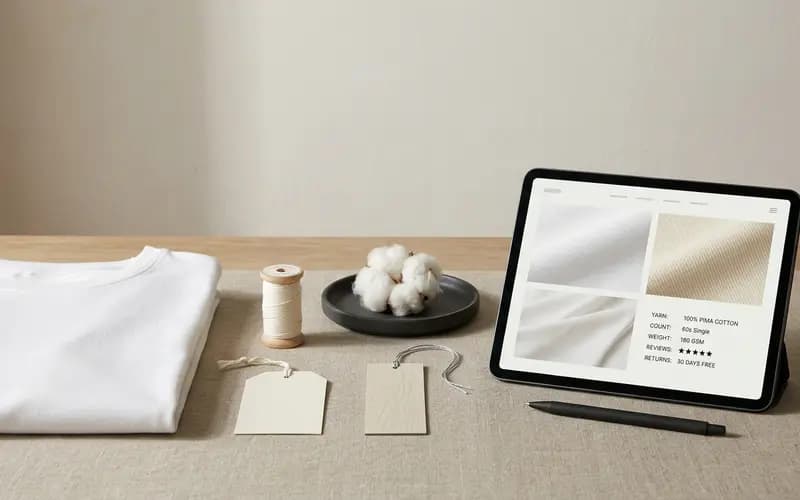
How to Spot Good Cotton Online (Without Touching It)
The touch test is gone when you shop online. Here are the six proxy signals that tell good cotton from bad before you spend.
T-Shirt GSM Guide: What the Number Really Means
GSM is the most quoted, least understood number on a tee. Here is what it actually predicts about quality.
How Many Plain T-Shirts Does a Man Need?
Do the laundry maths, land on your real number, and discover why repetition beats variety in the drawer.
Stay in the loop
New writing, no noise
Occasional notes on fit, fabric, and dressing simply well. No spam, unsubscribe anytime.
Subscribe