Buying
Why 10 brands sell the same blank tee: white-labelling explained
Many small t-shirt brands sell the exact same factory tee under different labels. Here is how to spot white-labelling and what genuine differentiation looks like.

Ten different logos, the same tee: white-labelling is how most brands actually work
Pick ten Indian t-shirt brands at random and inspect their basic round-neck tee closely. There is a real chance three or four of them came off the exact same production line, in the exact same fabric, just cut with different neck labels.
This is not a scandal. It is called white-labelling, and it is how a large share of apparel, food, cosmetics, and electronics gets made worldwide.
Understanding it changes how you shop, because it tells you where the real differentiation between brands actually lives, and where it is just marketing paint on an identical shirt.
This piece explains what white-labelling is, why it is so common in the t-shirt category specifically, and how to tell a brand that adds real value from one that is just relabelling a factory's stock design. Along the way we will point to our pieces on Tirupur's manufacturing cluster and how t-shirt prices break down, since both explain the mechanics behind this.
What white-labelling actually means
White-labelling is when a factory manufactures a generic product and multiple brands each put their own name and packaging on it, with little or no change to the product itself.
In t-shirts, this usually means a factory develops a base design, a fit block, a fabric spec, sometimes even a full sample range, and then sells that same design to any brand willing to place a minimum order. The factory might call it a "stock program" or "blank development."
A brand buying into that program orders the shirt in bulk, has its own neck label and size tag sewn in, and sells it under its own name. The fabric, the pattern, the stitching, and often even the factory are identical across every brand that bought into the same program.
This is different from private label, where a brand works with a factory to develop something proprietary, even if a similar factory relationship exists elsewhere. White-label is closer to buying off a shared menu; private label is closer to a custom order.
Why t-shirts are especially prone to this
A basic round-neck tee is a mechanically simple garment. There are only so many ways to cut a torso, sew two shoulder seams, and bind a neckline.
That simplicity means the fixed costs of developing a genuinely new pattern, testing fabric behaviour across dozens of wash cycles, and fine-tuning fit are relatively high compared to what a small brand can recoup on a first order. Buying into an existing, already-tested pattern is faster and cheaper.
Tirupur's knitting and garmenting units, which produce a huge share of India's basic tees, have built exactly this kind of shared infrastructure over decades. A single well-run factory can offer the same base fit and fabric spec to fifty different small brands, each placing modest minimum order quantities.
Our piece on Tirupur, India's t-shirt capital walks through how this cluster's density makes shared tooling and shared patterns the economically obvious choice, not a shortcut anyone is hiding.
How to spot a white-labelled tee
There are a few reliable tells, once you know to look for them.

Identical stitching quirks across brands. If you own tees from two different small brands and the collar rib width, the shoulder seam placement, and the hem finish are pixel-identical, that is not coincidence. Patterns do not converge that precisely by accident.
Nearly identical product photography angles and copy. Small brands sourcing from the same factory program often reuse the factory's own marketing kit with minor edits, because developing original photography and copy costs money the brand has not budgeted for.
Vague or absent fabric specification. A brand that genuinely developed its own fabric spec usually knows and states the GSM, the yarn count, and the knit type, because they paid to lock those in. A brand reselling a factory's stock program often only knows "premium cotton," because that is all the factory told them.
Prices clustered suspiciously close together. If five brands all sell what looks like the same tee at ₹599 to ₹649, they are likely paying close to the same landed cost and applying similar markups on the same base product.
Our guide on spotting good cotton online covers the fabric-specific version of this detective work in more depth.
| Signal | White-label likely | Genuine development likely |
|---|---|---|
| GSM and fabric composition | Vague, generic, "premium" | Specific number, named process (combed, ring-spun) |
| Product photography | Reused or near-identical to competitors | Original, brand-specific |
| Stitch and collar detail | Identical across unrelated brands | Distinct construction choices |
| Pricing pattern | Clustered tightly with 3-4 similar brands | Sits on its own logic |
| Factory disclosure | Never named | Named, or compliance cert shown |
Is white-labelling bad for you as a buyer?
Not automatically, and this is the part most anti-white-label takes miss. A well-run factory program can produce a genuinely solid tee, because the factory has iterated the pattern and fabric across hundreds of orders and thousands of wash tests, refining flaws that a single small brand could never afford to test for on its own.

The problem is not the shirt. The problem is when a brand markets a shared, generic product as if it were uniquely developed, charges a premium for that story, and the buyer has no way to verify it.
This is exactly the gap covered in our piece on how to spot fake premium claims. A ₹1,999 tee claiming exclusive fabric development, sourced from the same factory line as a ₹499 tee down the street, is where white-labelling becomes a genuine problem rather than a neutral business practice.
What real differentiation looks like
If a brand is not going to develop a fully custom pattern and fabric, which is expensive and only makes sense past a certain order volume, there are still meaningful ways it can add value on top of a shared base.
Fit refinement. Even working from a stock pattern, a brand can request specific tweaks: a slightly higher neckline, a different sleeve length, a shoulder seam moved half a centimetre. These are cheap changes that genuinely change how a shirt sits on the body, and you can usually spot them if you compare fit notes across brands.
Fabric grade selection. A brand can choose combed cotton over carded, request a specific GSM within the factory's range, or specify a particular dye process, even while using the same base pattern as other brands on the program. Our combed cotton versus carded cotton piece explains why this single choice moves quality more than most people expect.
Quality control standards. Two brands buying from the same factory can set very different acceptance thresholds for stitching defects, colour consistency, and shrinkage tolerance. A brand that rejects a higher percentage of a batch for minor flaws is doing real work, even on a shared base design.
Honest transparency. A brand that tells you exactly which cotton, which GSM, which factory cluster, and backs it with visible durability testing is adding trust value even if the shirt started from a shared pattern. That transparency is worth something, arguably more than a cosmetically unique cut nobody can verify.
At Boring Label, this is the lens we apply to our own round-neck tee: we did not pretend to reinvent the t-shirt, because nobody needs to. We chose combed cotton at a specific GSM, set our own defect tolerance with the factory, and put the fabric details on our quality page instead of hiding behind "premium" as a word doing all the work.
The economics behind why this happens at all
!Minimalist editorial photo illustrating at boring label, this is the lens we apply to our own [round-neck tee: we did not pretend to reinvent the t-shirt, because nobody needs to. we chose combed cotton at a specific gsm, set our own defect tolerance with the factory, and put the fabric details on our quality page instead of hiding behind "premium" as a word doing all the work., muted neutral tones, soft natural light, premium plain t-shirt context](/images/blog/white-label-tshirts-explained/inline-2.webp)
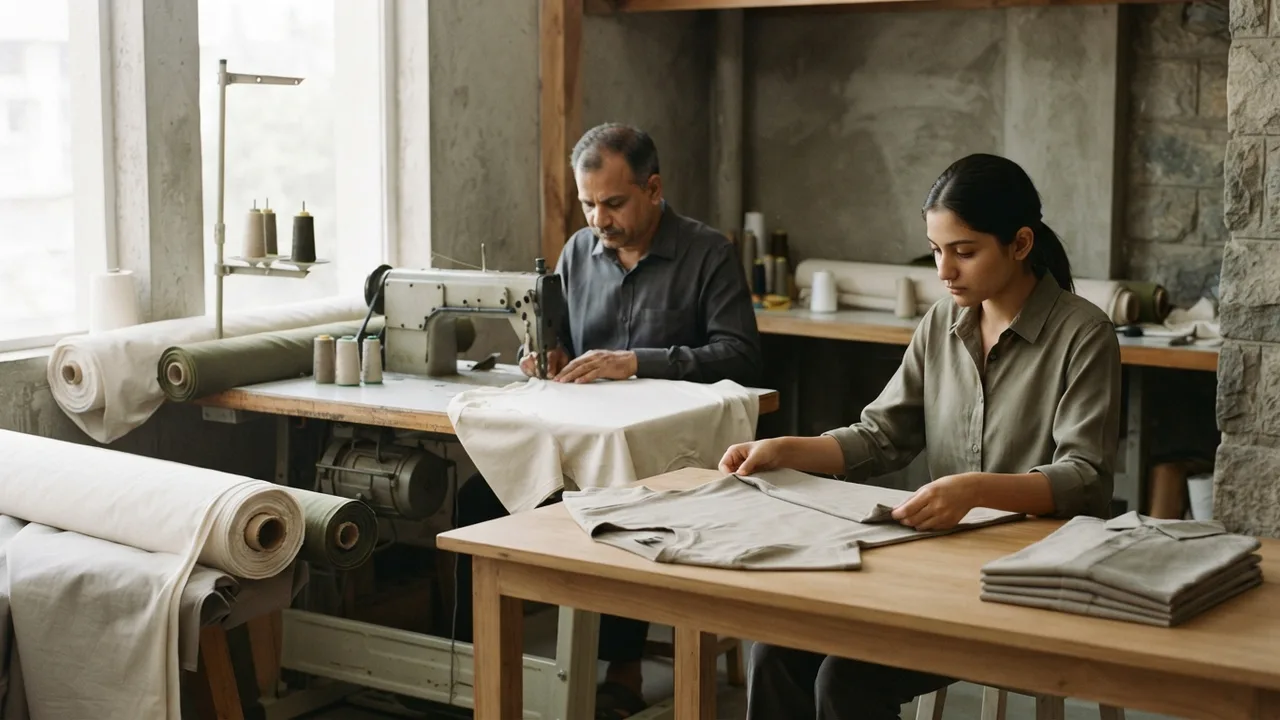
Developing a genuinely proprietary garment from scratch, new pattern, new fabric spec, new sampling rounds, typically costs a small or mid-size brand anywhere from ₹1.5 lakh to ₹5 lakh in development time and sample runs before a single shirt sells. That cost has to be recovered across every unit sold.
For a brand doing a first run of 500 to 1000 units, spreading that development cost evenly adds ₹150 to ₹1,000 per shirt just in fixed development costs, on top of raw production. Buying into an established factory program skips almost all of that, which is why so many young brands start there.
This is not a moral failing. It is a rational first step for a brand testing demand before committing capital to bespoke development, and it explains a lot of what you see in the fair-wage t-shirt cost breakdown, where labour and compliance costs matter more to the final price than pattern originality ever does.
What to actually do with this information
!Minimalist editorial photo illustrating this is not a moral failing. it is a rational first step for a brand testing demand before committing capital to bespoke development, and it explains a lot of what you see in the [fair-wage t-shirt cost breakdown, where labour and compliance costs matter more to the final price than pattern originality ever does., muted neutral tones, soft natural light, premium plain t-shirt context](/images/blog/white-label-tshirts-explained/inline-3.webp)
Stop assuming a unique brand name means a unique product, and stop assuming a shared factory means a bad product. Neither assumption holds up under inspection.
Instead, look at the specifics: named fabric, disclosed GSM, stated factory practices, and a price that tracks with what those specifics would actually cost to deliver. Our t-shirt label jargon guide is a useful companion here, since it decodes exactly which hangtag terms carry real information and which are filler.
The goal is not to avoid white-labelled tees entirely, since plenty of them are perfectly good shirts. The goal is to stop paying a premium for a story that a factory tag would quietly contradict.
!Minimalist editorial photo illustrating instead, look at the specifics: named fabric, disclosed gsm, stated factory practices, and a price that tracks with what those specifics would actually cost to deliver. our [t-shirt label jargon guide is a useful companion here, since it decodes exactly which hangtag terms carry real information and which are filler., muted neutral tones, soft natural light, premium plain t-shirt context](/images/blog/white-label-tshirts-explained/inline-3.webp)
A quick worked example
Say three brands are all selling what looks like the same round-neck tee, priced at ₹649, ₹699, and ₹1,299. The first two disclose nothing beyond "premium cotton" and use nearly identical product photography shot at the same studio angle.
That pattern strongly suggests both are buying into the same factory program, applying a modest markup, and differentiating purely through branding and marketing spend rather than the product itself. Neither is necessarily a bad shirt, but neither is paying for anything you could call unique development.
The third brand at ₹1,299 states a specific GSM, names combed cotton explicitly, discloses a reinforced double-stitched shoulder seam, and shows wash-test data going out to thirty washes. Even if that brand also sources from a shared Tirupur base pattern, which is entirely possible, it has clearly paid for fabric grade selection and quality control most of the category skips, and the price gap tracks with real, checkable differences rather than a vague premium story.
This is the exercise worth running any time you are choosing between similarly priced basics: read past the brand name to the specifics each one is actually willing to state.
The takeaway
White-labelling is the default, not the exception, in basic t-shirts, and it exists because it is genuinely efficient for both factories and small brands. The mistake is not buying a white-labelled tee.
The mistake is paying a "uniquely developed" premium for one. Learn to read the fabric specification, the fit details, and the pricing pattern, and you will spot the difference every time, whether you are shopping a big brand's basics wall or a small Instagram label's debut drop.
Boring Label
Wear the point of the article.
One honest tee. Heavyweight combed cotton, a collar that holds, a fit that actually fits. No logo, no noise.
Shop the round-neck teeFree shipping across India · Easy returns
Keep reading

Tirupur: Inside India's T-Shirt Capital
Tirupur exports over a third of India's cotton knitwear from a single dense cluster. Here is how that cluster works and what its label actually promises.

How to Spot a Fake Premium T-Shirt
Premium is a claim anyone can print on a tag. Here is how to check the stitches, fabric and seller before you pay for the story.

T-Shirt Label Jargon Decoded: What Actually Matters
What pre-shrunk, bio-washed, GSM, single jersey and ring-spun really mean - and which terms are quality signals versus marketing.
Stay in the loop
New writing, no noise
Occasional notes on fit, fabric, and dressing simply well. No spam, unsubscribe anytime.
Subscribe